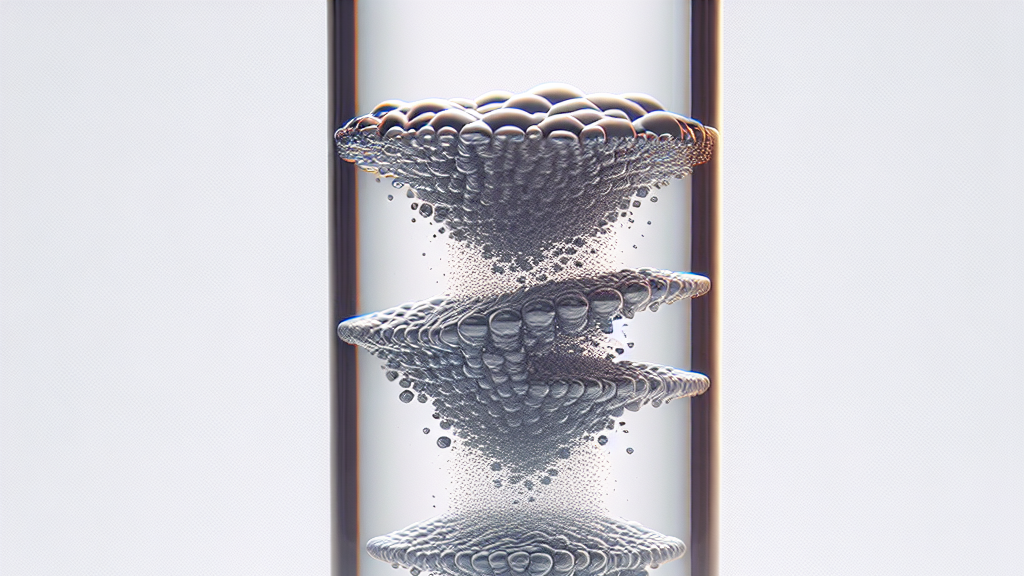
Imagine pouring syrup onto a vertical cylinder and watching as the thick liquid coats the surface. Rather than simply sliding straight down, it sometimes forms these donut-like rings as it moves. Scientists discovered that when the liquid is more solid-like, it changes how these rings form and move compared to more watery liquids.
In this study, researchers explored what happens when a unique kind of liquid, called viscoplastic, coats the inside or outside of a tube. These viscoplastic liquids have a kind of threshold that makes them act like a solid until enough force makes them flow. By using mathematical theories and computer simulations, the scientists studied how collars form and translate down the tube. They found that the interplay between the thickness of the liquid and its yield stress—a measure of its solidity—plays a crucial role in its downward journey.
In practical terms, understanding this behavior has real-world applications. Consider industries that rely on coating processes, such as how paints or protective finishes are applied to surfaces. The insights from this research could lead to better techniques to ensure even coatings, saving resources and improving quality. It also helps us understand natural events like lava flows or even aids in designing more efficient oil recovery methods.
A viscoplastic substance behaves like a thick, sticky liquid until just the right force—then it suddenly starts to flow!
FAQs
What is the Rayleigh-Plateau instability in viscoplastic liquids?
The Rayleigh-Plateau instability occurs when a liquid film forms collars due to surface tension effects. In viscoplastic liquids, this instability is affected by the liquid’s yield stress, which can enhance or dampen collar formation as the liquid begins to flow only when a certain force threshold is met.
How does gravity impact liquid collars on vertical tubes?
Gravity drives the movement of these collars down the tube. When a liquid has a high yield stress, gravity must overcome this stress for the collar to form and move, making the process more complex compared to regular liquids.
Why does the yield stress matter for viscoplastic liquids in a tube?
Yield stress defines how much force is needed before a viscoplastic liquid starts to flow. This stress affects the rate and manner in which liquid collars translate down a tube, influencing the stability and dynamics of the flow.
Do liquid collars behave differently in Newtonian vs. viscoplastic liquids?
Yes, in viscoplastic liquids, the collars adjust their volume and can reach steady translation due to the yield stress, unlike Newtonian liquids where such stability is more challenging.
What practical uses can arise from understanding liquid collars?
Understanding liquid collars can improve industrial processes like applying paints, leading to more uniform coatings and efficient material usage, and inform natural phenomena studies such as how lava flows behave.
Background
When liquids coat surfaces, they don’t always spread evenly, especially under gravity’s pull. The key concepts here involve fluid mechanics and the unique properties of viscoplastic materials—substances that act solid-like until they’re ‘pushed’ just right. This study examined how these liquids behave on vertical surfaces, specifically how they form and move as collars. Using mathematical models, scientists predict how these rings develop based on the fluid’s thickness and solidity (yield stress).
History
The study of liquid films and their instabilities, like the Rayleigh-Plateau instability, has been a topic of fascination for scientists for years. The classical Newtonian fluids, like water, behave predictably, forming stable patterns. However, as researchers began to explore non-Newtonian fluids, like viscoplastic materials, new dynamics emerged. This study builds on past research by exploring how these thicker, more ‘solid’ liquids differ, leading to new potential applications.
Based on “Viscoplasticity can stabilise liquid collar motion on vertical cylinders” by James D. Shemilt, Alice B. Thompson, Alex Horsley, Carl A. Whitfield, Oliver E. Jensen, available on arXiv (arxiv.org/abs/2502.08291), used under CC BY 4.0 (creativecommons.org/licenses/by/4.0/).