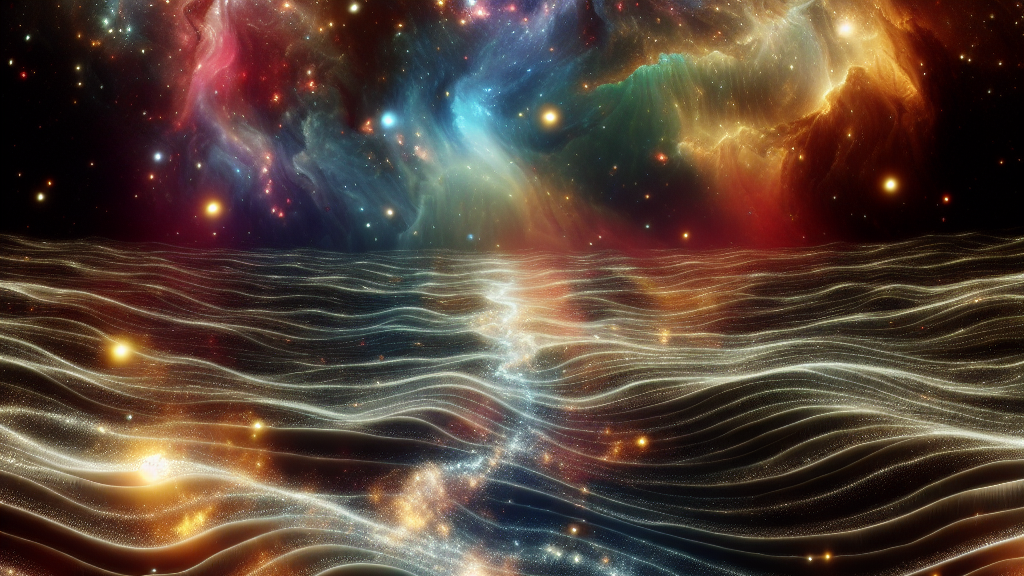
What if I told you that the shape and movement of our favorite galaxies could actually depend on some mysterious, invisible waves? Think about the waves you see on a beach, but in space and totally hidden to the naked eye. These aren’t just any waves, but rather those produced by fuzzy dark matter, a mysterious cosmic fabric that’s believed to blanket our universe. While we can’t see these waves with our eyes, they might be influential powerhouses shaping the universe quietly and invisibly, just like how wind shapes sand dunes at the beach.
So, what exactly is fuzzy dark matter? Imagine a super-light substance, made of tiny particles that are so light, they almost act like waves rather than solid things. Just like waves in a pond can overlap and create patterns, these particles can do the same out there in the cosmos. The research dives into how these wavy particles interact and change the way density bumps—like galaxy clusters—form and grow. By simulating these interactions, scientists are unraveling the mind-boggling behavior of dark matter and how it might impact the universe’s architecture.
Now, imagine if we could predict and see these changes. It could let us map out galaxies more precisely, shed light on ultra-faint dwarf galaxies, and even prepare for future space explorations! With these simulations, we can frame a clearer picture of our cosmic neighborhood and perhaps discover new rules of space, which could even guide us in thinking about where to travel in the universe, making sure no cosmic wave catches us by surprise. It’s a bit like suddenly being able to see the wind that pushes a sailboat forward.
Fuzzy dark matter is so light it behaves like a wave—a mix of particle and wave properties—challenging our usual understanding of what matter is!
FAQs
What is fuzzy dark matter and how does it relate to waves in space?
Fuzzy dark matter consists of ultra-light particles that exist in a fuzzy wave state, influencing the structures and movements of galaxies, much like ripples over a cosmic pond.
How do these dark matter waves affect galaxies?
The wavy nature of fuzzy dark matter can interfere with galaxy formation, potentially stopping density bumps from growing, and changing galaxy shapes over time.
Why is the study of fuzzy dark matter important to us?
Understanding these cosmic waves can help accurately map galaxy structures, aid in space exploration planning, and unlock mysteries of how our universe evolved.
How does this research use simulations to study dark matter?
The research uses simulations to mimic and understand how waves of fuzzy dark matter interact over time, helping to predict their effects on galaxy formation.
Could these dark matter waves affect our solar system?
While these waves predominantly influence large-scale cosmic structures, ongoing research could unveil more about their potential influence, even on smaller scales like our solar system.
Background
Fuzzy dark matter is a concept within the field of cosmology where dark matter is composed of ultra-light scalar fields that act like waves. These waves can interfere with one another, altering their behavior and affecting cosmic structures like galaxies. Scalar fields, in this context, possess inherent self-interactions that modify their dispersion, or spreading out, and growth of density perturbations—areas with slight differences in density.
History
The study of dark matter has evolved from the initial discovery of ‘missing mass’ in galaxies, leading to various dark matter models. Fuzzy dark matter arises from newer theories suggesting that dark matter might not fit the conventional ‘particle’ model, opening exploration into wave-like properties and quantum effects on an astronomical scale. This study builds on understanding scalar fields and their potential influence on cosmic structures, offering a unique perspective on the evolution of galaxies.
Based on “Wave Interference in Self-Interacting Fuzzy Dark Matter” by Christian Capanelli, Wayne Hu, Evan McDonough, available on arXiv (arxiv.org/abs/2503.21865), used under CC BY 4.0 (creativecommons.org/licenses/by/4.0/).