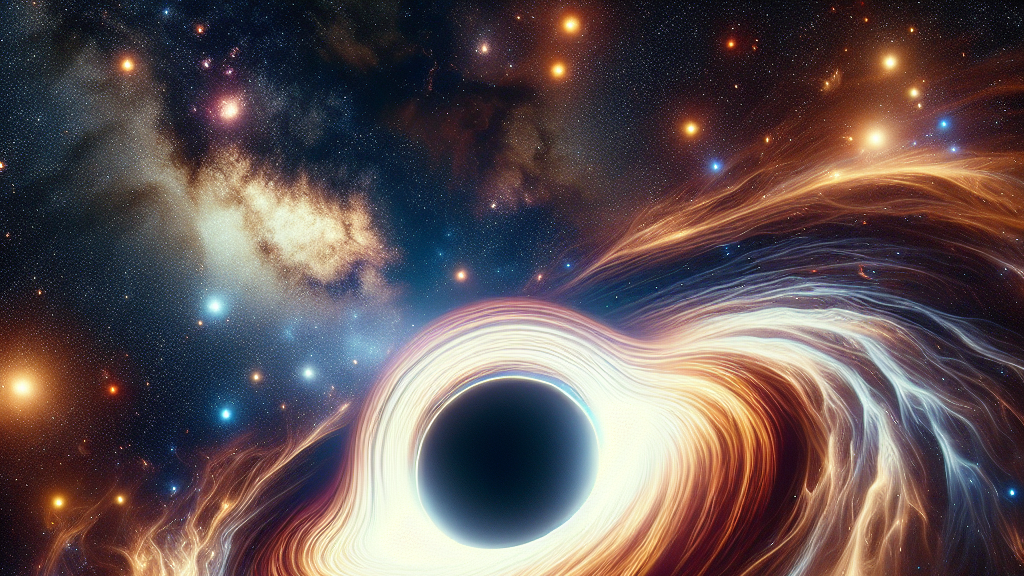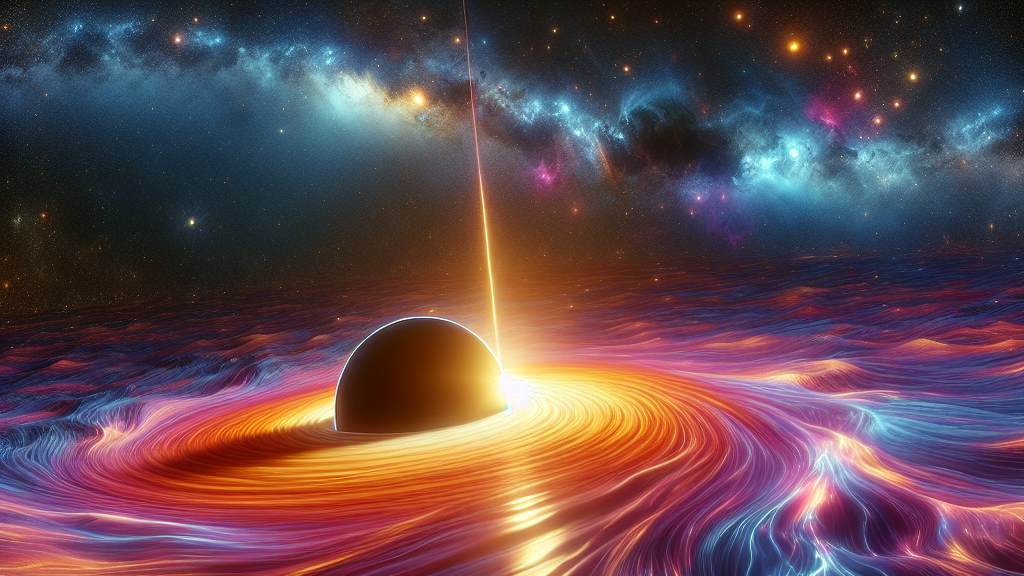
Imagine a star, not too different from our own sun, getting caught in the mesmerizing pull of a monstrous black hole. Instead of being swallowed whole, this star embarks on a cosmic dance where it slowly loses material while whispering secrets across the universe through gravitational waves. These waves are like faint ripples in the fabric of space-time, hinting at the incredible forces at play near black holes.
Scientists have been diving deep into this stellar dance, focusing on stars that get close to these cosmic giants. When a low-mass star, like a subgiant, spirals closer to a supermassive black hole, it starts shedding its outer layers. Rather than being a quick and chaotic event, this process can be remarkably stable and long-lasting. It sets off gravitational waves that instruments like the Laser Interferometer Space Antenna, or LISA, could potentially detect, turning the star into a kind of loud space beacon over time.
So why does this matter to us? Well, if such a system existed in our galaxy, it could serve as a unique telescope, offering us a peek at the inner workings of black holes and the mysterious forces of our universe. Imagine: one day, we could pinpoint a new beacon in the sky, tracing its whispers back to their source and unraveling the secrets of an otherwise invisible part of space. This could even help us piece together the grand puzzle of our galaxy’s history and the enigmatic lives of stars and their interactions with black holes.
Did you know stars near black holes can send ripples through space-time that we ‘hear’ as gravitational waves?
FAQs
How do stars near supermassive black holes create gravitational waves?
When stars orbit very close to supermassive black holes, their gravitational pull creates ripples in space-time, known as gravitational waves. This occurs as stars lose mass while being held in a stable orbit, making them long-term sources of these fascinating cosmic whispers.
Can we detect these gravitational waves? If so, how?
Yes, we can potentially detect these gravitational waves with tools like the Laser Interferometer Space Antenna (LISA), which is designed to capture the faint signals emitted by cosmic events, including those from stars orbiting black holes.
Why is this research on supermassive black holes important?
This research helps us understand the extreme environments near supermassive black holes and the behavior of stars in such conditions. It improves our knowledge of gravitational waves and can reveal insights into the fundamental properties of the universe.
What could happen if a detectable LISA source exists in our galaxy?
If such a source exists, it would allow us to study these cosmic events in incredible detail, enhancing our understanding of how stars interact with supermassive black holes and offering new data about the behavior and characteristics of black holes.
How likely is it that these gravitational wave sources are in our galaxy?
There is an estimated 1% chance that a detectable source, producing loud gravitational waves, exists in our galactic center, offering a remarkable opportunity for cosmic exploration.
Background
To grasp this research, one must understand gravitational waves, which are ripples in space-time generated by massive objects moving through space. Similar to how a boat creates waves as it moves through water, objects like stars and black holes send ripples through the universe. In this study, the focus is on how stars near supermassive black holes might generate such waves under specific conditions, allowing us to listen in on these cosmic conversations.
History
The idea of gravitational waves was first proposed by Albert Einstein over a century ago as part of his theory of general relativity. Since then, scientists have made significant strides in detecting them, notably with the groundbreaking detection of waves from colliding black holes in 2015. This study builds on that knowledge by exploring new sources of waves — stars spiraling into supermassive black holes — and considering their implications for our understanding of the universe.
Based on “Supermassive black holes stripping a subgiant star down to its helium core: a new type of multi-messenger source for LISA” by Aleksandra Olejak, Jakob Stegmann, Selma E. de Mink, Ruggero Valli, Re’em Sari, Stephen Justham, available on arXiv (arxiv.org/abs/2503.21995), used under CC BY 4.0 (creativecommons.org/licenses/by/4.0/).