Ever wondered how gigantic black holes, weighing billions of times the mass of our Sun, came into existence so swiftly after the universe was born? Until now, scientists have been scratching their heads, unsure how these cosmic giants could have formed so quickly. Recent research might have just found a clue that could unravel this mystery. They discovered a unique cosmic object from just 660 million years after the Big Bang, showcasing characteristics we haven’t seen before.
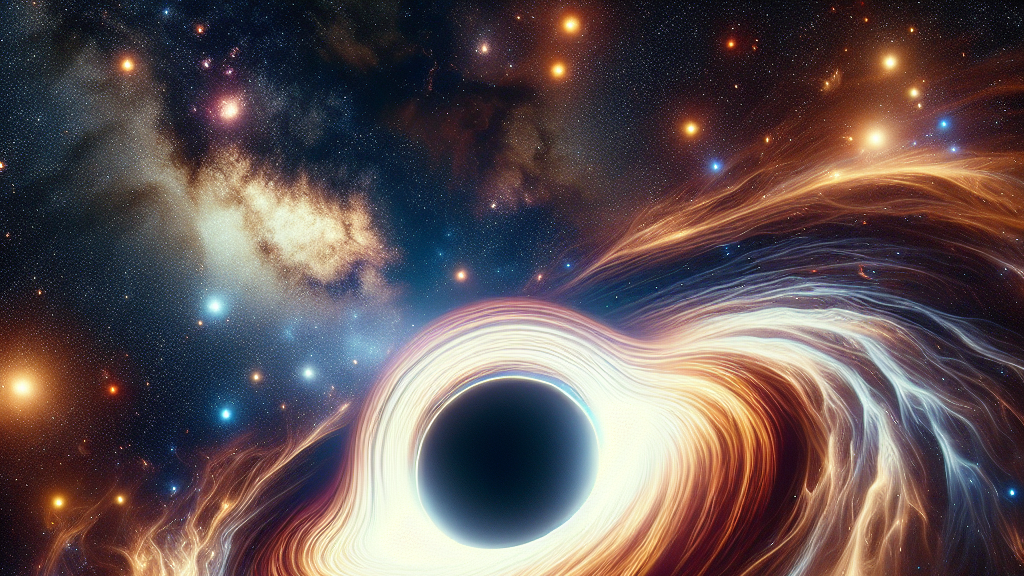
This object, dubbed a ‘black hole star’, seems to be swaddled in incredibly dense, turbulent gas. It’s like a space doughnut with a supermassive black hole in the center, surrounded by a dust-free atmosphere. This dense covering might allow the black hole to gobble up material at a rapid pace, helping it grow much faster than we’d expect. What’s even more exciting is that this could explain those mysterious cosmic entities called ‘Little Red Dots’—objects previously thought to have massive black holes, which may now be revealed as these unique stars in disguise.
So, why should we care? Imagine if we could find more of these black hole stars. It could transform our understanding of the universe’s earliest days and provide insight into those perplexing Little Red Dots. This discovery might even lead to a new way to search for and study black holes, offering a fresh lens on the cosmic history of black holes and the formation of galaxies. Fascinated by the cosmos? This cosmic enigma could hold the key to understanding some of the universe’s most profound secrets.
Black holes can grow billions of times heavier than our Sun within the first billion years of the universe’s existence.
FAQs
What is a black hole star, and why is it unique?
A black hole star is an extremely dense cosmic object with a supermassive black hole at its core, surrounded by a dust-free atmosphere. Its discovery helps explain how black holes grew so quickly after the Big Bang.
Why was this finding significant for cosmic studies?
This discovery of a black hole star just 660 million years after the Big Bang might solve the mystery of how supermassive black holes formed so fast, challenging existing theories.
How does this discovery relate to Little Red Dots (LRDs)?
Little Red Dots, once thought to contain large black holes, might actually contain black hole stars. This could mean their black hole masses have been overestimated, altering our understanding of these mysterious entities.
What does this mean for our understanding of the universe’s first billion years?
It offers a new perspective on the rapid growth of black holes and galaxy formation, potentially rewriting parts of cosmic history as we know it.
Can this help us find more black holes?
Yes, understanding black hole stars could lead to discovering more of these enigmatic objects, providing deeper insights into the early universe.
Background
Supermassive black holes grow by pulling in surrounding material, a process known as accretion. A key scientific principle is super-Eddington accretion, where a black hole gathers mass faster than typical limits. This research suggests such a process might have happened with these unique ‘black hole stars,’ explaining their rapid growth soon after the Big Bang.
History
The study of supermassive black holes dates back to the mid-20th century. In recent decades, researchers have theorized various mechanisms for their swift formation. Yet, direct observations eluded scientists until now. This discovery builds on years of theoretical work, potentially offering the first observational data of early black holes swathed in dense gas, a proposed method for quick growth.
Based on “A ‘Black Hole Star’ Reveals the Remarkable Gas-Enshrouded Hearts of the Little Red Dots” by Rohan P. Naidu, Jorryt Matthee, Harley Katz, Anna de Graaff, Pascal Oesch, Aaron Smith, Jenny E. Greene, Gabriel Brammer, Andrea Weibel, Raphael Hviding, John Chisholm, Ivo Labbé, Robert A. Simcoe, Callum Witten, Hakim Atek, Josephine F. W. Baggen, Sirio Belli, Rachel Bezanson, Leindert A. Boogaard, Sownak Bose, Alba Covelo-Paz, Pratika Dayal, Yoshinobu Fudamoto, Lukas J. Furtak, Emma Giovinazzo, Andy Goulding, Max Gronke, Kasper E. Heintz, Michaela Hirschmann, Garth Illingworth, Akio K. Inoue, Benjamin D. Johnson, Joel Leja, Ecaterina Leonova, Ian McConachie, Michael V. Maseda, Priyamvada Natarajan, Erica Nelson, David J. Setton, Irene Shivaei, David Sobral, Mauro Stefanon, Sandro Tacchella, Sune Toft, Alberto Torralba, Pieter van Dokkum, Arjen van der Wel, Marta Volonteri, Fabian Walter, Bingjie Wang, Darach Watson, available on arXiv (arxiv.org/abs/2503.16596), used under CC BY 4.0 (creativecommons.org/licenses/by/4.0/).