Connect with us

Search by keyword

Space

Is M101 Hiding a Cosmic Companion?

Astronomers have uncovered a potential cosmic companion for the famous spiral galaxy M101, challenging previous ideas about its structure. This discovery could change how we understand galaxy formation and interactions on a cosmic scale.

Is M101 Hiding a Cosmic Companion
✨Researched by humans. Explained by robots. Learn more.

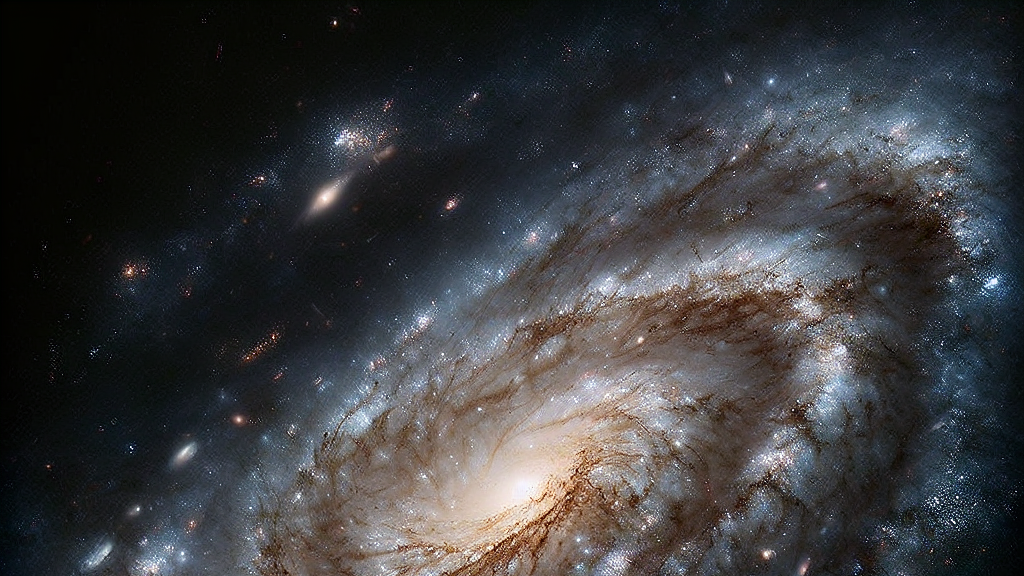
Did you know your favorite galaxy could have a hidden friend? The spiral galaxy M101, which many space enthusiasts admire, might be keeping a cosmic secret—a companion galaxy that has been hiding in plain sight all along. This discovery could shake up everything we know about galaxy formations and relationships in the universe.

Researchers noticed something strange in one of M101’s satellite galaxies, NGC 5474. There was an odd bulge that seemed out of place. What’s fascinating is that this bulge isn’t actually a part of the galaxy itself but might be an entirely separate dwarf galaxy. By using some advanced techniques, scientists measured and compared the movement of stars and gases in these parts of the galaxy. This showed that the bulge and the main galaxy disk are moving differently—proof they could be two different objects in orbit around one another.

Imagine how discovering a hidden companion changes things! This could tell us a lot about how galaxies like M101 form and evolve over billions of years. Maybe in the future, this could help astronomers better understand galactic interactions throughout the universe, aiding in the mapping of cosmic history with greater detail than ever before.

The spiral galaxy M101 is sometimes called the Pinwheel Galaxy, and it has a diameter twice that of the Milky Way!

FAQs

Did astronomers discover a hidden galaxy near M101?

Yes, astronomers suggest that a supposed bulge in the satellite galaxy NGC 5474 near M101 is actually a separate dwarf galaxy. This changes how we view the structure of M101.

Why does the discovery of a companion galaxy matter?

Finding a hidden galaxy could provide new insights into how galaxies form and interact. Understanding these cosmic processes can reveal more about the universe’s evolution.

How do astronomers know the bulge is a different galaxy?

By analyzing the motion of stars and gas, astronomers found that the bulge and the disk of NGC 5474 have different velocities, indicating they are separate entities.

What tools were used in this cosmic discovery?

Astronomers used advanced spectroscopy from the PPak Integral Field Spectroscopy Nearby Galaxies Survey (PINGS) to measure the motion of stars and gas.

How might this discovery affect future galaxy studies?

This research could reshape our understanding of galaxy formation and dynamics, offering insights into the complex interactions within galaxy groups like the M101 Group.

Background

Galaxies are massive systems of stars, gas, and dust bound together by gravity. M101, a spiral galaxy, is known for its grand pinwheel-like structure. The concept of galaxy bulges and their alignment with the galaxy disk is crucial because it informs our understanding of galaxy formation. Traditionally, bulges are thought to be part of the galaxy’s structure, but discovering a bulge that might actually be a separate galaxy orbiting a larger one offers a new perspective on how galaxies can evolve and interact.

History

The study of galaxy structure has evolved significantly over the past century. Initially, galaxies were categorized by their shapes into spirals, ellipticals, and irregulars. The discovery of separate components within galaxies, like bulges, refined these categories further. With advancements in technology, such as spectroscopy, astronomers can now analyze the individual motions within galaxies, leading to breakthroughs like the potential discovery of a hidden companion galaxy around M101.

Based on “When Is a Bulge Not a Bulge? Revealing the Satellite Nature of NGC 5474’s Bulge” by Ray Garner III (Texas A&M University), J. Christopher Mihos (Case Western Reserve University), F. Fabián Rosales-Ortega (Instituto Nacional de Astrofísica, Óptica y Electrónica), available on arXiv (arxiv.org/abs/2502.21188), used under CC BY 4.0 (creativecommons.org/licenses/by/4.0/).

Trending

Latest

Can AI Save Water Discover How

Computers

AI is transforming the tech world, but it uses lots of water! A new tool, SCARF, helps us measure and reduce AI's water footprint,...

Whats a Forbush Decrease and Why Should We Care Whats a Forbush Decrease and Why Should We Care

Space

Scientists just observed the biggest solar storm event in years, revealing unexpected cosmic ray patterns. Understanding these changes could help us protect our technology...

Can Cars Spot Danger Faster Than Humans Can Cars Spot Danger Faster Than Humans

Computers

Think about how quickly you react when something unexpected happens on the road. This research brings us closer to creating self-driving cars that can...

Can Fear of the Other Stop Social Harmony Can Fear of the Other Stop Social Harmony

Physics

Fear of the unknown might make it harder for people to agree and get along. This study shows that when people have strong xenophobic...

Can AI Revolutionize Breast Cancer Diagnosis Can AI Revolutionize Breast Cancer Diagnosis

Electricity

This research introduces a groundbreaking AI model that can accurately assess HER2-positive breast cancer using widely accessible staining methods, potentially revolutionizing how we diagnose...

Can AI Transform Your Singing into a Choir Can AI Transform Your Singing into a Choir

Computers

Imagine singing solo and having AI turn you into a choir. This research unveils a groundbreaking AI tool that transforms your voice into rich...

You May Also Like

Space

This research is changing the game for how we see the universe using radio waves! It enlists the help of regular people and smart...

General Relativity and Quantum Cosmology

This study explores the possible fate of our universe—revealing that under certain conditions, it might one day collapse into a Big Bang-like singularity or...

Space

Astronomers are turning cosmic data into music, making it easier for everyone to explore the mysteries of the universe. This fascinating approach of 'listening'...

Physics

Scientists are on a mission to discover if ghost-like particles called neutrinos could reveal astonishing insights about the universe. Using cutting-edge technology, they searched...

Space

Scientists are unraveling the mystery of Fast Radio Bursts, revealing that these mysterious space signals might all come from the same type of cosmic...

Space

Scientists have discovered a new way to check for volcanic activity on planets outside our solar system, opening the door to understanding how these...

Physics

This study explores how using AI and specialized tutoring systems in astronomy classes can enhance learning experiences and AI literacy for students, potentially transforming...

Space

Scientists are puzzled by the universe's changing speed, as it seems to be accelerating quickly at some points and slowing down at others. This...

General Relativity and Quantum Cosmology

Imagine a place in space where particles smash into each other with immense energy, like nature's own supercollider. Black holes might just be the...

Copyright © 2024 8ig8rain.

Disclaimer: The content on 8ig8rain.com consists of AI-generated summaries of scientific abstracts from arXiv. Please note that most arXiv abstracts are preprints and may not have undergone formal peer review. While these summaries aim to convey key ideas and potential applications, they are provided for informational purposes only and should not be interpreted as validated scientific findings or professional advice. The summaries are intended to educate, spark curiosity, and inspire further exploration of science.