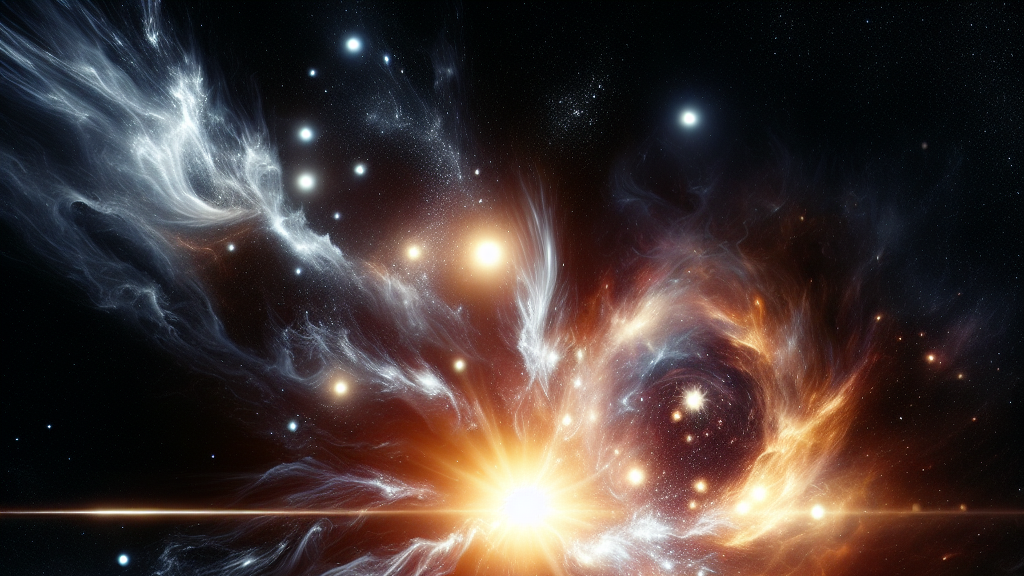
Have you ever wondered what causes those dazzling, explosive outbursts in space, making us marvel at the night sky? Scientists believe they might have uncovered a fascinating piece of the cosmic puzzle! It turns out, these cosmic fireworks could be the result of a gravitational dance between runaway stars and star clusters, potentially unraveling some of space’s most captivating mysteries.
In recent studies, researchers have simulated these interactions to understand how they might trigger explosive outflows. By examining the collision between a massive star and a cluster of smaller stars, scientists were able to determine that when the cluster’s mass is similar to the massive star, a brilliant and powerful burst can occur. This outburst, or explosive outflow, throws stars out of their cluster at impressive speeds, captivating astronomers and stargazers alike.
Imagine this: in the near future, by understanding these cosmic explosions better, scientists could predict when and where they will occur next, offering the potential for awe-inspiring space shows. Furthermore, the research might help us answer more profound questions about how stars and galaxies evolve over time. The universe, it seems, still holds many secrets waiting to unveil themselves to our curious minds.
A runaway star colliding with a cluster can eject stars at speeds faster than the collision itself!
FAQs
What role do runaway stars play in cosmic explosions?
Runaway stars can collide with star clusters, creating gravitational interactions that result in explosive outflows, ejecting stars at high velocities.
How does the mass of a star cluster influence explosive outflows?
When a star cluster’s mass is close to or slightly more than the impacting star’s mass, it can lead to significant explosive outflows, launching stars with high velocities.
Why is understanding explosive outflows important in astronomy?
Explosive outflows provide insights into the dynamics of star formation and galaxy evolution, helping scientists piece together the cosmic story of our universe.
Background
Stars form in clusters, surrounded by gas and dust, where their interactions can lead to dynamic events. When two celestial bodies interact gravitationally, especially if one is a massive runaway star, the energy from their encounter can trigger spectacular outflows. Understanding these gravitational interactions helps us model and predict behaviors in star-forming regions.
History
The study of star formation and explosive outflows dates back to observations of star clusters and nebulae. Over time, scientists have developed models to understand these phenomena, with recent advancements in computer simulations allowing us to explore complex gravitational dynamics. This study builds on decades of astrophysical research, focusing on the potential role of runaway stars in triggering such cosmic displays.
Based on “Gravitationally Induced Explosive Outflows” by Pedro Ruben Rivera-Ortiz, Ary Rodríguez-González, Jorge Cantó, Luis Alberto Zapata, Liliana Hernández-Martínez, Estrella Guzmán Ccolque, Manuel Fernández-López, available on arXiv (arxiv.org/abs/2504.11252), used under CC BY 4.0 (creativecommons.org/licenses/by/4.0/).