Have you ever wondered about the mysterious objects that lie between stars and planets? Meet brown dwarfs, those cosmic oddballs that don’t quite become stars but aren’t your average planets either. Recently, two such brown dwarfs have been discovered, each with fascinating stories to tell. They orbit stars and have traits that make astronomers scratch their heads in wonder.
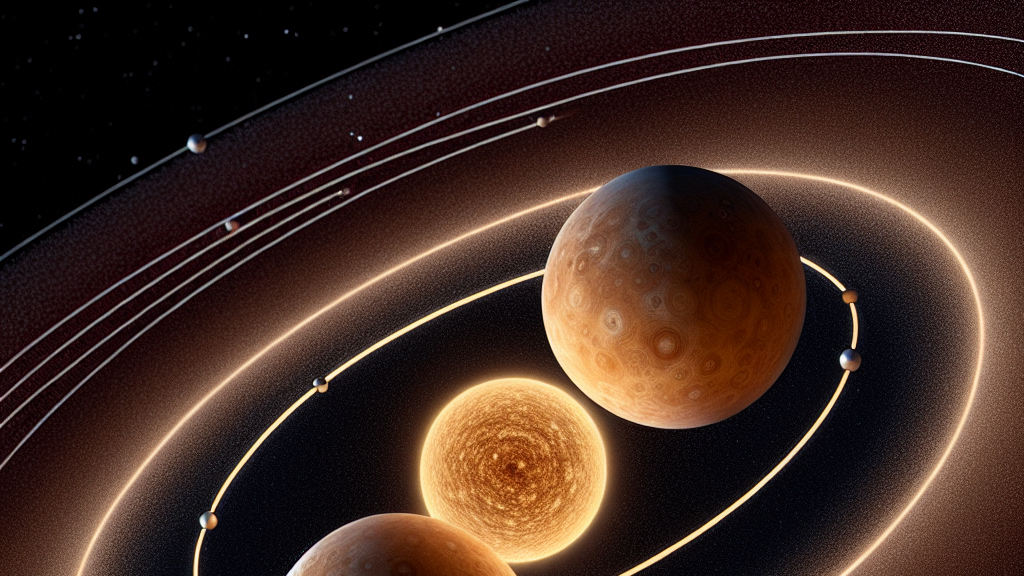
TOI-4776b and TOI-5422b are two brown dwarfs discovered by the TESS mission. Living in an underexplored part of space, these two are like distant cousins, similar in weight but different in age. TOI-4776b is youthful and plump, orbiting a star like our Sun, while TOI-5422b, older and denser, spins around a different type of star. What’s unique about TOI-5422b is its orbit being aligned with its star’s spin axis, a trait not commonly observed, suggesting that it might be playing a game of tug-of-war with its star.
The study of these cosmic entities helps astronomers fill gaps in their understanding of how stars and planets evolve. Imagine knowing what makes an object decide whether to become a star or remain a planet! These findings not only enrich our grasp of the cosmos but also hint at how the dynamics in the universe can mimic a massive cosmic dance, revealing the complex choreography that shapes our night sky.
Brown dwarfs are sometimes called ‘failed stars’ because they don’t have enough mass to sustain nuclear fusion like stars do!
FAQs
What are brown dwarfs and why are they important?
Brown dwarfs are celestial objects that are too large to be planets but too small to sustain nuclear fusion like stars do. They help astronomers understand the transition between planets and stars, shedding light on the formation and evolution of celestial bodies.
How do TOI-4776b and TOI-5422b differ from other brown dwarfs?
TOI-4776b has an inflated radius compared to its mass, suggesting it doesn’t fit typical models, while TOI-5422b is denser and its orbit aligns with its star’s rotation, showing unique behaviors not often seen.
Why is the alignment of TOI-5422b’s orbit with its star’s rotation unusual?
This alignment indicates that TOI-5422b might be transferring angular momentum to its host star, affecting the star’s rotation speed, which is an intriguing dynamic rarely seen in brown dwarfs.
How were TOI-4776b and TOI-5422b discovered?
They were discovered by NASA’s TESS mission, which looks for transiting celestial bodies by measuring changes in a star’s brightness as objects pass in front of them.
What does the discovery of these brown dwarfs mean for future research?
This discovery encourages further exploration of the mass-period space of brown dwarfs, leading to a better understanding of the past and future of these fascinating objects and their role in cosmic evolution.
Background
Brown dwarfs are celestial bodies that straddle the line between the smallest stars and the largest planets. They lack the mass required to ignite nuclear fusion of hydrogen in their cores, which is the hallmark of true stars. Instead, they generate some heat through the fusion of deuterium or, later, lithium. Understanding brown dwarfs is key to understanding the formation processes and properties that separate massive planets from small stars.
History
The study of brown dwarfs has intrigued astronomers since their theoretical prediction in the 1960s. Initially elusive, their discovery was confirmed in the 1990s. Over time, missions like TESS have enhanced our ability to spot these objects by measuring tiny dips in starlight when brown dwarfs transit their host stars. This research builds on past models by examining brown dwarfs that defy those predictions, offering new insights into the boundary between stars and planets.
Based on “An Oasis in the Brown Dwarf Desert: Confirmation of Two Low-mass Transiting Brown Dwarfs Discovered by TESS” by Elina Y. Zhang, Theron W. Carmichael, Daniel Huber, Keivan G. Stassun, Akihiko Fukui, Norio Narita, Felipe Murgas, Enric Palle, David W. Latham, Michael L. Calkins, Sara Seager, Joshua N. Winn, Michael Vezie, Rebekah Hounsell, Hugh P. Osborn, Douglas A. Caldwell, Jon M. Jenkins, available on arXiv (arxiv.org/abs/2503.05115), used under CC BY 4.0 (creativecommons.org/licenses/by/4.0/).