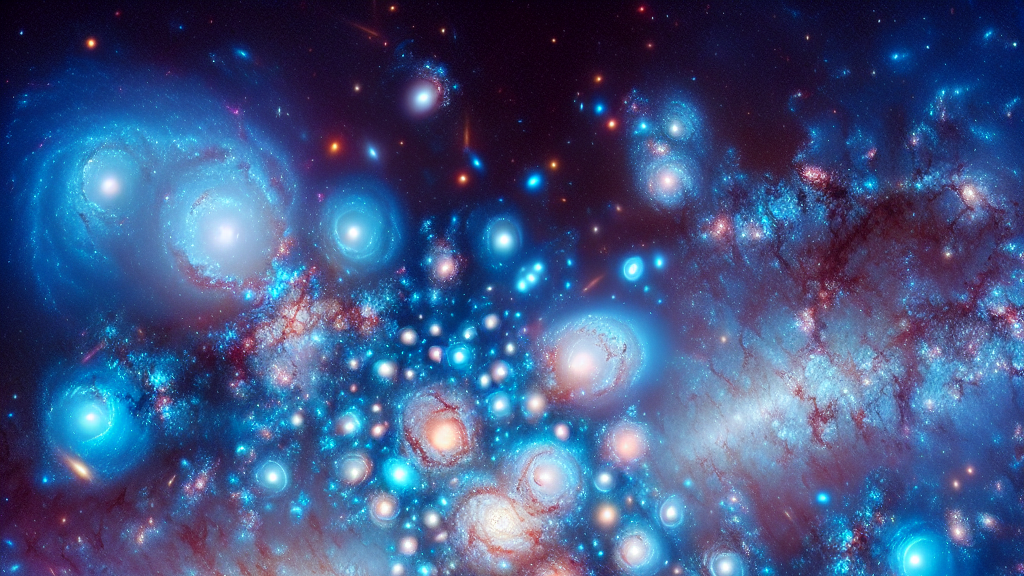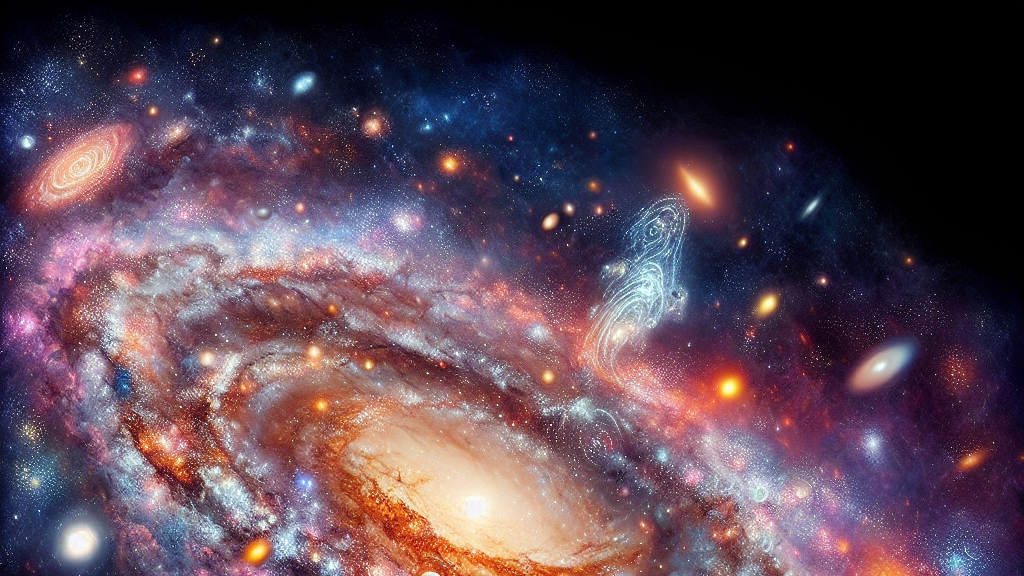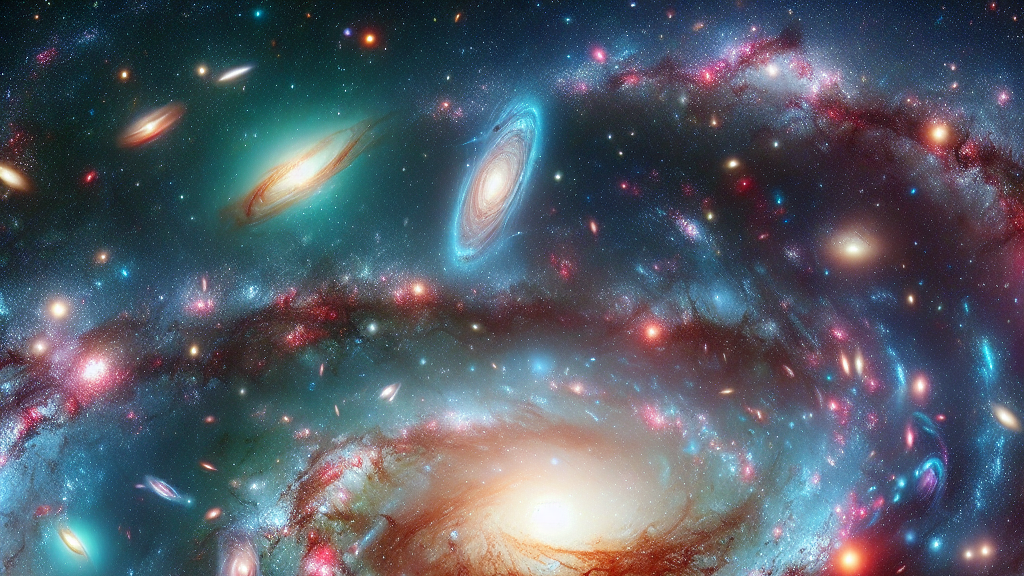
Imagine a bustling construction site, but instead of buildings, it’s a cluster of galaxies rapidly forming stars! Scientists have just spotted one of the universe’s most incredible cosmic star factories, offering a glimpse into how massive galaxy clusters are built. This is like finding a historical archive, showing us the dynamic past of galaxies much like our own Milky Way.
Researchers identified this extraordinary spot, named J0846, using a powerful telescope that captures far-reaching cosmic activities. Unlike typical galaxies, J0846 boasts an extraordinarily high star formation rate, suggesting these galaxies are forming stars 10,000 times faster than usual. This could be due to a fascinating cosmic phenomenon called gravitational lensing, where a nearby galaxy acts like a magnifying glass, allowing us to see this stellar explosion more clearly.
Understanding how this cosmic star factory operates might unlock secrets about the very galaxies that fill our night sky. For example, the techniques used to spot and study J0846 could help us understand how the Milky Way formed and evolved, shedding light on the fundamental processes that shaped the universe as we see it.
Did you know? Some galaxies are forming stars at a rate up to 10,000 times faster than our Milky Way!
FAQs
What is a protocluster in the context of galaxy formation?
A protocluster is a group of galaxies in the early stages of clustering, where they rapidly form stars and gain mass, eventually becoming large galaxy clusters like the ones we observe closer to us.
How does gravitational lensing help scientists study distant galaxies?
Gravitational lensing occurs when a massive object, like a galaxy or cluster, bends the light from objects behind it, acting as a natural telescope that magnifies distant galaxies and helps scientists study their properties more closely.
Why are astronomers excited about finding J0846?
J0846 is a cosmic jackpot, showing us a rare and dramatic phase of galaxy evolution where star formation is happening at a feverish pace, helping researchers understand the processes behind the formation of large-scale cosmic structures.
Background
In the universe, galaxies form stars from vast clouds of gas and dust. While galaxies like the Milky Way form stars at a steady pace, others can enter a ‘starburst’ phase, rapidly producing stars. These starbursts can illuminate the universe’s early days, helping scientists understand how massive galaxy clusters came to be. Gravitational lensing is a technique that enhances our ability to study these far-flung galaxies by making them appear larger and brighter through the bending of light around massive objects.
History
The study of galaxy formation has evolved dramatically since Edwin Hubble’s discovery of galaxies beyond the Milky Way. As telescopes became more advanced, researchers uncovered the intricacies of star formation and the role of galaxy collisions and mergers. This particular study builds on the use of gravitational lensing, a concept first confirmed by Einstein’s theory of general relativity, to examine starburst galaxies in greater detail, offering a window into the bustling early universe.
Based on “PASSAGES: The Discovery of a Strongly Lensed Protocluster Core Candidate at Cosmic Noon” by Nicholas Foo, Kevin C. Harrington, Brenda Frye, Patrick S. Kamieneski, Min S. Yun, Massimo Pascale, Ilsang Yoon, Allison Noble, Rogier A. Windhorst, Seth H. Cohen, James D. Lowenthal, Melanie Kaasinen, Belén Alcalde Pampliega, Daizhong Liu, Olivia Cooper, Carlos Garcia Diaz, Anastasio Diaz, Jose Diego, Nikhil Garuda, Eric F. Jiménez-Andrade, Reagen Leimbach, Amit Vishwas, Q. Daniel Wang, Dazhi Zhou, Adi Zitrin, available on arXiv (arxiv.org/abs/2504.05617), used under CC BY 4.0 (creativecommons.org/licenses/by/4.0/).