Imagine discovering that even the tiniest stars, known as brown dwarfs, might hold secrets about how planets come into existence. Recently, astronomers captured stunning images with ALMA, a powerful telescope, of a brown dwarf with a remarkable disk structure around it. This isn’t just any cosmic dust—this disk could be hiding clues to how planets form even in the most unlikely places.
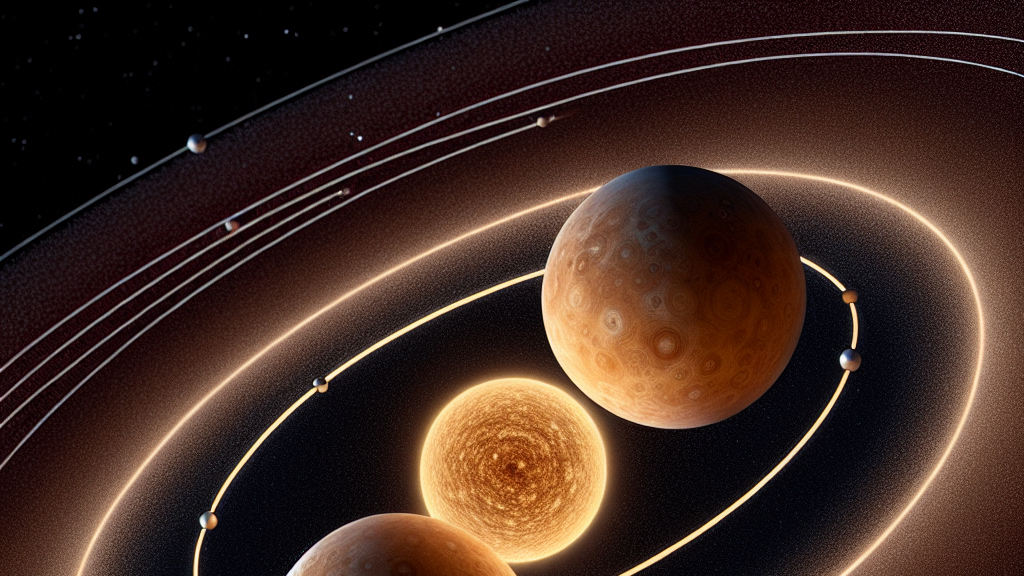
The research focused on 2MASS J04442713+2512164, or simply, 2M0444, a brown dwarf that’s basically a ‘failed star’ because it didn’t gather enough mass to ignite like our Sun. Scientists looked closely and found dust and gas swirling in a disk, with an interesting gap that suggests something big might be happening right there—a potential planet forming. This structure, seen for the first time around such a low-mass object, could help us rethink how planets form.
Why does this matter to us? Well, understanding planet formation around stars—big or small—helps us piece together the giant puzzle of our own solar system’s history and how Earth came to be. Imagine if these mini stars turn out to be mini laboratories for planet growth! As we push the boundaries with technology like ALMA, who knows what other cosmic surprises lie hidden in places we never thought to look?
Brown dwarfs are often referred to as ‘failed stars’ because they don’t have enough mass to sustain nuclear fusion like stars do.
FAQs
What is a brown dwarf, and how is it different from a regular star?
A brown dwarf is a celestial object that’s more massive than a planet but not massive enough to sustain the nuclear fusion process that powers stars. It’s often called a ‘failed star’ because it doesn’t shine as a star does.
How do brown dwarfs help us understand planet formation?
By studying the disks of dust and gas that surround brown dwarfs, scientists can observe the early stages of planet formation. These disks may have gaps and rings where planets are forming, providing valuable insights into similar processes around other stars.
What makes the discovery around 2M0444 unique?
The discovery is unique because 2M0444 is a very low-mass object, yet it shows signs of planet-forming activity. This challenges our understanding of where and how planets can form, suggesting that planetary systems might be more common than we thought.
What role does ALMA play in this research?
The Atacama Large Millimeter/submillimeter Array (ALMA) allows astronomers to capture detailed images of cosmic dust and gas around distant objects like brown dwarfs. It provides high-resolution observations that reveal fine details of disk structures.
Background
In astronomy, brown dwarfs blur the line between planets and stars. They are too heavy to be planets but not quite heavy enough to sustain the nuclear fusion reactions that make stars shine. This makes them fascinating objects for studying processes like planet formation, which typically are associated with stars. Using tools like the ALMA telescope, scientists can observe these celestial bodies and the surrounding dust and gas, revealing much about the early stages of planet formation.
History
The study of brown dwarfs has evolved significantly since their initial theoretical conception in the 1960s. They were confirmed as real celestial objects in the 1990s, prompting a surge of interest in how they fit into the broader narrative of star and planet formation. Previous studies often focused on larger, more massive stars, but recent advancements in technology such as ALMA have allowed researchers to explore smaller objects like brown dwarfs, leading to discoveries like possible planet formation activity around 2M0444.
Based on “Hints of Disk Substructure in the First Brown Dwarf with a Dynamical Mass Constraint” by Alejandro Santamaría Miranda, Pietro Curone, Laura Pérez, Nicolás T. Kurtovic, Carolina Agurto-Gangas, Anibal Sierra, Itziar De Gregorio-Monsalvo, Nuria Huélamo, James M. Miley, Aína Palau, Paola Pinilla, Isabel Rebollido, Álvaro Ribas, Pablo Rivière-Marichalar, Matthias R. Schreiber, Jinshi Sai, Benjamín Carrera, available on arXiv (arxiv.org/abs/2505.08107), used under CC BY 4.0 (creativecommons.org/licenses/by/4.0/).