Connect with us

Search by keyword

Space

Why is Andromeda’s Galaxy Neighbor Dance So Odd?

The Andromeda galaxy’s uneven distribution of satellite galaxies challenges our current understanding of the universe and how galaxies form, making it a cosmic anomaly. This finding might reshape how we think about galaxy formations and their interactions.

Why is Andromedas Galaxy Neighbor Dance So Odd
✨Researched by humans. Explained by robots. Learn more.

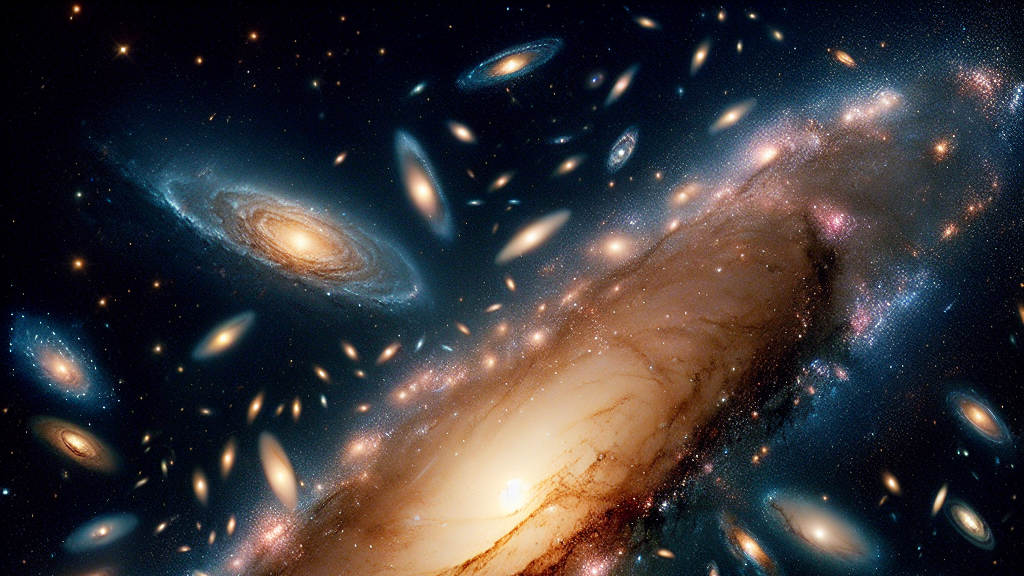
Imagine taking a snapshot of the night sky and discovering that Andromeda, our closest neighbor galaxy, is breaking the cosmic norm. Unlike the usual symmetrical halo of small satellite galaxies expected around a galaxy, Andromeda’s satellite companions are strangely skewed in their arrangement. Most of them point directly toward our own Milky Way—a surprising cosmic alignment that has bamboozled astronomers.

This peculiarity was identified through a detailed analysis of Andromeda’s satellite dwarf galaxies. According to the standard cosmology model, galaxies should have their satellites more evenly distributed. Yet, in the case of Andromeda, nearly all its 37 dwarf satellites are clustered within 107 degrees in the sky, towards us. This significant asymmetry is something not commonly seen, appearing in less than 0.5% of galaxy simulations, even accounting for possible observational blind spots.

So, what does this mean for us and the universe? If galaxies like Andromeda are supposed to follow certain rules and Andromeda doesn’t, it suggests we may need to rethink those rules. Perhaps our models of galaxy formation need tweaking, or maybe we’re about to uncover something entirely new about the way galaxies dance through space. Think about it—to uncover why Andromeda behaves this way could open new chapters in understanding the universe’s grand design!

Did you know? Despite the vastness of space, nearly all of Andromeda’s satellite galaxies are aligned in the same direction, pointing straight at us!

FAQs

What is unusual about the Andromeda galaxy’s satellite galaxies?

The Andromeda galaxy’s satellite galaxies are unusually asymmetrical, all but one are pointing towards the Milky Way, making this setup a rare cosmic phenomenon.

How common is such an asymmetrical distribution of satellite galaxies around other galaxies?

This kind of asymmetry is extremely rare, occurring in less than 0.5% of similar galaxy formations in cosmological simulations.

Why does the alignment of Andromeda’s satellite galaxies matter?

This unusual alignment challenges our current understanding of galaxy formation and the standard model of cosmology, potentially leading to new insights in astronomy.

Could this asymmetry affect Earth or our solar system?

Currently, this alignment doesn’t pose any direct threat or effect on Earth; it’s more about understanding the universe’s mysteries.

How might this discovery influence future cosmic research?

This discovery prompts astronomers to reconsider galaxy formation theories and could lead to new, groundbreaking insights about the universe’s structure.

Background

The standard model of cosmology suggests galaxies should have a near-isotropic distribution of external satellites, meaning their satellite galaxies are almost evenly spread out in all directions. This model helps scientists predict and understand how galaxies form and behave. The unexpected clustering of Andromeda’s satellites toward the Milky Way defies this expectation and suggests there might be more to learn about cosmic structures.

History

Galaxy formation and structure have been studied for decades, with models evolving as new observations are made. The standard model, also known as the concordance model, has been a cornerstone, suggesting universes have matter and energy distributed in specific, predictable patterns. Discoveries like Andromeda’s surprising satellite arrangement push scientists to reevaluate these models, much like earlier cosmic findings that led to the refinement of theories such as dark matter and dark energy.

Based on “Andromeda’s asymmetric satellite system as a challenge to cold dark matter cosmology” by Kosuke Jamie Kanehisa, Marcel S. Pawlowski, Noam Libeskind, available on arXiv (arxiv.org/abs/2504.08047), used under CC BY 4.0 (creativecommons.org/licenses/by/4.0/).

Trending

Latest

Can AI Save Water Discover How

Computers

AI is transforming the tech world, but it uses lots of water! A new tool, SCARF, helps us measure and reduce AI's water footprint,...

Whats a Forbush Decrease and Why Should We Care Whats a Forbush Decrease and Why Should We Care

Space

Scientists just observed the biggest solar storm event in years, revealing unexpected cosmic ray patterns. Understanding these changes could help us protect our technology...

Can Cars Spot Danger Faster Than Humans Can Cars Spot Danger Faster Than Humans

Computers

Think about how quickly you react when something unexpected happens on the road. This research brings us closer to creating self-driving cars that can...

Can Fear of the Other Stop Social Harmony Can Fear of the Other Stop Social Harmony

Physics

Fear of the unknown might make it harder for people to agree and get along. This study shows that when people have strong xenophobic...

Can AI Revolutionize Breast Cancer Diagnosis Can AI Revolutionize Breast Cancer Diagnosis

Electricity

This research introduces a groundbreaking AI model that can accurately assess HER2-positive breast cancer using widely accessible staining methods, potentially revolutionizing how we diagnose...

Can AI Transform Your Singing into a Choir Can AI Transform Your Singing into a Choir

Computers

Imagine singing solo and having AI turn you into a choir. This research unveils a groundbreaking AI tool that transforms your voice into rich...

You May Also Like

Space

This research unravels the mysterious behavior of dark matter by exploring a two-species model, which could explain why some galactic regions are denser than...

Space

Our understanding of the universe's uniformity faces a serious challenge, as new findings suggest our cosmos might not be as smooth and even as...

Physics

Scientists explore the fascinating possibility that our entire universe may have originated as a 'baby' universe. This intriguing idea not only aligns with existing...

General Relativity and Quantum Cosmology

Imagine if gravity could move faster than light and change our understanding of the universe. This research introduces new ideas that could solve cosmic...

General Relativity and Quantum Cosmology

This study introduces a new way to understand gravity, potentially solving mysteries like the Universe's expansion. If true, it could change everything we thought...

Space

New findings suggest that the mysterious force driving the universe's expansion, dark energy, might be changing over time, challenging our understanding of the cosmos.

Space

Dwarf galaxies are mysteriously clustering like massive galaxies, hinting at new insights into dark matter and galaxy formation. This discovery could reshape our understanding...

Space

This study introduces an AI system that could revolutionize the way scientific research is conducted by automating key tasks, potentially speeding up groundbreaking discoveries....

Space

Discover how tiny, isolated galaxies might hold the key to understanding dark matter and the secrets of the universe, challenging existing theories and opening...

Copyright © 2024 8ig8rain.

Disclaimer: The content on 8ig8rain.com consists of AI-generated summaries of scientific abstracts from arXiv. Please note that most arXiv abstracts are preprints and may not have undergone formal peer review. While these summaries aim to convey key ideas and potential applications, they are provided for informational purposes only and should not be interpreted as validated scientific findings or professional advice. The summaries are intended to educate, spark curiosity, and inspire further exploration of science.