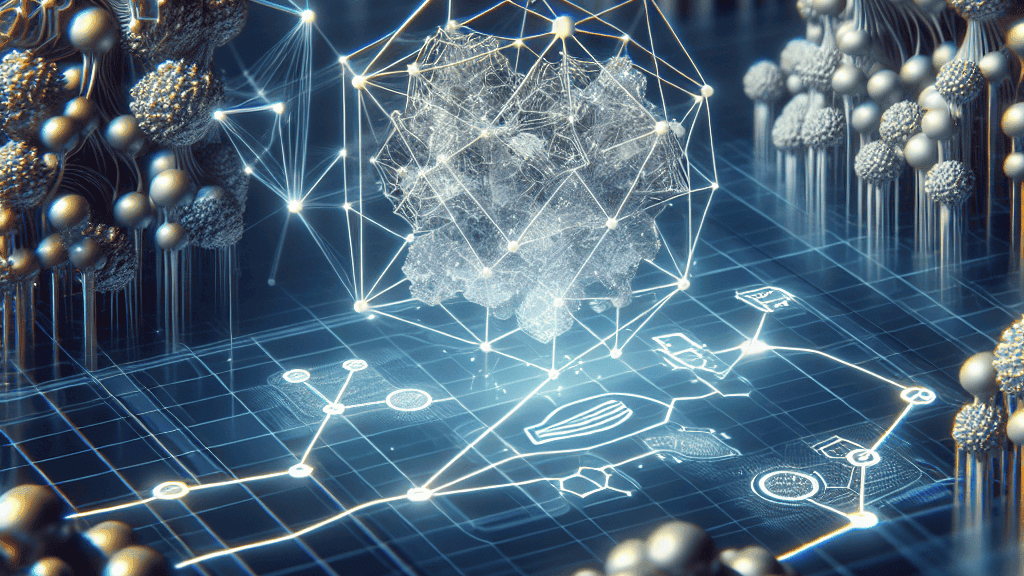
Imagine a world where the special materials inside your phone or car are discovered in just days, instead of years. That’s the kind of future DenseGNN, a new AI-powered model, is steering us towards. By mastering the prediction of material properties, AI can close the once extensive gap between theoretical possibilities and real-world applications.
DenseGNN is like a supercharged version of current tools, using something called Graph Neural Networks to learn about and predict how materials behave. It improves upon existing models by tackling problems such as high costs and adapting to new discoveries. With DenseGNN, scientists can quickly sift through loads of hypothetical materials and find the ones that are worth making in a lab, potentially as accurately as the traditional method of X-ray diffraction.
What does this mean for you? Well, think about solar panels that are more efficient, or a smartphone battery that lasts much longer. The research being done with DenseGNN now can pave the way for these innovations to come to market faster. By making materials discovery more efficient, this AI tool could lead us into a future with better technology more aligned with our everyday needs.
Did you know? AI can now predict material properties with almost the same accuracy as complex lab techniques like X-ray diffraction!
FAQs
What unexpected discovery did scientists make?
AI can predict material properties with accuracy close to traditional lab methods like X-ray diffraction.
How does DenseGNN improve on previous models?
DenseGNN uses enhanced networks to tackle high costs and domain adaptation issues, improving material property predictions.
Why does this research matter for everyday life?
It could speed up the development of new materials for things like stronger, more efficient electronics.
What makes DenseGNN unique?
It combines sophisticated learning networks to optimize predictions and reduce computational costs, enabling deeper exploration of materials.
What are potential applications of this research?
Faster materials discovery could lead to advancements in renewable energy, consumer electronics, and more.
Background
Graph Neural Networks (GNNs) are a kind of machine learning that excels at finding patterns in data arranged like a network, such as atoms in a crystal or neurons in a brain. They can learn relationships and predict outcomes based on those connections. However, traditional GNNs can be expensive to train and sometimes struggle to adapt to new domains or start giving similar predictions as they get more complex. DenseGNN is designed to overcome these issues with innovative improvements.
History
The field of materials science has long relied on experimental and theoretical methods to discover and optimize materials. With the advent of machine learning, models like Graph Neural Networks began to offer a way to analyze large datasets and predict properties more efficiently. DenseGNN builds on this foundation by integrating new techniques to handle the challenges that have limited other models.
Based on “DenseGNN: universal and scalable deeper graph neural networks for high-performance property prediction in crystals and molecules” by Hongwei Du, Jiamin Wang, Jian Hui, Lanting Zhang, Hong Wang, available on arXiv (arxiv.org/abs/2501.03278), used under CC BY 4.0 (creativecommons.org/licenses/by/4.0/).