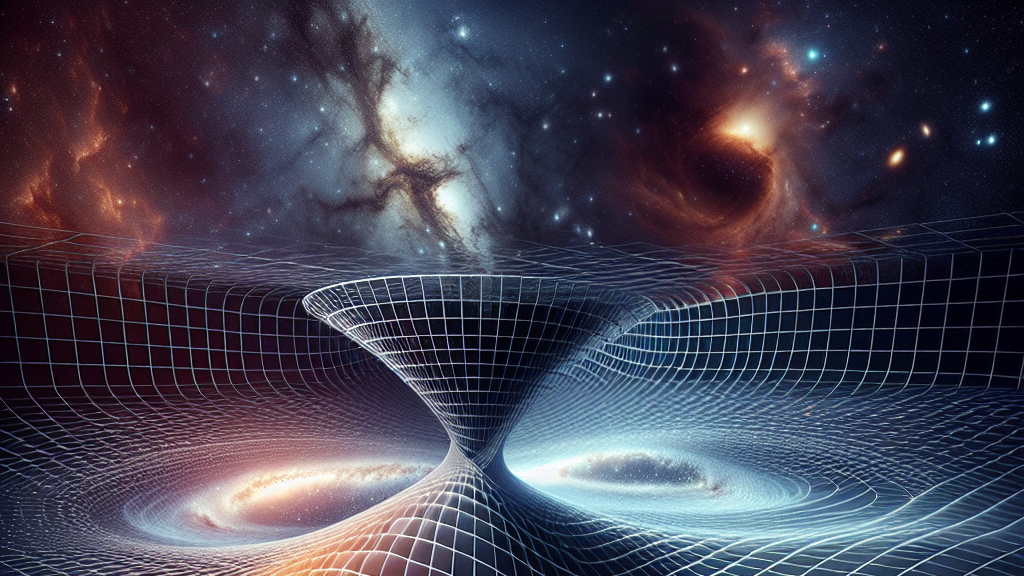
Imagine a surface that doesn’t just sit there like a flat table, but instead continuously changes shape as if it’s a living, breathing entity. That’s the magic of mean curvature flow—and scientists have just unraveled some of its astonishing secrets! When these surfaces flow through space, they form intriguing shapes and patterns, especially when they encounter so-called ‘cylindrical singularities’. This is like discovering that a calm river has mysterious whirlpools that appear and disappear.
The researchers dove deep into the world of geometry and topology to examine these singularities, which are isolated in both space and time. By understanding them, scientists could see how surfaces transform and interact when they pass through these mysterious areas. Imagine these changes as the shifts you might see in a digital artist’s canvas where shapes morph seamlessly from one into another. The ability to study these transformations is made possible by a new mathematical formula that lets us track how these surfaces ‘decay’ or change.
Now, why is this important? Picture this: Engineers and designers could use these findings to innovate in architecture or create new digital visual effects for movies that we can’t even dream of yet. By harnessing the power of shape-shifting surfaces, we might soon see buildings that transform according to the weather or wearable technology that molds to your body as you move. This research holds the potential to revolutionize the way we interact with the very shapes that surround us every day.
Did you know? In geometry, surfaces can actually ‘flow’ and change shape over time, much like a lava lamp’s mesmerizing blobs!
FAQs
What are shape-shifting surfaces?
Shape-shifting surfaces are geometrical entities that change their form over time through a process known as mean curvature flow, similar to how blobs in a lava lamp move and transform.
How does mean curvature flow affect surfaces?
Mean curvature flow influences how surfaces evolve, creating intriguing patterns and forms by interacting with singular points in space, altering their geometry and topology.
Why is the study of singularities important?
Understanding singularities helps scientists predict and model how surfaces will transform, offering potential innovations in fields like architecture, technology, and art through their unique properties.
How could this research impact everyday life?
This research can lead to real-world applications such as adaptive architecture that changes its form based on environmental conditions or dynamic visual effects in digital media for captivating experiences.
Background
Mean curvature flow is a mathematical concept used to study how surfaces evolve over time, much like watching a balloon shape-shift as air is blown into it. It describes how the surface bends and curves as it moves through space. Nondegenerate cylindrical singularities refer to points where the surface behaves oddly, creating unique shapes and patterns. Topology is about understanding the properties of a space that remain unchanged even if the space is stretched or bent.
History
The study of mean curvature flow has been a fascinating area for mathematicians and physicists for many years. Initial research focused on understanding basic geometric flows, with significant contributions from notable mathematicians who developed foundational theories. This research builds on previous studies by exploring the isolated nature of specific singularities and providing a more detailed understanding of how surfaces change as they flow, connecting modern geometric theories with classical concepts like Morse functions.
Based on “Passing through nondegenerate singularities in mean curvature flows” by Ao Sun, Zhihan Wang, Jinxin Xue, available on arXiv (arxiv.org/abs/2501.16678), used under CC BY 4.0 (creativecommons.org/licenses/by/4.0/).