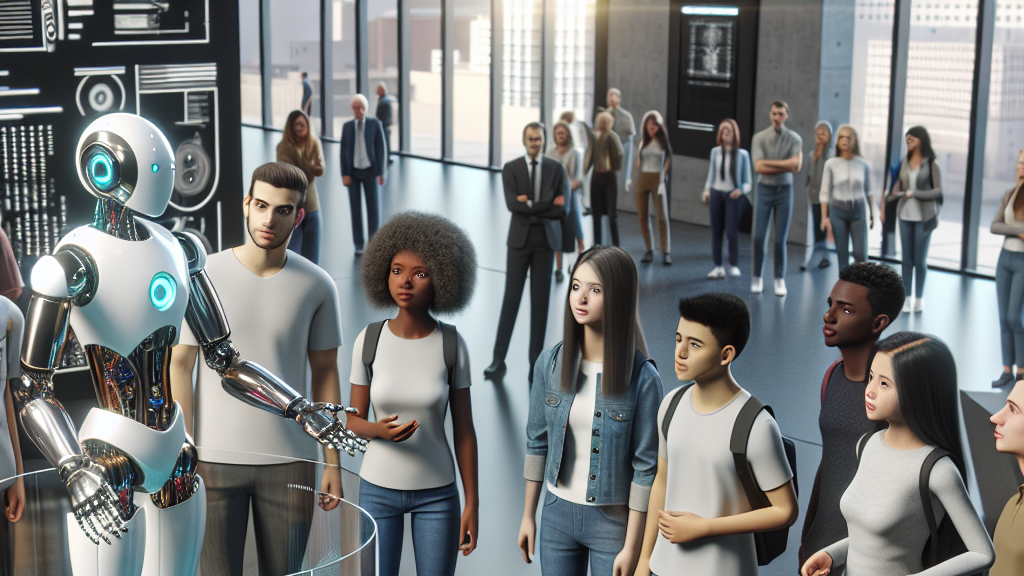
Ever dreamt of commanding a group of robots to perform complex tasks just by speaking to them? That’s becoming a reality! Researchers have developed a system where robots can understand and act on human language to form patterns, a task as tricky as it sounds.
The magic behind this innovation is a system called ZeroCAP. It uses smart language models that help robots interpret what we say and convert it into real-world actions. These robots can now coordinate with each other to form patterns, like surrounding an object or filling in a space, all based on our instructions. It’s like having a team of assistants who understand not just your words but also the context behind them.
Imagine being at a concert and directing a fleet of drones to create specific formations for a light show, just by telling them what to do. This could change how we interact with technology in daily life, from entertainment to construction, by making robotic systems more intuitive and adaptable to our needs.
Did you know? With current technology, robots can interpret human language and work together to form complex shapes and patterns!
FAQs
How does the ZeroCAP system help robots understand language?
ZeroCAP uses advanced language models to translate human spoken instructions into commands that robots can follow, enabling them to perform tasks based on context and spatial orientation.
What makes pattern formation challenging for robots?
Pattern formation involves spatial awareness and coordination among multiple robots, tasks that require understanding of both language and environment to execute accurately without prior examples.
Can robots with ZeroCAP form patterns in real-world scenarios?
Yes, ZeroCAP has shown proficiency in executing context-aware pattern formations across various tasks, proving its adaptability in real-world environments.
Why is language conditioning important in robotics?
Language conditioning allows robots to understand and interpret human intentions more naturally, opening up new possibilities for human-robot interaction and collaborative tasks.
What are potential applications of this research in everyday life?
This technology could revolutionize areas such as automated event management, smart construction sites, and even personalized home automation systems, making interactions with robots seamless and intuitive.
Background
The core idea here is language-conditioned robotics. It combines the interpretative capabilities of language models, which are like super-smart computer programs that understand human language, with robotic operations. This is important because while robots can perform a lot of tasks, getting them to understand and follow complex human instructions—especially in dynamic environments—is a real game-changer.
History
Robotics has been evolving from the days of simple, pre-programmed machines to advanced systems capable of learning new tasks. Earlier, robots needed specific programming for every action, but recent developments in artificial intelligence, particularly in language models, have allowed them to interpret natural language instructions. This study builds on those advances by integrating them into multi-robot systems, showcasing a significant leap from task-specific robots to those capable of complex coordination by understanding human language.
Based on “ZeroCAP: Zero-Shot Multi-Robot Context Aware Pattern Formation via Large Language Models” by Vishnunandan L. N. Venkatesh, Byung-Cheol Min, available on arXiv (arxiv.org/abs/2404.02318), used under CC BY 4.0 (creativecommons.org/licenses/by/4.0/).