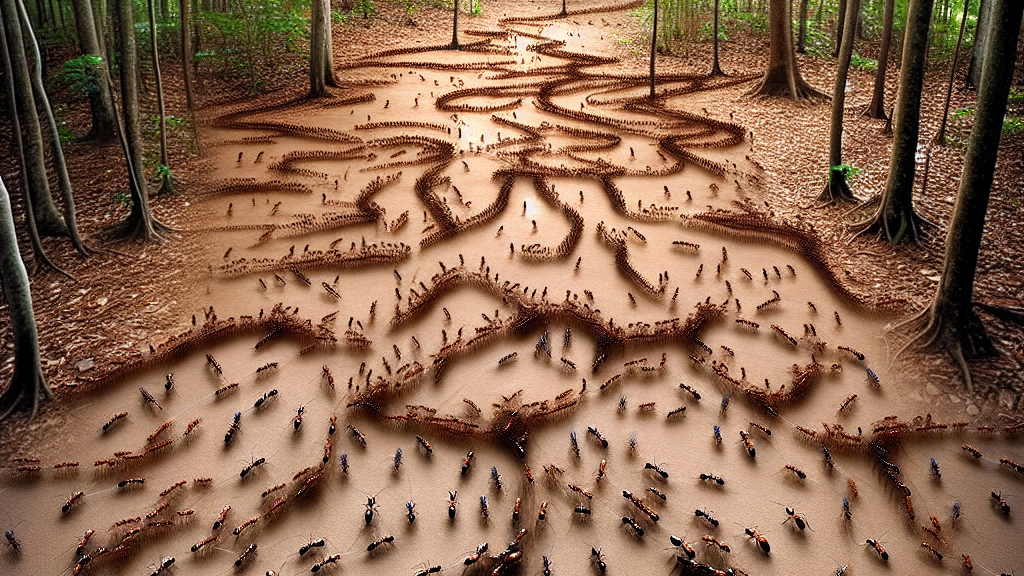
Imagine a world where chaos doesn’t just mean disorder. Scientists have discovered that when seemingly random particles start interacting, they can spontaneously form beautiful, intricate patterns. This isn’t just a wild idea—it’s a groundbreaking insight into how the universe organizes itself!
By looking into fields like physics and information theory, researchers are unlocking the mysteries of how chaos turns into order. They started with a bunch of random particles and observed how their interactions caused structured patterns to emerge. It turns out that as these particles interact, they move from unlikely random states to more organized ones, all thanks to entropy and a fascinating dynamic exchange of information.
What does this mean for you and me? Well, consider how this research could help us understand complex things like weather systems or even our own minds! By uncovering how order emerges from chaos, scientists might one day predict storms with greater accuracy or unravel the complexities of human thought and behavior. This is more than just science—it’s a peek into the hidden order that governs our world.
Did you know? Even the most chaotic systems, like a storm, can reveal hidden patterns and order over time!
FAQs
How do chaotic systems form intricate patterns?
Scientists have discovered that when particles with different internal properties interact over time, they can self-organize into intricate patterns. This transition from chaos to order happens due to entropy and dynamic exchange of information.
Why is this research on chaos and patterns important?
Understanding how chaos leads to order can help us predict and manage complex systems like weather patterns, traffic flow, and even neural networks, potentially transforming how we interact with the world.
Can this research explain natural phenomena like storms?
Yes, by revealing how chaos forms order, this research could improve our understanding and prediction of natural events, offering valuable insights into their behavior and impact.
How might this study of patterns influence technology?
This research could lead to advancements in creating more efficient systems and algorithms, potentially enhancing everything from data analysis to artificial intelligence.
Could understanding entropy and self-organization reshape our perspective on life?
Absolutely, by demonstrating the interconnectedness and underlying order in complex systems, this research invites us to rethink how we perceive randomness and organization in the universe.
Background
The study of complexity and self-organization involves understanding how order emerges from disorder. This is linked to concepts like entropy, which in science describes a system’s tendency towards disorder, and information theory, which examines the transmission and transformation of information. In this research, nonlinear dynamics helps explain how small interactions can lead to significant changes, often resulting in beautiful, intricate patterns.
History
For years, scientists have been fascinated by how seemingly chaotic systems like weather conditions or traffic can exhibit organized behavior. This interest stems from early studies in physics and mathematics that observed how simple rules could lead to complex behavior. Recent advancements in computational power have enabled more detailed simulations, providing deeper insights into how chaos can create order.
Based on “From Disorder to Design: Entropy-Driven Self-Organization in an Agent Based Swarming Model and Pattern Formation” by Vinesh Vijayan, Karpagavalli K, Sandhiya Jenifer J, Prakash R, available on arXiv (arxiv.org/abs/2503.18401), used under CC BY 4.0 (creativecommons.org/licenses/by/4.0/).