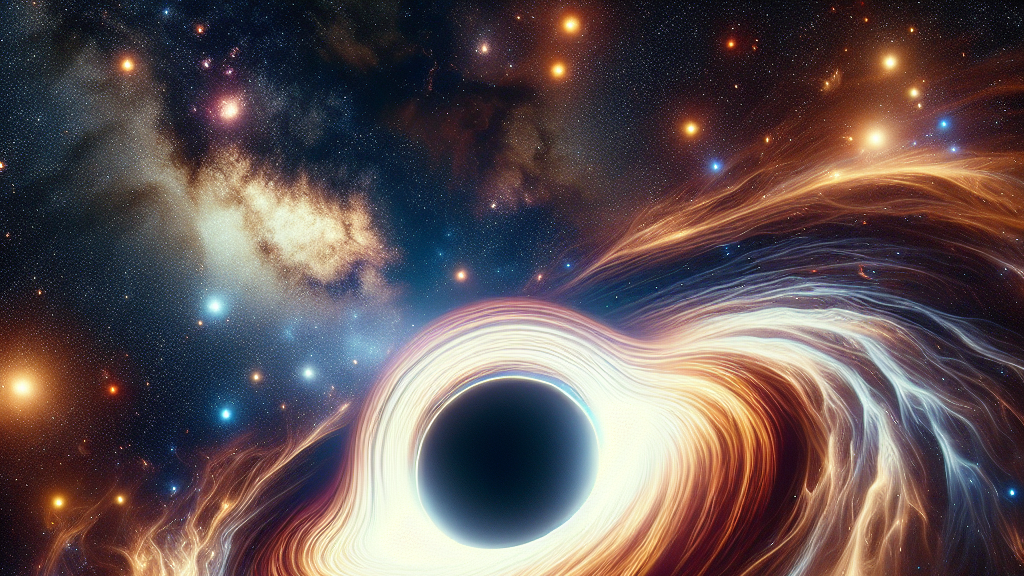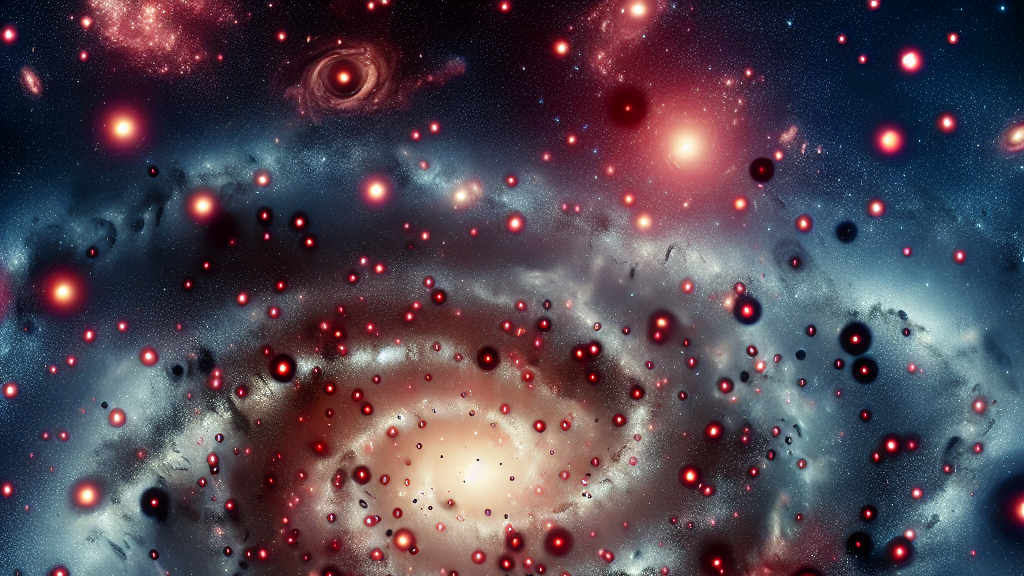
Imagine a universe where tiny galaxies with bizarrely dense centers host giant black holes, a bit like packing an entire city into a single building. These cosmic curiosities, recently observed by the James Webb Space Telescope, are known as ‘little red dots.’ While they might seem insignificant now, their fate could be anything but. They could actually transform into the massive elliptical galaxies adorning our skies today.
In a groundbreaking set of simulations, scientists explored how these dense ‘little red dots’ might evolve. By simulating galaxy mergers, they found that as these galaxies collide and merge, their central supermassive black holes can eject a lot of mass from their cores. This slingshot effect makes the galaxy’s center less packed, ultimately leading to a decrease in their density. Furthermore, the phenomenon of gravitational waves, often associated with these colossal cosmic events, helps further deplete the dense galaxy centers, aligning them more with the elliptical galaxies we see in the universe today.
So, why should you care about these tiny red galaxies and their transformation? Picture this: by understanding these early cosmic changes, we gain insight into the entire cosmic story of how galaxies grow and evolve. This knowledge might someday help us unravel the mysteries of our universe, maybe even shedding light on how galaxies like our own Milky Way came to be. In essence, these ‘little red dots’ are not just specks in the sky—they’re potential keys to the universe’s past and future.
Did you know? The James Webb Space Telescope can spot galaxies from almost 13 billion years ago, showing us the universe as it was shortly after the Big Bang!
FAQs
What are little red dots and why are they significant?
‘Little red dots’ are small but dense galaxies with massive central black holes, observed at high redshifts by the James Webb Space Telescope. They’re important because they offer clues about galaxy evolution and the role of black holes in shaping galaxies.
How do little red dots evolve into elliptical galaxies?
The evolution occurs through mergers with other galaxies, where black holes in the centers slingshot stars away, reducing density. Gravitational waves also help make the centers less dense, transforming into elliptical galaxies over millions of years.
What role do supermassive black holes play in galaxy evolution?
Supermassive black holes can influence galaxy evolution by ejecting mass during mergers, changing the central density, and driving the transformation into less dense galaxy forms.
Why is gravitational wave emission important in this research?
Gravitational wave emissions, resulting from black hole mergers, contribute to mass ejection and play a role in transforming dense galaxy cores to resemble present-day elliptical galaxies.
How does this research impact our understanding of the universe?
By studying how tiny, dense galaxies evolve, astronomers can better understand the timeline and processes that shape the universe’s structures, from ancient galaxies to the ones we see today.
Background
In the vast cosmos, galaxies are like cosmic islands of stars. Among them, some are surprisingly small and dense, with supermassive black holes at their centers. These galaxies, called ‘little red dots,’ are interesting because they might hold answers to how galaxies change over billions of years. By studying their transformations, scientists can understand the forces shaping our universe.
History
The study of galaxies has come a long way since the first telescopic observations. In recent years, the James Webb Space Telescope has allowed scientists to peer back in time, observing galaxies as they were billions of years ago. This research builds on years of theoretical models and observations, offering fresh insights into the life cycle of galaxies and the crucial role of supermassive black holes.
Based on “Where Have All the Little Red Dots Gone? Supermassive Black Hole Binary Dynamics and its Impact on Galaxy Properties” by Fazeel Mahmood Khan, Benjamin L. Davis, Andrea Valerio Macciò, Kelly Holley-Bockelmann, available on arXiv (arxiv.org/abs/2503.07711), used under CC BY 4.0 (creativecommons.org/licenses/by/4.0/).