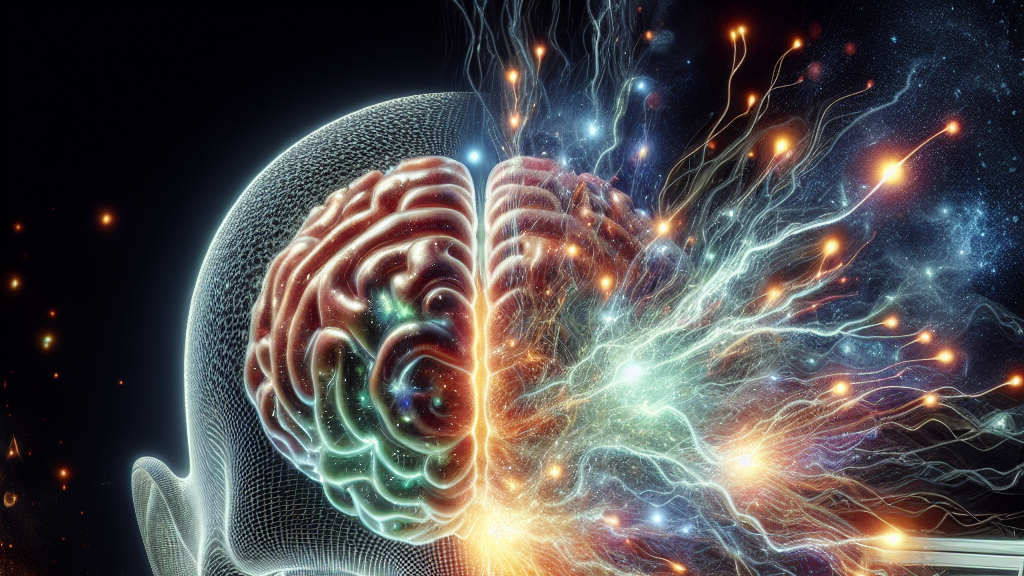
Imagine if your brain was more powerful and mysterious than the most advanced computer. That’s what a new study is suggesting. Researchers have uncovered that the human brain might handle consciousness in such a complex way that it goes beyond what traditional digital computers can manage. It’s like having a supercomputer in your head running on a completely different kind of code.
The study looked at how we experience consciousness and the amount of information needed to describe these experiences. They found that the human brain would need more ‘space’ to store information about every possible conscious state than it has available. This suggests that our brains are doing more than simply running a program – they may be using some other, non-digital method for processing our experiences.
In the future, understanding how our brains manage to do this could lead to breakthroughs in AI, helping computers learn from the brain’s efficiency and complexity. Imagine if your smartphone could ‘think’ like you do, enhancing its computing power and making everyday technology smarter and more adaptable.
Your brain’s power is like having a supercomputer but with its own unique operating system!
FAQs
How does this study change our understanding of the human brain and consciousness?
This study challenges the idea that the human brain functions like a classical digital computer by highlighting the brain’s unique ability to handle complex conscious states, suggesting it uses mechanisms beyond traditional computation.
What implications does this have for artificial intelligence?
If our brains use non-classical methods to process information, mimicking these processes could lead to more advanced, efficient AI systems that better replicate human thought.
Why can’t traditional computers fully model human consciousness?
Traditional computers may fall short because they operate on linear, digital processes, while the human brain appears to employ more complex, multidimensional ways of processing information that are not yet fully understood.
Background
In the study of consciousness and the brain, scientists often compare the brain to a computer. A classical digital computer processes information in a linear, straightforward manner, using binary code (zeros and ones) to perform tasks. This study suggests that the brain’s processing of consciousness might be far more complex, functioning in a way that exceeds these computational methods and capabilities. Consciousness involves awareness and the ability to experience sensations and thoughts, which might involve different dimensions of information processing that aren’t captured by traditional computer models.
History
The comparison between the brain and computers has long been drawn by scientists seeking to understand human cognition and consciousness. Previous studies have focused on creating models that simulate brain functions in digital constructs. This new study builds on that research by analyzing the information requirements of conscious states and proposes that our brain’s processing mechanisms go beyond classical digital models, suggesting a need for alternative approaches to understanding and replicating consciousness.
Based on “Why the Brain Cannot Be a Digital Computer: History-Dependence and the Computational Limits of Consciousness” by Andrew Knight, available on arXiv (arxiv.org/abs/2503.10518), used under CC BY 4.0 (creativecommons.org/licenses/by/4.0/).