Connect with us

Search by keyword

Quantum Biology

How Ancient Cells Became Green Powerhouses

Uncover the ancient secret behind how cells became efficient energy factories through a fascinating evolutionary journey that turned simple bacteria into the green powerhouses we see today.

How Ancient Cells Became Green Powerhouses
✨Researched by humans. Explained by robots. Learn more.

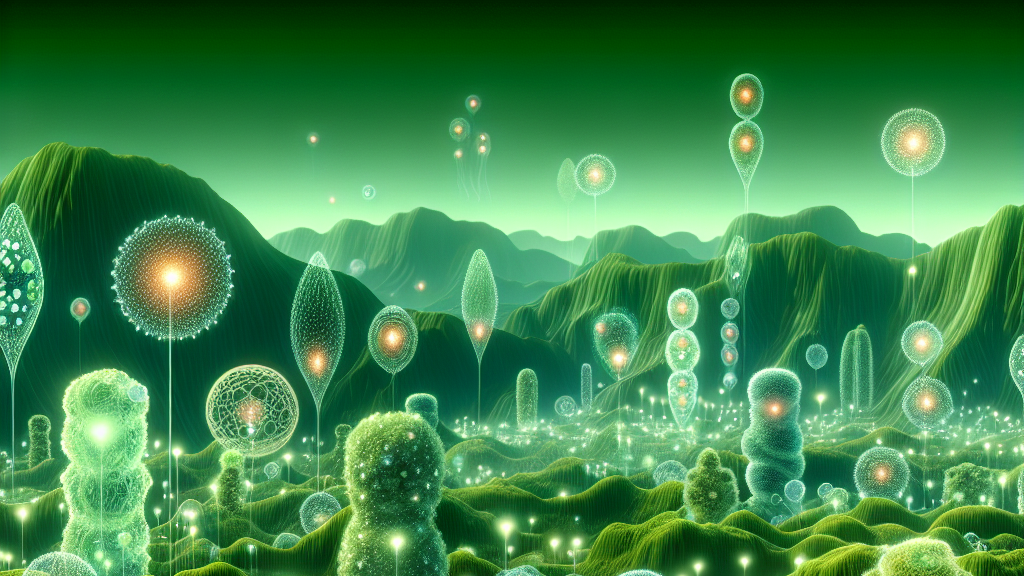
Imagine a world where life was just beginning to explore the potential of sunlight. In this ancient setting, some of the earliest bacteria embarked on a monumental journey—evolving to harness the sun’s energy more effectively than ever before. This transformation gave rise to the thylakoid membranes, tiny structures within cells that act like solar panels, boosting the efficiency of photosynthesis, a process crucial for life on Earth as we know it.

The research delves into this evolutionary leap from primitive, single-layer membranes in early bacteria, like Gloeobacterales, to the complex, multitiered ones found in modern plants. These membranes weren’t always meant for oxygenic photosynthesis; they likely started by supporting alternative electron flows before evolving into the power-packed structures responsible for converting sunlight into oxygen and energy efficiently. This change not only facilitated the proliferation of plants and algae but also marked a significant turning point in the Earth’s evolutionary timeline.

Now, let’s dream about where this knowledge could take us. Imagine applying discoveries from these ancient membranes to create more efficient solar energy technologies, inspired by biology’s natural systems. Such advances could revolutionize how we harness energy, making it cleaner and more sustainable, while drawing directly from the blueprints of life’s oldest power stations.

Thylakoid membranes are like nature’s solar panels, and their evolution helped turn simple bacteria into the first green powerhouses.

FAQs

What are thylakoid membranes and why are they important?

Thylakoid membranes are structures in cells that increase the surface area available for photosystems, thus boosting photosynthetic efficiency. This allows them to convert sunlight into usable energy and oxygen, supporting life on Earth.

How did early bacteria evolve to become efficient photosynthesizers?

Early bacteria likely started with simpler, single-layer membranes where photosynthesis occurred. Over time, they evolved to multitiered thylakoid membranes, enhancing their ability to process sunlight and increase photosynthetic efficiency.

Could this research enhance our future technologies?

Understanding the evolution of thylakoid membranes could inspire the development of advanced solar energy systems, potentially leading to cleaner and more efficient energy solutions based on natural processes.

What makes Gloeobacterales unique in photosynthesis research?

Gloeobacterales represent an ancestral state of photosynthesis, occurring in simpler cytoplasmic membranes rather than thylakoid membranes, offering insights into the early stages of photosynthetic evolution.

Background

Thylakoid membranes are essential components of photosynthetic cells found in plants and algae. These membranes create large surface areas for photosystems to efficiently capture sunlight and convert it into energy and oxygen. The evolution of thylakoid membranes marked a significant step in enabling early life forms to flourish using sunlight as an energy source.

History

The study of thylakoid membranes traces back to research on early photosynthetic bacteria, such as cyanobacteria, which evolved to utilize sunlight efficiently, leading to the oxygenation of the Earth’s atmosphere. This research builds upon our understanding of how life adapted to changing environmental conditions, resulting in the biodiversity we observe today.

Based on “On the Non-Oxygenic Origins of Thylakoids” by Luc Cornet, available on arXiv (arxiv.org/abs/2411.07081), used under CC BY 4.0 (creativecommons.org/licenses/by/4.0/).

Trending

Latest

Can AI Save Water Discover How

Computers

AI is transforming the tech world, but it uses lots of water! A new tool, SCARF, helps us measure and reduce AI's water footprint,...

Whats a Forbush Decrease and Why Should We Care Whats a Forbush Decrease and Why Should We Care

Space

Scientists just observed the biggest solar storm event in years, revealing unexpected cosmic ray patterns. Understanding these changes could help us protect our technology...

Can Cars Spot Danger Faster Than Humans Can Cars Spot Danger Faster Than Humans

Computers

Think about how quickly you react when something unexpected happens on the road. This research brings us closer to creating self-driving cars that can...

Can Fear of the Other Stop Social Harmony Can Fear of the Other Stop Social Harmony

Physics

Fear of the unknown might make it harder for people to agree and get along. This study shows that when people have strong xenophobic...

Can AI Revolutionize Breast Cancer Diagnosis Can AI Revolutionize Breast Cancer Diagnosis

Electricity

This research introduces a groundbreaking AI model that can accurately assess HER2-positive breast cancer using widely accessible staining methods, potentially revolutionizing how we diagnose...

Can AI Transform Your Singing into a Choir Can AI Transform Your Singing into a Choir

Computers

Imagine singing solo and having AI turn you into a choir. This research unveils a groundbreaking AI tool that transforms your voice into rich...

You May Also Like

Math

This research shows how mathematical proofs can change and adapt to create stronger conclusions through a logical analysis called 'ordinal analysis.' This matters because...

Quantum Biology

Ever wondered if a virus could change the course of life on Earth? Imagine ancient viruses slipping into DNA, sparking species creation through shared...

Quantum Biology

This research dives into the fascinating link between evolution and our feelings, exploring how natural selection might shape not only our minds but also...

Quantum Biology

This study redefines fitness in evolution by linking it to machine learning, showing how nature's adaptations can inspire smarter AI and improve our understanding...

Quantum Biology

Stem cells could hold the secret to why our bodies can reliably form their complex shapes despite unpredictable changes. This discovery might change how...

Quantum Biology

This research uncovers how the principles of evolution and AI can connect, potentially revolutionizing our understanding of how both living organisms and machines learn...

General Relativity and Quantum Cosmology

Human thinking might depend on gravitational waves! Gravitational waves help keep Earth's core hot, enabling tectonic action that shaped climates, which could have jump-started...

Quantum Biology

This research reveals why some creatures have tiny genomes while others have massive ones, connecting genome length to evolutionary needs. It shows how cellular...

Space

Ever wonder how stars like our Sun form? Scientists have found intriguing clues in a rare type of space cloud, possibly revealing new stars...

Copyright © 2024 8ig8rain.

Disclaimer: The content on 8ig8rain.com consists of AI-generated summaries of scientific abstracts from arXiv. Please note that most arXiv abstracts are preprints and may not have undergone formal peer review. While these summaries aim to convey key ideas and potential applications, they are provided for informational purposes only and should not be interpreted as validated scientific findings or professional advice. The summaries are intended to educate, spark curiosity, and inspire further exploration of science.