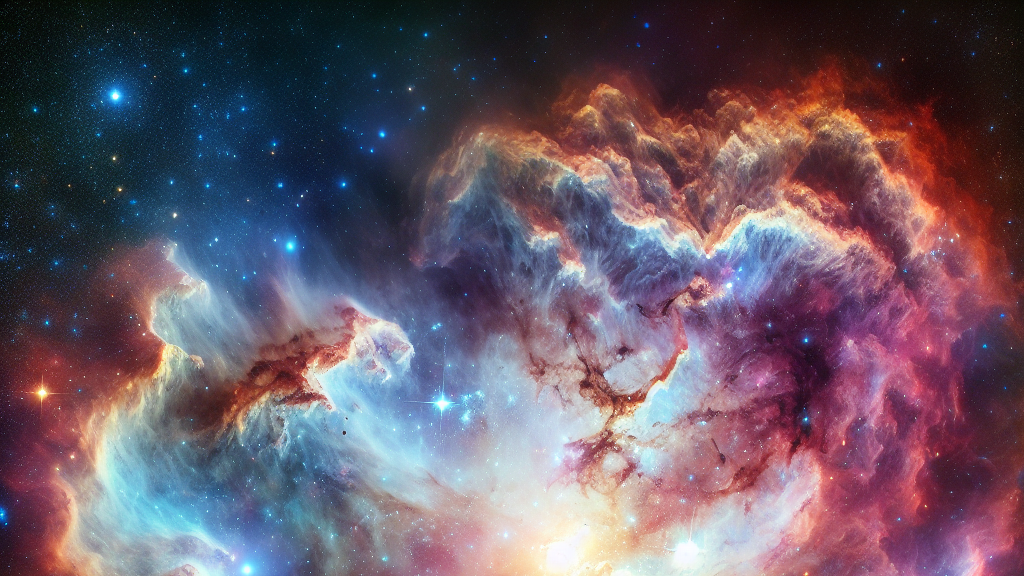
Imagine a hidden treasure chest in the middle of a bustling city. Now, replace that city with our Milky Way’s busy center and the treasure with a gigantic cloud of gas and dust. This isn’t just a cosmic fluff—it’s a potential cradle for new stars! Recently, scientists using the Green Bank Telescope stumbled upon this enormous cloud, humorously named ‘Nexus’ and ‘Filament’, right in the heart of our galaxy’s bar-shaped dust lanes.
So, what’s so special about this discovery? Well, this giant cloud is like a massive transition zone where cosmic material moves from a quieter area of the galaxy into a more chaotic one, known as the central molecular zone. This place is fascinating because the gas and dust here are packed tightly together, making it a prime location for new stars to form. Researchers found a peculiar space radio signal known as an ammonia maser here, hinting at vibrant star-forming activities.
This discovery could mean big things for our understanding of how galaxies like the Milky Way build and evolve. In the future, the newfound knowledge could guide scientists to design more precise space missions or even inspire new technologies for exploring cosmic phenomena. It’s like finding a construction site where the universe builds its own skyscrapers—the stars!
The newly discovered cloud is about 60 light-years long, which is about 6,000 times wider than the Grand Canyon!
FAQs
What is a giant molecular cloud?
A giant molecular cloud is a massive region in space filled with gas and dust, often acting as a nursery for new stars. These clouds are crucial for understanding how stars are born and evolve.
Why is the discovery of this new cloud important?
Uncovered near the Milky Way’s center, it provides clues about the movement of material in space and star formation processes, offering new insights into galaxy evolution.
How was this giant molecular cloud detected?
Scientists used the Green Bank Telescope to measure specific radio signals, helping them identify and map the cloud, which was previously undetectable.
What is a maser in space?
A maser is a natural cosmic microwave laser, emitting concentrated radio waves, often found in star-forming regions, indicating dynamic activities in these clouds.
What makes this region suitable for star formation?
The dense concentration of gas and dust in this cloud creates ideal conditions for new stars to form, similar to how a dust-filled construction site offers raw materials for building.
Background
The highest level of detail comes from understanding how dense regions of gas and dust within the galaxy act as incubators for new stars. These regions, known as giant molecular clouds, contain the fundamental building blocks needed for star formation. They are often detected through radio telescopes that pick up specific signals emitted by the molecules within these clouds, such as ammonia. Understanding their dynamics provides insight into how galaxies like the Milky Way function and evolve.
History
Scientific interest in giant molecular clouds has grown over the decades as technology to observe them has improved. With the advancement of radio telescopes, our ability to detect and study these clouds has expanded. Earlier studies focused on mapping molecular clouds throughout our galaxy, but new discoveries like the one announced here show the complexity and variety of such clouds, pushing the boundaries of what we know about our own cosmic neighborhood.
Based on “Discovery of a Giant Molecular Cloud at the Midpoint of the Galactic Bar Dust Lanes: M4.7-0.8” by Natalie Butterfield, Larry Morgan, Ashley Barnes, Adam Ginsburg, Savannah Gramze, Mark Morris, Mattia Sormani, Cara Battersby, Charlie Burton, Allison Costa, Elisabeth Mills, Juergen Ott, Michael Rugel, available on arXiv (arxiv.org/abs/2503.14174), used under CC BY 4.0 (creativecommons.org/licenses/by/4.0/).