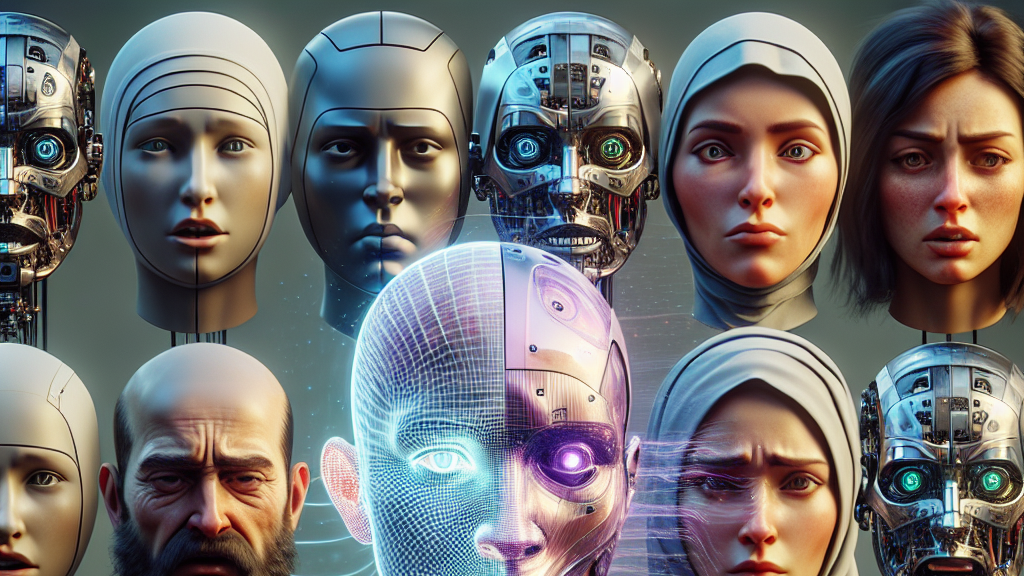
Imagine a world where robots aren’t just tools, but companions that can smile, frown, or even look surprised! It seems like science fiction, but we’re closer to it than you might think, thanks to incredible advancements in social robotics. This fascinating research explores how changes in robot appearances and facial designs affect our ability to read their emotions. Just like with humans, these factors play a critical role in how we perceive robot emotions.
This study examined how different robot face designs influence human perception of emotions. Through a series of tests with 305 participants, researchers found that robots with fully animated faces could express emotions just as effectively as humans. Interestingly, when only the eye region of a face was visible, whether human or robot, it was much harder to identify the emotion correctly. However, robots that were styled to look more human-like improved emotion recognition even in this limited context.
So why does this matter? Picture a future where your service robot or virtual assistant can respond with appropriate emotions, making interactions more natural and meaningful. Imagine a robot in a hospital or classroom not only assisting but also providing emotional support. This research could transform how we design robots to make them more relatable and effective in everyday life, bridging the gap between humans and machines in exciting new ways.
Did you know that robots can now express emotions so well that they almost rival human expressions?
FAQs
How do robot appearances impact emotion perception?
Robot appearances, specifically whether they are human-like or mechanical, play a significant role in how people perceive their emotions. Human-like robots generally enhance the recognition of emotions compared to mechanical-looking robots.
Why was the focus on full-face versus eye-region robot expressions?
The study focused on these areas to understand how different levels of facial feature visibility impact emotional recognition. It showed that full-face expressions are much more effective for emotion recognition than just viewing the eye region.
Can robots express emotions as effectively as humans?
Yes, robots with fully animated, back-projected faces can express emotions comparable to humans. This capacity greatly relies on their design, demonstrating the importance of facial animation in social robots.
Background
In social robotics, robot design is key to human-robot interaction. The perception of robot emotions is influenced by how closely they resemble humans in appearance and facial expressiveness. Effective emotional communication requires designing robots that can convey emotions through facial expressions, which can be achieved with fully animated faces.
History
The field of social robotics has evolved from clunky, mechanical machines to sophisticated robots capable of mimicking human expressions. Earlier studies focused on basic interactions, but newer research strives for robots that can engage emotionally. This study improves on these ideas by providing insights into the design of expressive robot faces.
Based on “Perception of Emotions in Human and Robot Faces: Is the Eye Region Enough?” by Chinmaya Mishra, Gabriel Skantze, Peter Hagoort, Rinus Verdonschot, available on arXiv (arxiv.org/abs/2410.14337), used under CC BY 4.0 (creativecommons.org/licenses/by/4.0/).