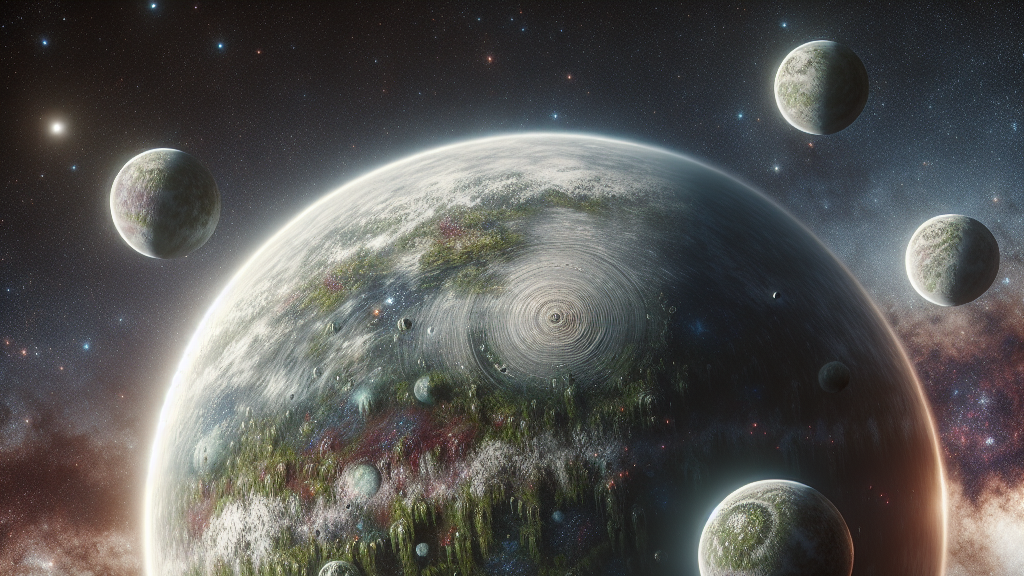
Imagine a planet hiding in the deepest reaches of our solar system, like a cosmic phantom playing hide-and-seek with astronomers. This elusive body, tentatively named Planet Nine, might be the key to mysteries involving distant space objects that refuse to follow the rules of orbital mechanics as we know them. Just think about the thrill of potentially discovering something so massive and strange lurking just beyond our cosmic backyard!
Researchers are deploying some of the most sensitive telescopes to search for Planet Nine’s faint signals. By focusing on specific sky regions and using a clever technique to spot its position based on nightly movements, they hope to capture it on a cosmic camera. Even though they didn’t find it this time, the hunt is providing valuable data and refining their search methods. They’re like celestial detectives, closing in on this planetary mystery.
If Planet Nine is found, the implications could be monumental. It might not only validate years of mathematical predictions but also reshape our understanding of planetary formation and migration. This research is a stepping stone, showing how the universe is full of surprises waiting to be discovered. Who knows? This mysterious planet might hold secrets about our own place in the cosmic tapestry.
Planet Nine is thought to have a mass about 10 times that of Earth!
FAQs
Why is the search for Planet Nine important?
Discovering Planet Nine would explain anomalies in the orbits of distant objects in our solar system, providing insights into solar system formation and potential hidden forces at play.
How do scientists search for a planet that we can’t see?
Scientists use telescopes to capture its faint light and analyze the motion of nearby objects affected by its gravity. It’s like looking for clues in a cosmic detective story.
Could Planet Nine be affecting Earth in any way?
Currently, there’s no evidence that Planet Nine has any direct impact on Earth, but its discovery would expand our understanding of cosmic forces and potential interactions in space.
Background
The concept of Planet Nine arises from the unusual orbits of several extreme trans-Neptunian objects (ETNOs). These objects follow paths that are hard to explain with our current knowledge of the solar system. It’s believed that the gravitational influence of a yet-undetected ninth planet might be causing these anomalies. Scientists look for such hidden celestial bodies by detecting slight movements in light or gravitational effects on other objects, using advanced telescopes and clever observational techniques.
History
The idea of undiscovered planets in the solar system isn’t new. In the 19th century, Neptune was discovered due to irregularities in Uranus’ orbit, leading to similar speculations about other planets. Planet Nine captures this legacy, building on mathematical predictions and technological advances in astronomy. Recent studies have used both new observations and existing survey data to narrow down the potential location and characteristics of this mysterious planet.
Based on “A targeted search for Planet Nine in the CNEOS14 field” by Héctor Socas-Navarro, Ignacio Trujillo, available on arXiv (arxiv.org/abs/2504.05473), used under CC BY 4.0 (creativecommons.org/licenses/by/4.0/).