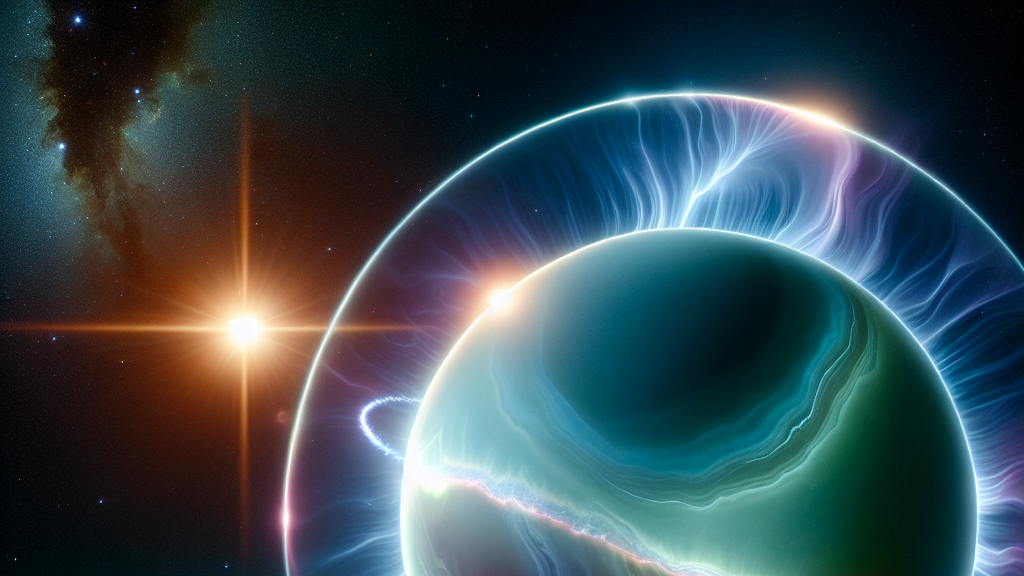
Imagine your neighborhood’s most mysterious residents, neither fully stars nor planets, but something intriguingly in between. These brown dwarfs, TOI-4776 and TOI-5422, have been spotted by the TESS space telescope in a less crowded part of the cosmic town: the mass-period space. With different ages but similar masses, these celestial siblings have thrown astronomers a delightful curveball.
TOI-4776, the younger and bulkier one, is nearly 5.4 billion years old and stands inflated beyond what models anticipated. Meanwhile, TOI-5422, aged over 8 billion years, is smaller and seems to have a unique twist – it isn’t as bright as expected. Plus, TOI-5422 appears to dance in sync with its host star, possibly tugging it into a faster spin. Such peculiar behavior hints at unknown dynamics in the galaxy’s lineup of stars and planets.
This discovery could change how we see our cosmic neighbors. Envision technology that uses the unique traits of these brown dwarfs to help us find more life-harboring planets. Imagine a future where our enhanced understanding of such ‘cosmic oddballs’ helps us better place Earth in the grand dance of the cosmos. Who knows what else these space enigmas might reveal?
Brown dwarfs are often referred to as ‘failed stars’ because they don’t have enough mass to ignite nuclear fusion at their core, yet they often behave like stars!
FAQs
What are brown dwarfs?
Brown dwarfs are celestial objects that fall between the size of planets and stars, often described as ‘failed stars’ because they lack the mass to sustain nuclear fusion.
Why is the discovery of TOI-4776 and TOI-5422 important?
These brown dwarfs challenge existing models of mass and brightness, offering new insights into how celestial objects evolve across the planet-to-star spectrum.
How might this research on brown dwarfs affect us?
Understanding brown dwarfs could lead to breakthroughs in finding new planets and comprehending star dynamics, positioning us better for discovering extraterrestrial life one day.
What makes TOI-5422 unique among brown dwarfs?
TOI-5422 is slightly underluminous and seems to be influencing its host star’s spin, an unusual behavior among brown dwarfs.
How do brown dwarfs like TOI-4776 and TOI-5422 form?
Brown dwarfs form similarly to stars, from collapsing clouds of gas and dust, but they lack the mass to start the nuclear fusion that makes stars shine.
Background
Brown dwarfs are fascinating objects in space that straddle the line between planets and stars. They are too big to be considered planets but too small to sustain the hydrogen fusion process that lights up stars. This makes them crucial for studying the transition of mass and characteristics in celestial bodies. The Transiting Exoplanet Survey Satellite (TESS) plays a pivotal role in identifying such objects by monitoring changes in light as these objects pass in front of their host stars.
History
Research into brown dwarfs began in the 1960s when scientists first hypothesized their existence. With advancements in telescope technology and space missions like TESS, astronomers have progressively identified and studied these objects. Each discovery adds a piece to the puzzle of how our universe is structured and how different celestial objects influence each other. TOI-4776 and TOI-5422 are the latest in this fascinating chain of discoveries, offering new insights into the behavior and characteristics of these enigmatic objects.
Based on “An Oasis in the Brown Dwarf Desert: Confirmation of Two Low-mass Transiting Brown Dwarfs Discovered by TESS” by Elina Y. Zhang, Theron W. Carmichael, Daniel Huber, Keivan G. Stassun, Akihiko Fukui, Norio Narita, Felipe Murgas, Enric Palle, David W. Latham, Michael L. Calkins, Sara Seager, Joshua N. Winn, Michael Vezie, Rebekah Hounsell, Hugh P. Osborn, Douglas A. Caldwell, Jon M. Jenkins, available on arXiv (arxiv.org/abs/2503.05115), used under CC BY 4.0 (creativecommons.org/licenses/by/4.0/).