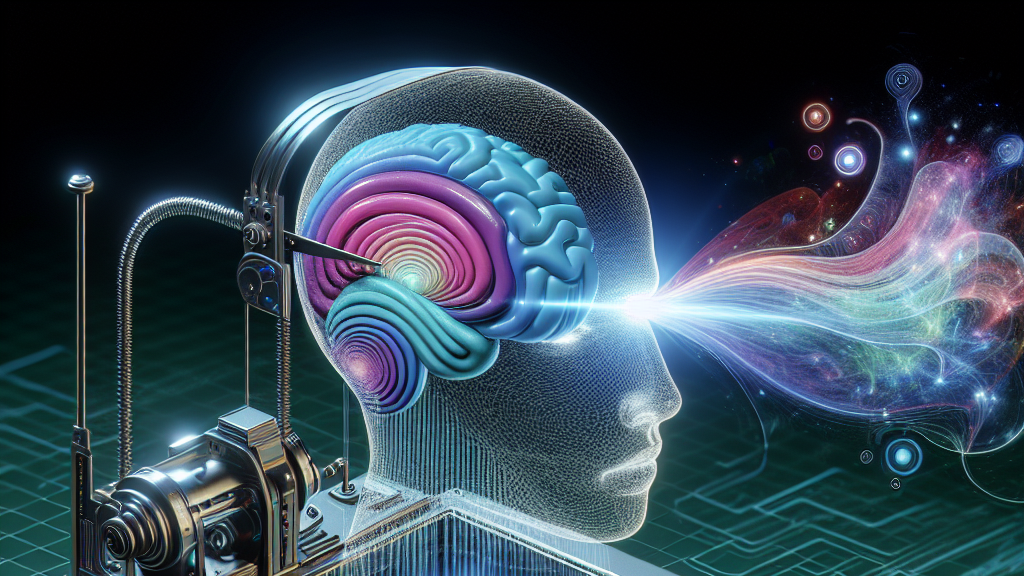
Imagine a future where you can build a 3D model simply by thinking about it. Groundbreaking research is taking steps towards making this a reality by using brainwaves—those mysterious signals your brain buzzes with all the time.
In trying to tap into the power of your thoughts, scientists have found a way to turn brain signals into 3D objects. They traditionally used a technique called functional magnetic resonance imaging, which is super precise but also very expensive and slow. Enter electroencephalography, or EEG for short—a more wallet-friendly and real-time method that involves placing electrodes on your scalp to pick up those brain signals. The research team created a new system that uses deep learning to understand EEG signals and transform them into 3D shapes—almost like magic!
Why is this cool? Besides being mind-blowingly futuristic, these techniques could someday help create amazing virtual reality experiences, allow people to control prosthetics with their minds, or even build new types of brain-computer interfaces, making everyday tech feel like something straight out of a sci-fi movie. The possibilities of interacting with technology using just our thoughts are endless!
Did you know your brain produces enough electricity to power a small light bulb?
FAQs
How can brain waves be translated into 3D objects?
Brain waves are recorded using electroencephalography (EEG), which captures the electrical activity of the brain. Researchers use deep learning to decode these signals and transform them into 3D shapes by employing specialized models and techniques.
Why is EEG preferred over fMRI in brain-computer interface research?
EEG is more affordable, non-invasive, and can be used in real-time applications compared to functional magnetic resonance imaging (fMRI), which is costly and not suitable for real-time tasks.
Can this research impact virtual reality?
Yes, by decoding brain waves into 3D objects, this research could lead to new ways of interacting with virtual reality environments, providing more immersive and intuitive experiences.
What are potential everyday applications for mind-controlled 3D models?
This technology could revolutionize fields like neuroprosthetics, allowing users to control prosthetic limbs through thought, or provide innovative solutions in virtual reality and gaming.
Is creating 3D objects from brain waves safe and practical?
Using EEG to record brain waves is a non-invasive and safe method. While the technology is still in the early stages, ongoing advancements could make it more practical for everyday use.
Background
EEG, or electroencephalography, is a method used to record electrical activity along the scalp. It captures the brain’s spontaneous electrical activity over a period of time. This method is favored in recent research due to its affordability and non-invasive nature compared to other technologies like fMRI, which uses magnetic fields to create detailed images of the brain’s activity but comes at a steep cost financially and in terms of immediacy.
History
Early brain-computer interface research predominantly used fMRI due to its superior spatial resolution, enabling detailed monitoring of brain activity. However, this approach faced limitations in cost and speed. With the rise of deep learning, there has been a shift towards developing systems like EEG that can encode brain signals into readable formats. This recent study pioneers a new pathway in translating EEG signals into structured 3D representations, building on existing knowledge and opening new possibilities for brain-computer interface applications.
Based on “Mind2Matter: Creating 3D Models from EEG Signals” by Xia Deng, Shen Chen, Jiale Zhou, Lei Li, available on arXiv (arxiv.org/abs/2504.11936), used under CC BY 4.0 (creativecommons.org/licenses/by/4.0/).