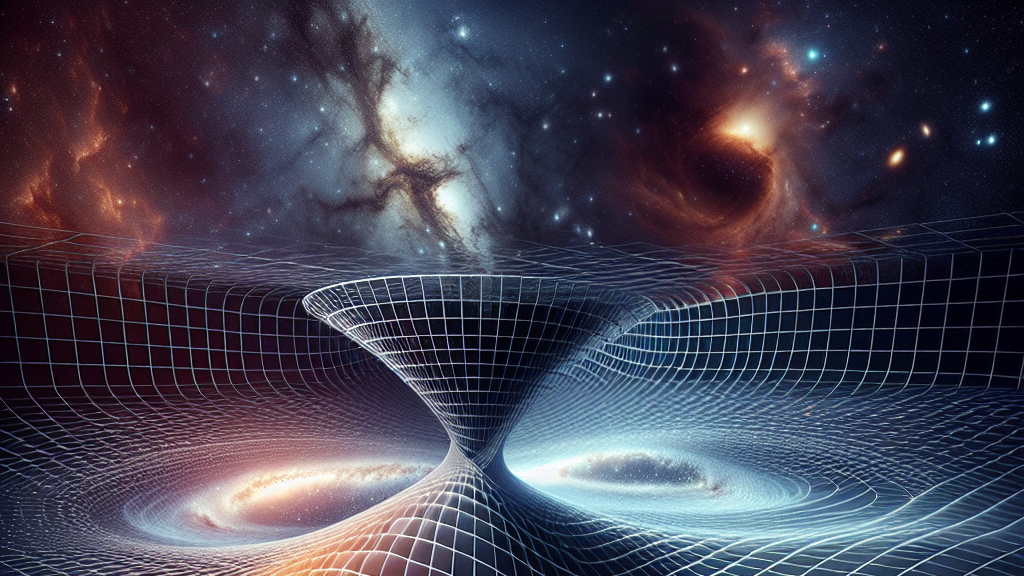
Inertia is like the universe’s secret caretaker for motion, yet even the great minds like Newton and Einstein couldn’t completely unravel its enigmatic nature. Imagine a force so fundamental, it touches everything from the way planets orbit to how cars drive on the road—and yet, it remains one of the universe’s most closely guarded secrets. Scientists have been scratching their heads for centuries, asking, ‘What is inertia?’ and ‘How does it really work?’
This research aims to untangle this mystery by separating two types of motion: geodesic inertial motion and natural motion. Think of geodesic inertial motion as the purest form of movement, like a pebble gliding across a perfectly still pond, while natural motion considers changes, like ripples forming as the pebble hits the water. By analyzing these concepts, scientists hope to redefine our understanding of motion and inertia in a way that’s never been done before.
Picture a future where understanding inertia could revolutionize how we travel, making trips more efficient and environmentally friendly. Imagine rockets that could glide effortlessly through space with minimal fuel or cars that navigate effortlessly with less energy. With this new approach to understanding inertia, such innovations might just be around the corner.
Did you know that inertia is why you feel pushed back in your seat when a car accelerates? It’s the invisible force that keeps everything moving—or stopping—the way it does!
FAQs
What makes inertia such a big mystery in physics?
Inertia is fundamental to understanding motion and forces, yet it’s surprisingly elusive. It’s been a source of curiosity for centuries, even for legendary scientists like Newton and Einstein.
How does this research change our understanding of inertia?
This research separates geodesic inertial motion from natural motion, offering a fresh perspective on how bodies move and interact. It sheds light on the nuanced differences in motion that were previously overlooked.
Can learning about inertia impact our everyday lives?
Absolutely! Understanding inertia could enhance transport efficiency and lead to innovations in space travel, potentially reducing fuel consumption and leading to more sustainable technologies.
What is geodesic inertial motion?
Geodesic inertial motion refers to motion that follows the purest path, like a smooth glide without any external interference, revealing fundamental truths about movement.
How did Newton and Einstein view inertia?
Both saw inertia as a central concept in physics, crucial to laws of motion and relativity. Yet, they acknowledged there’s much we still don’t know about it, making it a fascinating topic to explore.
Background
Inertia is the resistance of any physical object to a change in its state of motion or rest. It is described by Newton’s First Law of Motion, which states that an object will remain at rest or in uniform motion unless acted upon by an external force. This concept is essential for understanding how forces affect motion in everything from everyday experiences to cosmic phenomena.
History
The concept of inertia dates back to ancient philosophers, but it was Sir Isaac Newton who formalized it in his laws of motion in the 17th century. Albert Einstein later expanded on these ideas with his theory of relativity, which provided a new framework for understanding motion and gravity. This study aims to build on their foundational work, offering a new way of looking at motion by distinguishing between different types of inertial motion—a step that could unlock further mysteries about how the universe operates.
Based on “Apples Falling, Buckets Rolling, and Why Inertia Keeps Trolling” by Nicola Bamonti, available on arXiv (arxiv.org/abs/2504.14734), used under CC BY 4.0 (creativecommons.org/licenses/by/4.0/).