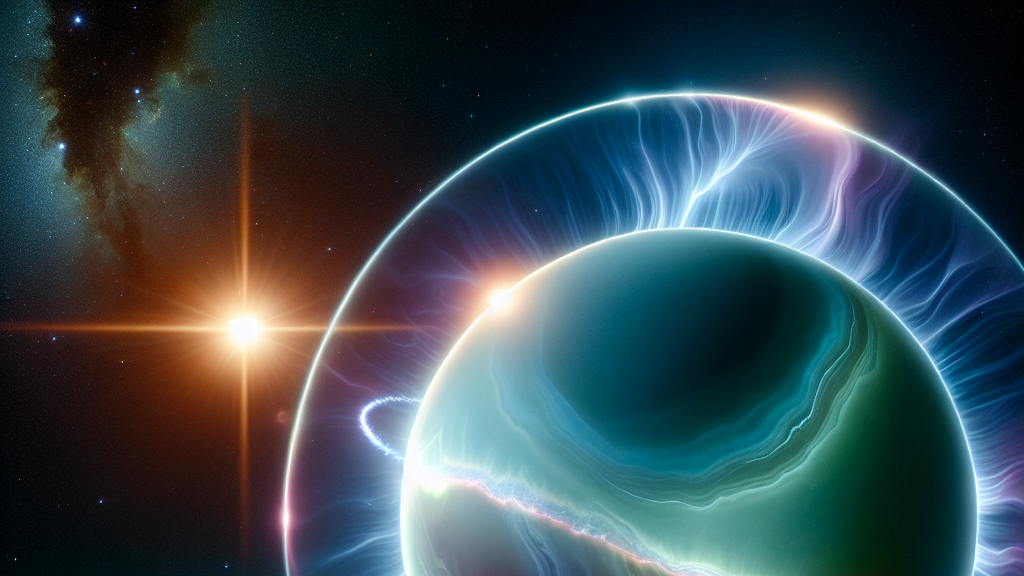
Did you know that planets can ring like bells? Imagine if a space rock the size of Neptune slammed into a giant planet. Such a colossal impact could send waves throughout the planet, making it oscillate for millions of years. A young super-Jupiter like Beta Pictoris b might still be ringing today, creating light variations visible from Earth!
Researchers have delved into this phenomenon using advanced modeling. They found that when a young gas giant gets walloped by large rocky bodies, it sets off long-lasting seismic waves. These waves are like a planet’s version of ringing, continuing for a significant fraction of its age. For Beta Pictoris b, if a sizable collision occurred in the last 9 to 18 million years, these oscillations could still be detected today with our cutting-edge telescopes.
In the future, the James Webb Space Telescope could catch glimpses of these celestial tunes. By measuring the light variations caused by these waves, scientists might uncover more secrets about the early solar systems. This research takes us one step closer to understanding the grand cosmic concerts that play out in the universe, and who knows? Maybe one day, we’ll listen to a cosmic symphony live from outer space!
Beta Pictoris b might still be ringing from a cosmic impact that happened millions of years ago!
FAQs
Can planets really ring like bells after a giant impact?
Yes, when a large solid body impacts a giant planet, it generates seismic waves that cause the planet to oscillate, like ringing a bell. These oscillations can last for millions of years, depending on the size and energy of the impact.
How can we detect the oscillations of planets like Beta Pictoris b?
Scientists can detect these oscillations by observing changes in the planet’s brightness, known as photometric variability. The James Webb Space Telescope is capable of measuring these subtle changes.
What makes Beta Pictoris b an interesting target for this research?
Beta Pictoris b is a young, massive planet known to have a high metal content, making it a likely candidate to have experienced massive collisions in its past. These collisions would still cause detectable oscillations.
What kind of bodies could impact a giant planet to cause these rings?
The research suggests that collisions with bodies around the size of Neptune, roughly 17 times the mass of Earth, could cause these noticeable oscillations in giant planets like Beta Pictoris b.
Why is observing these planetary oscillations important?
Observing these oscillations helps scientists learn about the history and formation of giant planets. It can give insights into their internal structure and the roles that cosmic impacts play in shaping them.
Background
Understanding giant exoplanets requires knowing about their cores, which are thought to be made of heavy metals. When a giant planet forms, it might merge with other massive solid bodies, generating seismic waves that ripple through the planet. These waves are detectable as variations in the planet’s brightness, which telescopes on Earth or in space can capture.
History
The study of exoplanets has grown rapidly with advancements in telescope technology, leading to discoveries of planets that are unlike anything in our solar system. Prior research has focused on their composition and the role of heavy metals. This study builds on the discovery of Beta Pictoris b, hypothesizing about past cosmic impacts that could have caused long-lasting oscillations.
Based on “Seismic Oscillations Excited by Giant Impacts in Directly-Imaged Giant Planets” by J. J. Zanazzi, Eugene Chiang, Yifan Zhou, available on arXiv (arxiv.org/abs/2505.01496), used under CC BY 4.0 (creativecommons.org/licenses/by/4.0/).