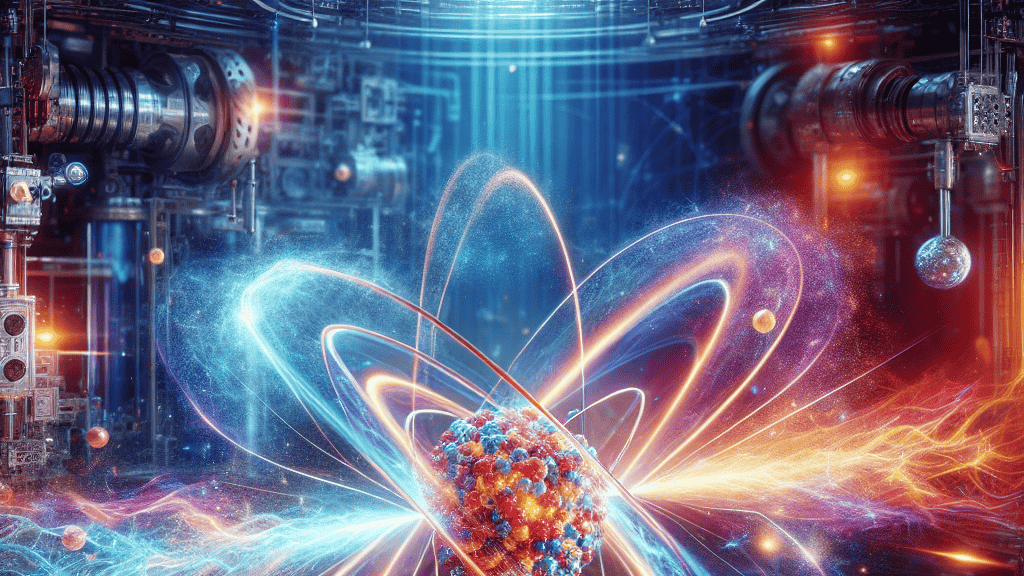
Ever wonder how we figure out what’s happening in the universe’s hottest and most chaotic environments? Quark-gluon plasma, a state of matter believed to have existed just after the Big Bang, is one such environment. Scientists have long been trying to understand the light—or photons—this plasma emits, as it holds clues to the very essence of our cosmos.
In this study, researchers used a powerful approach called lattice QCD to examine these photon signals without resorting to complicated mathematical problems. By focusing on specific temperatures and using improved techniques, they managed to capture two important parts of the photon spectrum. This breakthrough is significant because these signals were previously mysterious and hard to decode.
Imagine decoding the light from a far-off galaxy. With this research, scientists are getting closer to explaining how the photons from quark-gluon plasma not only appear but behave in different conditions. This could help solve the ‘direct photon puzzle’ in heavy-ion collision studies, potentially leading to new insights into the forces that shaped the universe right after the Big Bang.
Did you know that quark-gluon plasma is so hot it’s believed to have existed only microseconds after the Big Bang?
FAQs
What is the quark-gluon plasma and why is it important?
Quark-gluon plasma is a state of matter that consists of quarks and gluons, the fundamental building blocks of protons and neutrons. It’s important because studying it helps us understand the conditions of the universe shortly after the Big Bang.
How does this photon spectrum research solve the direct photon puzzle?
This research provides a new method to compute the spectrum of photons emitted by the quark-gluon plasma, offering a clearer view of these mysterious signals, which helps solve the puzzle of why they appear the way they do in heavy-ion collisions.
What is lattice QCD and why is it used in this research?
Lattice QCD is a computational technique used to study quarks and gluons, which are too small to observe directly. It’s used here to estimate photon emissions without complicated mathematical problems, giving more accurate results.
Why are photons significant in studying quark-gluon plasma?
Photons are significant because they can escape the quark-gluon plasma without strong interactions, carrying valuable information about the conditions and processes occurring within, which is crucial for understanding cosmic conditions.
What potential real-world applications exist for this research?
This research could improve our understanding of the forces at play in the early universe, leading to advances in astrophysics and nuclear physics, and possibly even practical technologies in energy and materials science.
Background
Quark-gluon plasma is a state of matter that existed only microseconds after the Big Bang, where quarks and gluons move freely instead of being confined in protons and neutrons. The challenge lies in understanding how photons, or particles of light, are emitted from this plasma since these photons can help us understand dynamic cosmic events without being directly obstructed.
History
The study of quark-gluon plasma has been ongoing since the 1970s. Earlier efforts focused on understanding the fundamental forces and particles of the universe. Recent advances, such as using lattice QCD, have allowed scientists to simulate and study this plasma in controlled conditions, improving our understanding of its properties and behaviors.
Based on “Probing how bright the quark-gluon plasma glows in lattice QCD” by Ardit Krasniqi, Marco Cè, Tim Harris, Renwick J. Hudspith, Harvey B. Meyer, available on arXiv (arxiv.org/abs/2505.10295), used under CC BY 4.0 (creativecommons.org/licenses/by/4.0/).