Connect with us

Search by keyword

General Relativity and Quantum Cosmology

Are Black Holes Just Cosmic Time Machines?

Did you know black holes might actually be cosmic time machines? This research reveals two new ways of looking at black holes, hinting they could help us understand the mysteries of our universe, including gravitational waves and cosmic bursts.

Are Black Holes Just Cosmic Time Machines
✨Researched by humans. Explained by robots. Learn more.

Ever wondered if black holes are more than just cosmic vacuum cleaners? Recent groundbreaking research suggests they might actually be unparalleled cosmic time machines. Imagine a place in space that not only swallows everything but also holds the key to understanding the fabric of our universe! This study uncovers two mind-blowing ways to look at black holes, revealing that they might be more interconnected with time and space than ever thought before.

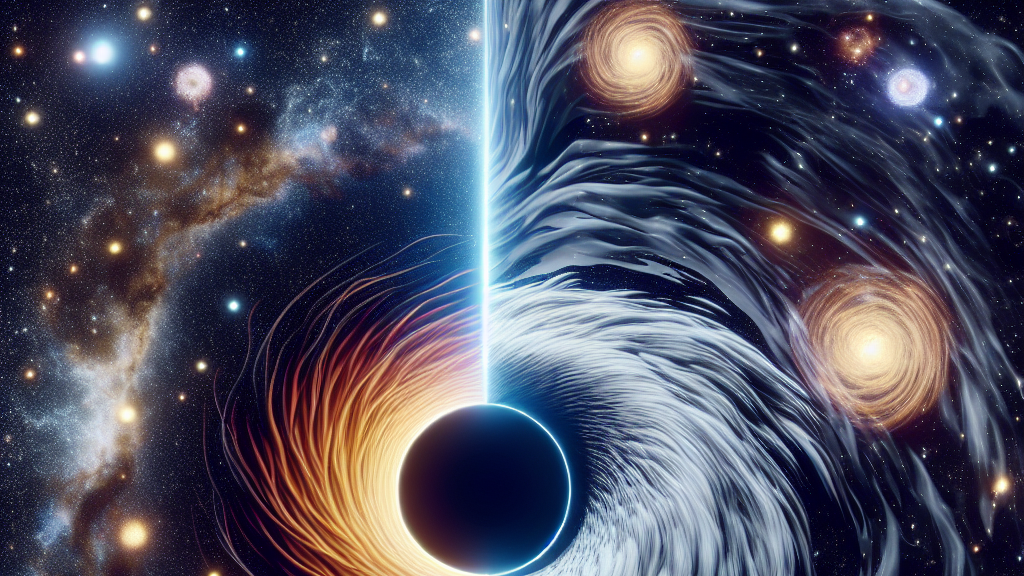
The researchers found two different, but complementary ways to describe black holes using advanced solutions to Einstein’s equations. One focuses on how matter collapses into these intense singularities, while the other looks at what happens across different time frames. It’s like having two sides of the same coin, offering insights into the mysterious insides of a black hole formed through gravitational collapse. By understanding this duality, scientists have even managed to tie it back to the famous area law formula for black hole entropy discovered by Bekenstein and Hawking.

But why should you care? Imagine this: we might be on the brink of understanding more cosmic phenomena like gravitational waves or even those fast radio bursts that baffle scientists. The implications are vast, potentially opening new doors to space-time travel theories or revealing unseen forces in our universe. So next time you look up at the night sky, remember, a black hole could be way more than just a dark spot; it might be a gateway to cosmic wonders yet to be explored.

Did you know? Black holes could potentially hold the secrets to time travel by connecting different periods of space-time!

FAQs

How do black holes relate to time travel?

This research suggests that black holes might be cosmic time machines, offering insights into the nature of time and space by acting like connections between different time periods.

What is the Bekenstein-Hawking entropy in relation to black holes?

The Bekenstein-Hawking entropy formula is a way to measure the amount of disorder or information contained within a black hole, and this research shows how it naturally arises from the wave-function’s degeneracy of collapsing matter.

How could this research on black holes impact our understanding of the universe?

By exploring two complementary views of black holes, this research could help us better understand cosmic phenomena like gravitational waves and fast radio bursts, possibly leading to groundbreaking discoveries about the universe’s structure.

Why are gravitational waves important in this study of black holes?

Gravitational waves provide evidence for the complex interactions of black holes, and this study shows support for its findings through observations of these ripples in space-time caused by massive cosmic events like mergers.

What role do fast radio bursts play in this research on black holes?

Fast radio bursts are mysterious, sudden bursts of radio waves from space, and this study predicts they could be linked to single-body perturbations in black holes, providing new insights into these enigmatic phenomena.

Background

Einstein’s theory of general relativity describes how massive objects like black holes warp the fabric of space and time. Black holes form when massive stars collapse under their own gravity, creating a point of no return known as the event horizon. The Bekenstein-Hawking entropy connects black holes to quantum physics, suggesting that black holes have thermodynamic properties like temperature and entropy.

History

Since the discovery of black holes, scientists have been trying to reconcile general relativity with quantum mechanics. This study builds on the seminal works of Stephen Hawking and Jacob Bekenstein by proposing a new way of understanding black holes through complementary descriptions, offering a potential bridge between the two fields.

Based on “Inside Black Holes, Singularity or Complementarity?” by Ding-fang Zeng, available on arXiv (arxiv.org/abs/2505.14750), used under CC BY 4.0 (creativecommons.org/licenses/by/4.0/).

Trending

Latest

Can AI Save Water Discover How

Computers

AI is transforming the tech world, but it uses lots of water! A new tool, SCARF, helps us measure and reduce AI's water footprint,...

Whats a Forbush Decrease and Why Should We Care Whats a Forbush Decrease and Why Should We Care

Space

Scientists just observed the biggest solar storm event in years, revealing unexpected cosmic ray patterns. Understanding these changes could help us protect our technology...

Can Cars Spot Danger Faster Than Humans Can Cars Spot Danger Faster Than Humans

Computers

Think about how quickly you react when something unexpected happens on the road. This research brings us closer to creating self-driving cars that can...

Can Fear of the Other Stop Social Harmony Can Fear of the Other Stop Social Harmony

Physics

Fear of the unknown might make it harder for people to agree and get along. This study shows that when people have strong xenophobic...

Can AI Revolutionize Breast Cancer Diagnosis Can AI Revolutionize Breast Cancer Diagnosis

Electricity

This research introduces a groundbreaking AI model that can accurately assess HER2-positive breast cancer using widely accessible staining methods, potentially revolutionizing how we diagnose...

Can AI Transform Your Singing into a Choir Can AI Transform Your Singing into a Choir

Computers

Imagine singing solo and having AI turn you into a choir. This research unveils a groundbreaking AI tool that transforms your voice into rich...

You May Also Like

Space

Scientists have discovered a new way that tiny early-universe structures might grow into massive black holes, potentially changing our understanding of cosmic evolution! This...

Materials

New insights suggest quantum mechanics might influence macroscopic decisions, giving a fresh perspective on how reality is formed during big events.

General Relativity and Quantum Cosmology

Researchers have uncovered a potential connection between the behavior of black holes and elusive dark matter particles. This exciting discovery may change how we...

General Relativity and Quantum Cosmology

Imagine using a tabletop setup to mimic the intense gravitational effects of a black hole! These 'gravity simulators' are pushing the boundaries of what...

General Relativity and Quantum Cosmology

Scientists are finding that black holes might not be the simple, spherical giants we once thought—they could have fractal edges, with surprising effects on...

Space

Jellyfish galaxies are cosmic wonders where dramatic transformations happen because of their harsh surroundings. This study reveals how their unique 'tails' hint at active,...

General Relativity and Quantum Cosmology

Ever wondered if black holes could be studied right here on Earth? Scientists are using creative lab setups to mimic the strange physics around...

General Relativity and Quantum Cosmology

Scientists are bringing the mysteries of black holes into the lab by creating small-scale experiments that simulate their incredible gravitational forces. This means we...

Space

Dark matter around black holes might help us detect subtle cosmic signals, leading to new discoveries about the universe with advanced space technology.

Copyright © 2024 8ig8rain.

Disclaimer: The content on 8ig8rain.com consists of AI-generated summaries of scientific abstracts from arXiv. Please note that most arXiv abstracts are preprints and may not have undergone formal peer review. While these summaries aim to convey key ideas and potential applications, they are provided for informational purposes only and should not be interpreted as validated scientific findings or professional advice. The summaries are intended to educate, spark curiosity, and inspire further exploration of science.