Connect with us

Search by keyword

General Relativity and Quantum Cosmology

What Happens to Information in Black Holes?

Ever wondered what happens to information once it falls into a black hole? This thrilling research delves into the discrepancies of quantum theories and black holes, challenging our understanding of the universe and hinting at big mysteries yet to be unraveled!

What Happens to Information in Black Holes
✨Researched by humans. Explained by robots. Learn more.

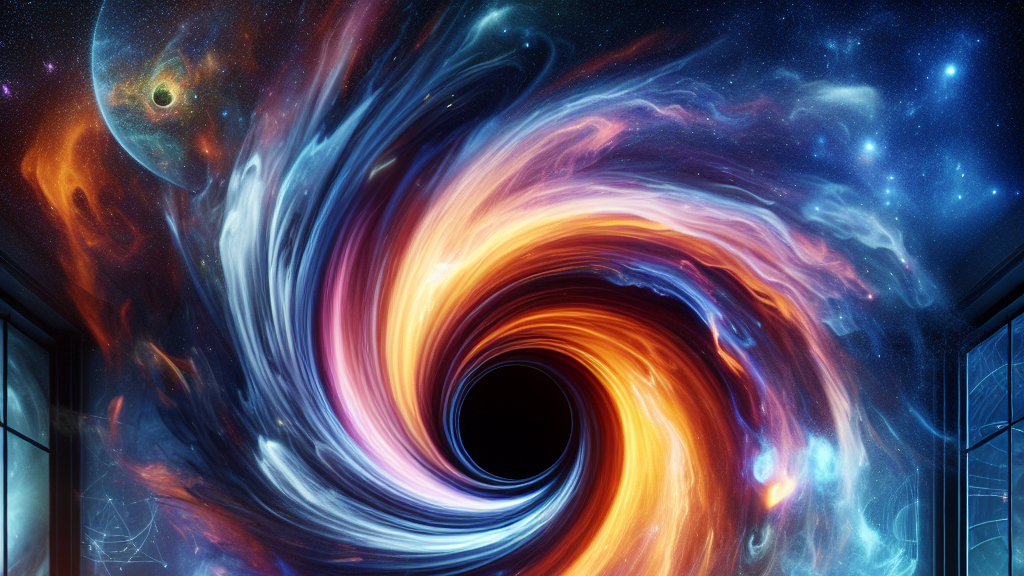
Black holes are like the cosmic Houdini, shrouded in mystery and capturing our imagination with their puzzling nature. One of the biggest questions is ‘what happens to information once a black hole evaporates?’ This isn’t just a mind-bending puzzle for scientists—it’s a question that challenges the very basis of our understanding of physics and the universe. It’s about whether the universe is predictable and makes sense, or if it’s filled with chaotic surprises.

This research uncovers the intriguing concept of how black holes can lose information. Imagine a process where a black hole, known for sucking in everything, eventually evaporates. But as it vanishes, the information of everything it has consumed might just disappear too. It’s as if you shredded a document and threw away the pieces without a trace left behind, breaking the rules of how we think information should behave in the universe.

If these findings hold true, it could change how we think about physics, space, and time profoundly. Future technologies could harness this concept, perhaps in computing or data encryption, potentially leading to breakthroughs in how we safeguard information. Picture a future where the secrets of the universe might just be the key to keeping our data secure!

Black holes can shrink and disappear over time through a process called evaporation!

FAQs

What is the black hole information problem?

The black hole information problem questions what happens to information that falls into a black hole once the black hole evaporates. It challenges whether information is ever truly lost in the universe.

How do black holes evaporate?

Black holes can gradually shrink and vanish through a process called Hawking radiation, where they emit particles, losing mass over time until they eventually disappear.

Why does this research on black hole information matter?

This research is crucial because it challenges the principles of quantum mechanics and general relativity, ultimately expanding our understanding of the universe and how information behaves across it.

What are the potential future applications of this research on black holes?

Understanding black hole information could lead to revolutionary technologies in data encryption and computation by harnessing principles from quantum physics and black hole dynamics.

Is information truly lost in black holes?

The research suggests that if no new physics emerge at very small scales, information might indeed be lost when a black hole evaporates, despite quantum mechanics traditionally suggesting that information should be conserved.

Background

Think of gravity as a kind of invisible force that keeps you from floating away into space. Semiclassical gravity blends the ideas of the large-scale effects of gravity (like those pulling you to the ground) with the tiny world of quantum mechanics, which deals with how the tiniest particles in the universe behave. This combination gives us insights into strange phenomena like black holes and how they interact with the universe.

History

The idea of black holes has fascinated scientists ever since German physicist Karl Schwarzschild first proposed their possibility in 1916. Over the years, groundbreaking work by legendary physicists like Stephen Hawking has refined our understanding, particularly with Hawking radiation, which predicted that black holes could emit particles and eventually evaporate. This ongoing research builds on these foundations and questions the core principles of how the universe conserves information.

Based on “A pedagogical approach to the black hole information problem” by Thiago T. Bergamaschi, available on arXiv (arxiv.org/abs/2505.17164), used under CC BY 4.0 (creativecommons.org/licenses/by/4.0/).


Trending

Latest

Can AI Save Water Discover How

Computers

AI is transforming the tech world, but it uses lots of water! A new tool, SCARF, helps us measure and reduce AI's water footprint,...

Whats a Forbush Decrease and Why Should We Care Whats a Forbush Decrease and Why Should We Care

Space

Scientists just observed the biggest solar storm event in years, revealing unexpected cosmic ray patterns. Understanding these changes could help us protect our technology...

Can Cars Spot Danger Faster Than Humans Can Cars Spot Danger Faster Than Humans

Computers

Think about how quickly you react when something unexpected happens on the road. This research brings us closer to creating self-driving cars that can...

Can Fear of the Other Stop Social Harmony Can Fear of the Other Stop Social Harmony

Physics

Fear of the unknown might make it harder for people to agree and get along. This study shows that when people have strong xenophobic...

Can AI Revolutionize Breast Cancer Diagnosis Can AI Revolutionize Breast Cancer Diagnosis

Electricity

This research introduces a groundbreaking AI model that can accurately assess HER2-positive breast cancer using widely accessible staining methods, potentially revolutionizing how we diagnose...

Can AI Transform Your Singing into a Choir Can AI Transform Your Singing into a Choir

Computers

Imagine singing solo and having AI turn you into a choir. This research unveils a groundbreaking AI tool that transforms your voice into rich...

You May Also Like

Space

Scientists have discovered a new way that tiny early-universe structures might grow into massive black holes, potentially changing our understanding of cosmic evolution! This...

Materials

New insights suggest quantum mechanics might influence macroscopic decisions, giving a fresh perspective on how reality is formed during big events.

General Relativity and Quantum Cosmology

Researchers have uncovered a potential connection between the behavior of black holes and elusive dark matter particles. This exciting discovery may change how we...

General Relativity and Quantum Cosmology

Imagine using a tabletop setup to mimic the intense gravitational effects of a black hole! These 'gravity simulators' are pushing the boundaries of what...

General Relativity and Quantum Cosmology

Scientists are finding that black holes might not be the simple, spherical giants we once thought—they could have fractal edges, with surprising effects on...

Space

Jellyfish galaxies are cosmic wonders where dramatic transformations happen because of their harsh surroundings. This study reveals how their unique 'tails' hint at active,...

General Relativity and Quantum Cosmology

Ever wondered if black holes could be studied right here on Earth? Scientists are using creative lab setups to mimic the strange physics around...

Math

Scientists have found a way to 'see' atoms by using light and unique detectors, helping us understand the invisible world around us better.

General Relativity and Quantum Cosmology

Scientists are bringing the mysteries of black holes into the lab by creating small-scale experiments that simulate their incredible gravitational forces. This means we...

Copyright © 2024 8ig8rain.

Disclaimer: The content on 8ig8rain.com consists of AI-generated summaries of scientific abstracts from arXiv. Please note that most arXiv abstracts are preprints and may not have undergone formal peer review. While these summaries aim to convey key ideas and potential applications, they are provided for informational purposes only and should not be interpreted as validated scientific findings or professional advice. The summaries are intended to educate, spark curiosity, and inspire further exploration of science.