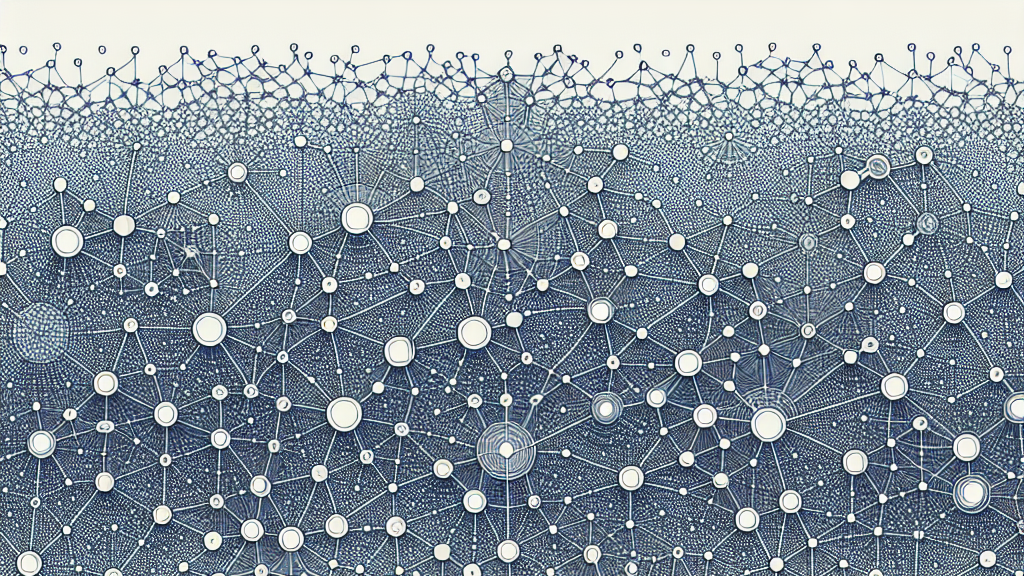
Ever wondered if math can predict patterns in the chaos of complex networks? Well, researchers have discovered a way to do just that! They’ve found constants that help determine when a network, or graph, contains specific long cycles, turning what seems like random connections into predictable patterns. It’s like seeing the hidden lines in a picture that only an expert can spot.
The research dives deep into graph theory—a branch of mathematics that studies networks made up of nodes (like dots in a connect-the-dots drawing). By identifying particular conditions, scientists can predict when these networks will contain long, repeating cycles. They’ve even shown that the number of unique ways these networks can be arranged explodes exponentially under certain conditions.
Imagine using this research to design more efficient computer networks or to understand social networks better. In the future, this might help us detect patterns that reveal how information spreads or even how diseases travel through populations, giving us new tools to tackle big challenges in our interconnected world.
Every social network you interact with daily can be represented mathematically as a graph!
FAQs
What is the core topic of this graph theory research?
This research focuses on graph theory, specifically on predicting the presence of long cycles and the number of unique subgraphs in complex networks.
How does predicting patterns in graphs benefit us?
Predicting patterns in graphs can be extremely beneficial for designing efficient computer networks, understanding social networks better, and even tackling problems like information spread or disease transmission.
What are induced subgraphs and why do they matter?
Induced subgraphs are smaller networks within a larger graph, maintaining the same connections. They are crucial for understanding the structure and characteristics of large networks.
How does this research relate to exponential growth?
It shows that under certain conditions, the number of unique ways a network can be configured grows exponentially, revealing the vast potential and complexity within these structures.
Why are constants important in predicting graph patterns?
Constants provide specific conditions under which predictions about graph patterns can be accurately made, helping to reveal hidden structural insights.
Background
Graph theory is a field of mathematics that explores how things are interconnected. It uses the concept of graphs, which are collections of points (nodes) connected by lines (edges), to study the relationships and structures within networks. This study often involves finding patterns or properties that are present in a given type of graph. In this particular research, scientists are interested in recognizing certain cycles and configurations within these complex networks.
History
The study of graph theory began in the 18th century with the famous problem of the Seven Bridges of Königsberg, which led to the formulation of the first known graph-theory theorem. Since then, graph theory has evolved significantly, becoming crucial to fields like computer science, biology, and sociology. This research builds on past findings by using mathematical constants to predict specific patterns such as long cycles within these graphs, marking another leap forward in understanding the networked world.
Based on “A large hole in pseudo-random graphs” by Sahar Diskin, Michael Krivelevich, Itay Markbreit, Maksim Zhukovskii, available on arXiv (arxiv.org/abs/2505.23384), used under CC BY 4.0 (creativecommons.org/licenses/by/4.0/).