Connect with us

Search by keyword

Physics

Can We Make Materials Break Their Own Rules?

Scientists have found a way to use light to make a material, that normally behaves one way, act like it’s breaking the laws of physics and become something it shouldn’t be. This discovery could lead to new, incredible materials that defy expectations.

Can We Make Materials Break Their Own Rules
✨Researched by humans. Explained by robots. Learn more.

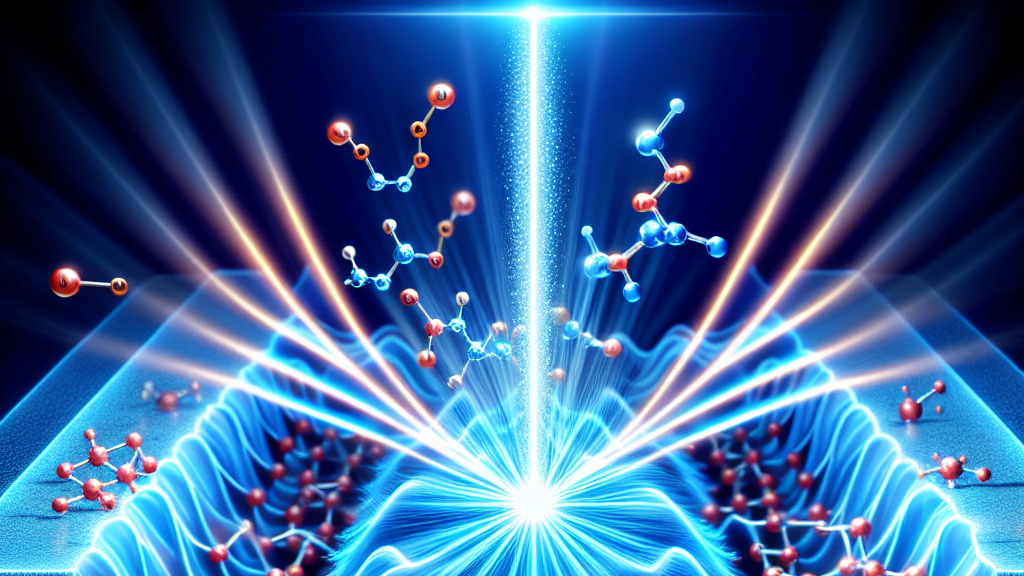
Imagine if we could tell a material to forget its usual behavior and act like it’s in a different world. Well, scientists have discovered a way to do just that using special pulses of light. It’s like giving the material a tiny nudge with an invisible finger that can make it do things that seemed impossible before.

The material in question is called Strontium Titanate, a type of crystal that usually stays pretty steady and predictable. But with the help of resonant mid-infrared light pulses, researchers have managed to push this material into doing something extraordinary. By carefully controlling these light pulses, they can suppress the usual quantum fluctuations that keep the atoms from settling into a new, more stable state.

So, why does this matter in the real world? Well, just think about all the technology that relies on specific material properties, like electronics and sensors. If we can control how materials behave with light, we could develop gadgets and devices that are faster, smarter, and more energy-efficient. Imagine batteries that last longer or computers that run on light instead of electricity. The possibilities are as exciting as they are endless!

Strontium Titanate can be made to act like it’s colder than absolute zero with light pulses!

FAQs

What makes Strontium Titanate special in quantum physics?

Strontium Titanate is usually paraelectric, meaning it does not become ferroelectric even at extremely low temperatures. However, scientists have discovered that it can be made ferroelectric with light pulses, challenging our understanding of quantum physics.

How can light pulses change the behavior of materials?

By using resonant mid-infrared light pulses, researchers can manipulate quantum fluctuations in the material, pushing it into a new state that is distinct from its normal behavior. This can make the material act in ways it usually wouldn’t, like becoming ferroelectric.

Could this research lead to real-world applications?

Yes, controlling material behavior with light could revolutionize technology, leading to more efficient and innovative devices, such as longer-lasting batteries and faster computers that run on light instead of electricity.

Background

Quantum mechanics is the branch of physics that describes the strange behaviors of particles at extremely small scales, like atoms and photons. In many cases, quantum uncertainty prevents certain behaviors, such as ferroelectric transitions, where materials acquire a permanent electric polarization. The study focuses on Strontium Titanate, a material that does not naturally become ferroelectric due to quantum fluctuations governed by the Heisenberg uncertainty principle. The researchers used resonant mid-infrared light pulses to suppress these fluctuations and achieve a transition to a ferroelectric state.

History

The study of ferroelectric materials has a long history, with traditional ferroelectric transitions usually requiring specific temperature and pressure conditions. In recent years, advances in material science and quantum mechanics have led researchers to explore how electromagnetic fields, like light, can influence material properties. This new research builds on these earlier works by demonstrating a novel way to manipulate quantum fluctuations using pulsed light, representing a significant breakthrough in the field.

Based on “Quantum cooling below absolute zero” by Francesco Libbi, Lorenzo Monacelli, Boris Kozinsky, available on arXiv (arxiv.org/abs/2505.22791), used under CC BY 4.0 (creativecommons.org/licenses/by/4.0/).

Trending

Latest

Can AI Save Water Discover How

Computers

AI is transforming the tech world, but it uses lots of water! A new tool, SCARF, helps us measure and reduce AI's water footprint,...

Whats a Forbush Decrease and Why Should We Care Whats a Forbush Decrease and Why Should We Care

Space

Scientists just observed the biggest solar storm event in years, revealing unexpected cosmic ray patterns. Understanding these changes could help us protect our technology...

Can Cars Spot Danger Faster Than Humans Can Cars Spot Danger Faster Than Humans

Computers

Think about how quickly you react when something unexpected happens on the road. This research brings us closer to creating self-driving cars that can...

Can Fear of the Other Stop Social Harmony Can Fear of the Other Stop Social Harmony

Physics

Fear of the unknown might make it harder for people to agree and get along. This study shows that when people have strong xenophobic...

Can AI Revolutionize Breast Cancer Diagnosis Can AI Revolutionize Breast Cancer Diagnosis

Electricity

This research introduces a groundbreaking AI model that can accurately assess HER2-positive breast cancer using widely accessible staining methods, potentially revolutionizing how we diagnose...

Can AI Transform Your Singing into a Choir Can AI Transform Your Singing into a Choir

Computers

Imagine singing solo and having AI turn you into a choir. This research unveils a groundbreaking AI tool that transforms your voice into rich...

You May Also Like

Materials

New insights suggest quantum mechanics might influence macroscopic decisions, giving a fresh perspective on how reality is formed during big events.

General Relativity and Quantum Cosmology

Imagine using a tabletop setup to mimic the intense gravitational effects of a black hole! These 'gravity simulators' are pushing the boundaries of what...

General Relativity and Quantum Cosmology

Scientists are bringing the mysteries of black holes into the lab by creating small-scale experiments that simulate their incredible gravitational forces. This means we...

Physics

Ever wondered where the universe decides to play by completely different rules? This research suggests the boundary between classical and quantum physics might not...

General Relativity and Quantum Cosmology

Ever wondered what happens to information once it falls into a black hole? This thrilling research delves into the discrepancies of quantum theories and...

General Relativity and Quantum Cosmology

Did you know black holes might actually be cosmic time machines? This research reveals two new ways of looking at black holes, hinting they...

Physics

Scientists are diving into the world of particles, using quantum entanglement to possibly unlock secrets of the universe! Imagine if understanding tiny particles can...

Physics

Imagine if every tiny blip in your phone or computer was due to a predictable 'wave' rather than a random 'dot.' By understanding wavefunctions,...

Math

This research shows that if a certain simple pattern exists in a quantum spin chain, it ensures the entire system behaves predictably. This could...

Copyright © 2024 8ig8rain.

Disclaimer: The content on 8ig8rain.com consists of AI-generated summaries of scientific abstracts from arXiv. Please note that most arXiv abstracts are preprints and may not have undergone formal peer review. While these summaries aim to convey key ideas and potential applications, they are provided for informational purposes only and should not be interpreted as validated scientific findings or professional advice. The summaries are intended to educate, spark curiosity, and inspire further exploration of science.