Connect with us

Search by keyword

Physics

Are We Living in a Universe of Quark Spaghetti?

Imagine a hidden universe in our own, where particles act like a spaghetti soup, in-between two known states of matter. Scientists are discovering this ‘Spaghetti of Quarks’ phase, which could change how we understand the very fabric of our universe!

Are We Living in a Universe of Quark Spaghetti
✨Researched by humans. Explained by robots. Learn more.

What if the universe as we know it had a hidden state—a ‘spaghetti’ phase, filled with twisting, tangled strands of matter? Scientists have long debated the existence of such a phase in the cosmos, and new research is shedding light on what’s happening between two known states of matter. Imagine our universe transitioning seamlessly from a hadron gas to a Quark-Gluon Plasma, as if flipping a cosmic switch. Now, researchers believe there’s an intermediate phase reminiscent of a spaghetti soup right in between these two states.

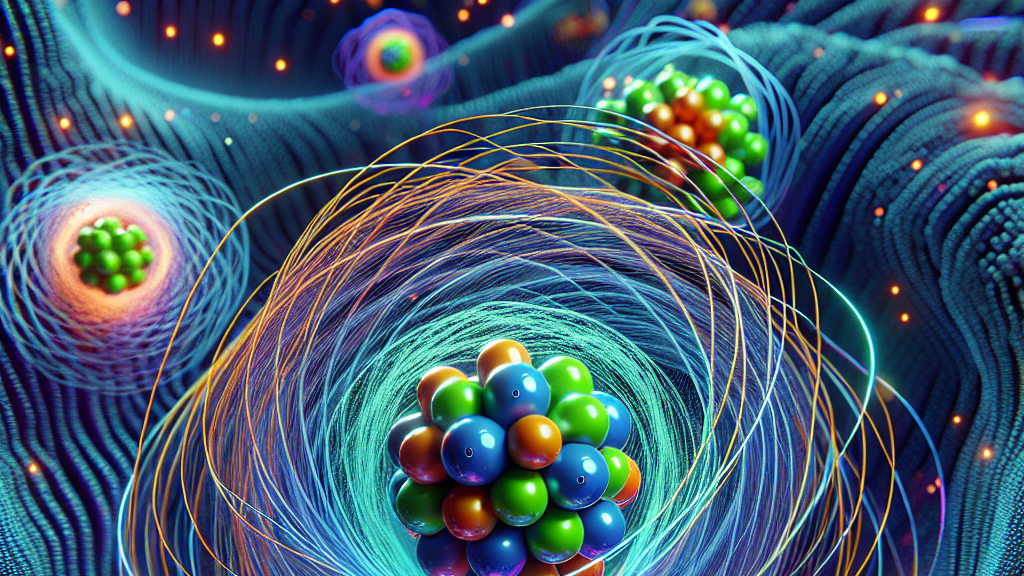
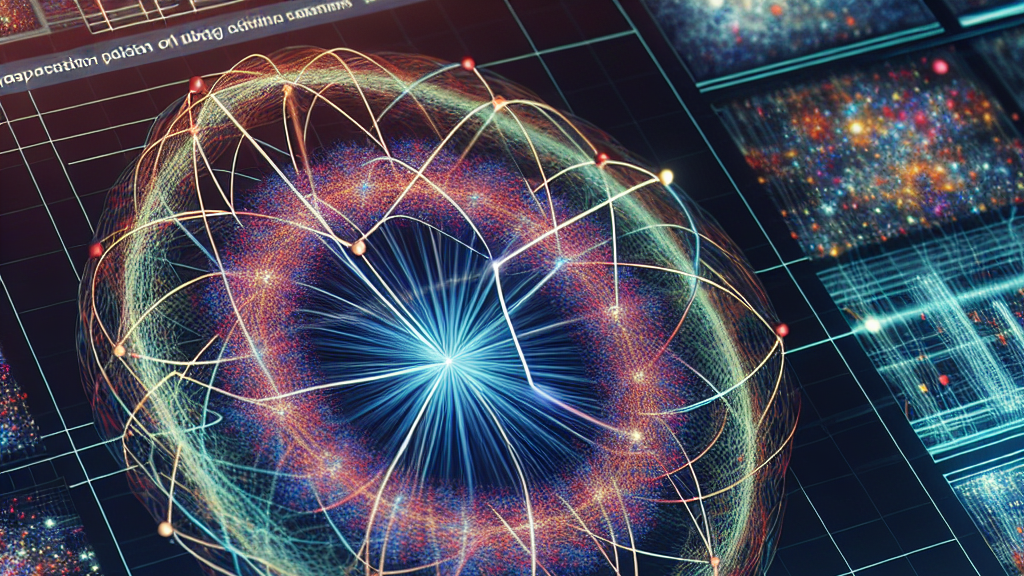
This research dives deep into the world of particle physics to explore the tantalizing idea of a ‘Spaghetti of Quarks with Glueballs.’ In this phase, quarks—tiny particles that make up protons and neutrons—move freely, while gluons, the particles that usually stick quarks together, remain confined in structures known as glueballs. Researchers used complex lattice QCD simulations to explore this phenomenon, creating a new phase diagram that includes this SQGB phase. By examining the range of temperatures from 160 to 285 MeV, they’ve been able to identify this potential new phase, adding to our understanding of how matter works at the subatomic level.

Imagine if future technologies could harness this mysterious phase, leading to advances in materials science or nuclear energy. The implications of understanding this phase of matter extend far beyond theoretical physics; it could pave the way for practical applications we have yet to dream of. The idea that there’s a cosmic ‘spaghetti’ phase hidden in plain sight speaks to the endless wonders of our universe, waiting to be discovered.

Did you know? At extremely high temperatures, matter could exist in a state that behaves like spaghetti, called the ‘Spaghetti of Quarks with Glueballs’!

FAQs

What is the ‘Spaghetti of Quarks’ phase?

This intriguing phase is a proposed state of matter where quarks move freely, similar to a soup, while gluons remain confined in glueball structures. It’s a bridge between two known states of matter, offering new insights into particle physics.

How do scientists study the ‘Spaghetti of Quarks’ phase?

Researchers use advanced lattice QCD simulations to explore how this spaghetti-like phase behaves, particularly focusing on temperatures between 160 and 285 MeV to understand its properties and transitions.

Why is the discovery of the ‘Spaghetti of Quarks’ phase important?

Identifying this phase adds a new layer to our understanding of the universe’s structure, potentially leading to breakthroughs in materials science and energy. It shows how complex and fascinating the subatomic world can be.

Background

The research revolves around understanding different phases of matter at the subatomic level. Scientists describe certain phases using the temperature (measured in million electronvolts) and how particles like quarks and gluons behave at these temperatures. Quarks, part of protons and neutrons, and gluons, the particles that bind them, show different behaviors depending on temperature, leading to different states of matter.

History

You may not remember, but the concept of a Quark-Gluon Plasma (QGP) is not new. For decades, researchers have known that when matter is extremely hot, the particles within exist in a soup-like state. This study builds on previous findings to suggest an intermediary, Spaghetti of Quarks with Glueballs state, which was not clearly understood before.

Based on “A New State of Matter between the Hadronic Phase and the Quark-Gluon Plasma?” by Yuki Fujimoto, Kenji Fukushima, Yoshimasa Hidaka, Larry McLerran, available on arXiv (arxiv.org/abs/2506.00237), used under CC BY 4.0 (creativecommons.org/licenses/by/4.0/).

Trending

Latest

Can AI Save Water Discover How

Computers

AI is transforming the tech world, but it uses lots of water! A new tool, SCARF, helps us measure and reduce AI's water footprint,...

Whats a Forbush Decrease and Why Should We Care Whats a Forbush Decrease and Why Should We Care

Space

Scientists just observed the biggest solar storm event in years, revealing unexpected cosmic ray patterns. Understanding these changes could help us protect our technology...

Can Cars Spot Danger Faster Than Humans Can Cars Spot Danger Faster Than Humans

Computers

Think about how quickly you react when something unexpected happens on the road. This research brings us closer to creating self-driving cars that can...

Can Fear of the Other Stop Social Harmony Can Fear of the Other Stop Social Harmony

Physics

Fear of the unknown might make it harder for people to agree and get along. This study shows that when people have strong xenophobic...

Can AI Revolutionize Breast Cancer Diagnosis Can AI Revolutionize Breast Cancer Diagnosis

Electricity

This research introduces a groundbreaking AI model that can accurately assess HER2-positive breast cancer using widely accessible staining methods, potentially revolutionizing how we diagnose...

Can AI Transform Your Singing into a Choir Can AI Transform Your Singing into a Choir

Computers

Imagine singing solo and having AI turn you into a choir. This research unveils a groundbreaking AI tool that transforms your voice into rich...

You May Also Like

Physics

Scientists have discovered that an ultra-light version of a mysterious particle called the axion could significantly alter the behavior and appearance of neutron stars,...

Physics

Scientists have found a way to better understand mysterious photon signals in hot plasma without getting tangled up in complex equations, potentially solving unsolved...

Nuclear Theory

Exploring the quark-gluon plasma lets us peek into the universe's earliest moments, offering insights into the fundamental forces at play and potentially unlocking breakthroughs...

Nuclear Theory

Discover how smashing ions together at incredible speeds helps scientists unlock the mysteries of the universe by creating and studying a new, exotic form...

Physics

Scientists are uncovering the mysterious internal structure of exotic particles called hidden-charm pentaquarks, which might help revolutionize our understanding of the universe and the...

Physics

This research uncovers the surprising way particles behave in super-hot quark 'soups' created during heavy-ion collisions, challenging previous beliefs about their sound-like behavior and...

Physics

Scientists are exploring tiny collisions to understand how quark-gluon plasma, a mysterious state of matter, forms. These small crashes could unlock secrets of the...

Physics

This research uses powerful AI tools to solve one of the biggest mysteries in physics—understanding how quarks, the building blocks of matter, interact with...

Physics

Quantum computers could revolutionize how we study the tiny particles in jets like quarks and gluons, making future technologies faster and more efficient.

Copyright © 2024 8ig8rain.

Disclaimer: The content on 8ig8rain.com consists of AI-generated summaries of scientific abstracts from arXiv. Please note that most arXiv abstracts are preprints and may not have undergone formal peer review. While these summaries aim to convey key ideas and potential applications, they are provided for informational purposes only and should not be interpreted as validated scientific findings or professional advice. The summaries are intended to educate, spark curiosity, and inspire further exploration of science.