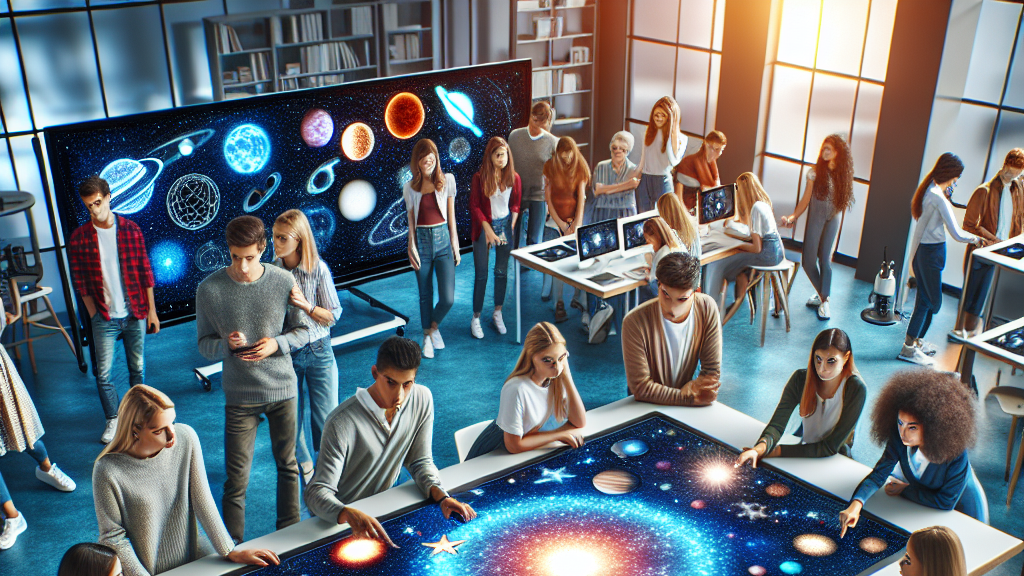
Have you ever wondered how AI could change the way we learn, especially in subjects like astronomy? Imagine a classroom where instead of just traditional textbooks, students have access to an AI-powered tutor that helps them engage with complex concepts and provides detailed feedback, making learning not only faster but more personalized. This isn’t just a dream; it’s being tested in real educational settings, and it’s making waves in how students interact and learn.
Researchers have embedded AI into an astronomy course, creating a system called AstroTutor, which uses large language models and curated content to assist students. As these students progress, they don’t just learn about stars and galaxies; they also develop skills in using AI, becoming more tech-savvy and capable of critically evaluating information. By comparing traditional grading and AI-assisted evaluation, the researchers found that AI could provide consistent and detailed feedback, aiding in personalized learning experiences that cater to individual student needs.
Why should you care? Because integrating AI into classrooms could fundamentally reshape education, making it more engaging and efficient. Imagine exams tailored to your learning style, feedback that helps you improve instantly, and a classroom experience that feels more like a futuristic learning adventure. With AI, the future of education is here, and it’s something we might all soon experience, whether we’re in a classroom or learning from home.
Did you know that some students initially using AI help reduce their reliance on it over time by developing better critical thinking skills?
FAQs
What impact does AI integration have on astronomy education?
AI integration, through systems like AstroTutor, revolutionizes astronomy education by offering detailed feedback and fostering critical evaluation skills, making learning more personalized and efficient.
How do students benefit from AI-powered tools in their studies?
Students using AI-powered tools like AstroTutor enhance their learning experiences by developing effective AI literacy skills, which include better prompting strategies, critical thinking, and verification techniques.
Can AI replace traditional grading in classrooms?
AI shows strong potential in providing consistent and detailed feedback similar to human grading, offering a scalable alternative that can enhance student evaluation processes without fully replacing human graders.
How does the AI system AstroTutor assist students?
AstroTutor assists students by offering curated, domain-specific content and detailed feedback throughout the semester, helping them develop strategic AI use and critical evaluation capabilities.
What are the long-term implications of using AI in education?
Long-term, AI in education can lead to more personalized learning experiences, enhanced critical thinking skills, and improved student engagement, transforming how education is delivered globally.
Background
Large language models (LLMs) like those used in AstroTutor are AI systems designed to understand and generate human language based on vast amounts of text data. In education, these models can provide personalized feedback, support learning, and assist with complex problem-solving, offering a new layer of interactivity and tailor-made support to students.
History
This research builds on the growing field of educational technology, particularly the integration of AI in classrooms. It follows previous studies that have explored AI’s role in personalized learning and assessment, further advancing by utilizing domain-specific content to tailor educational experiences to fields such as astronomy.
Based on “Teaching Astronomy with Large Language Models” by Yuan-Sen Ting, Teaghan O’Briain, available on arXiv (arxiv.org/abs/2506.06921), used under CC BY 4.0 (creativecommons.org/licenses/by/4.0/).