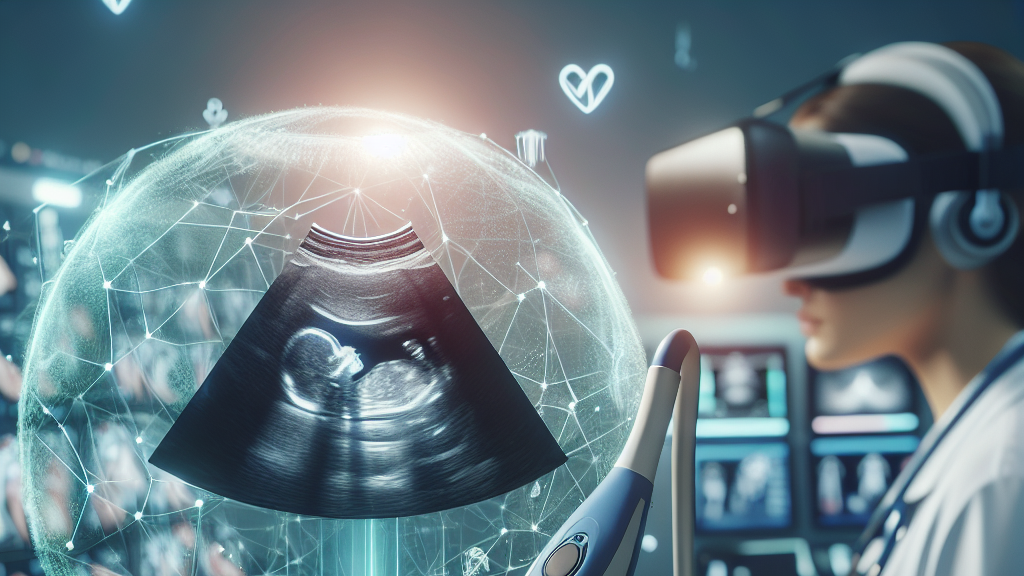
What if your doctor could give you an ultrasound without being in the same room—or even the same city? Thanks to a groundbreaking new system, that’s not just a futuristic fantasy but a reality. Imagine sitting in a small community health center and having an expert sonographer from a big city perform your ultrasound through virtual reality. It’s like being in two places at once, and it’s a game-changer for remote communities that don’t have easy access to specialized medical care.
Here’s how it works: a local healthcare worker, even if they’re not an ultrasound expert, can wear a virtual reality headset and feel like they’re actually performing the ultrasound. Meanwhile, an expert sonographer, sitting miles away, sees exactly what the local worker sees. They guide the worker to capture images of the patient’s abdomen with pinpoint precision. To make this work, the system uses clever tech like force sensors and a virtual model of the patient, so the local worker knows just how much pressure to apply.
Why does this matter? The possibilities are huge! Imagine communities in remote areas finally being able to access vital ultrasound exams without having to travel hours or days to see a specialist. This means quicker diagnoses, faster treatment options, and better health outcomes. In the future, this could be the norm for medical check-ups in places that are hard to reach or have limited resources. It’s not just about convenience; it’s about saving lives by bringing essential healthcare services to everyone, everywhere.
Did you know? This virtual ultrasound system can effectively work from more than 750 kilometers away!
FAQs
How can virtual reality enhance ultrasound capabilities?
Virtual reality can enable a remote expert to guide a novice in performing accurate ultrasound scans, thus providing critical diagnostic capabilities to remote areas without direct access to a sonographer.
What makes the ultrasound system effective in remote areas?
The system uses haptic feedback and a virtual model of the patient to guide non-expert users in capturing high-quality ultrasound images, enabling effective remote diagnostics.
Why is tele-ultrasound revolutionary for remote communities?
Tele-ultrasound allows for the delivery of essential medical services to remote communities by eliminating the need for specialized personnel on site, thus bridging gaps in healthcare accessibility.
Can anyone use this tele-ultrasound system?
While the system is designed to be used by novices, it still requires some basic training to effectively capture the necessary ultrasound images under the guidance of a remote expert.
How accurate are the images captured using remote ultrasound systems?
In the study, 92% of the images captured remotely were deemed of sufficient quality by radiologists, demonstrating the system’s capability for accurate remote diagnostics.
Background
Ultrasound uses sound waves to create images of organs inside the body. Traditionally, it’s conducted by a trained professional who must be physically present. However, in remote places without nearby specialists, getting such exams is challenging. This research uses virtual reality and haptic feedback—where a person feels the correct pressure and position through a device—to allow someone with less expertise to conduct an ultrasound under the guidance of a distant expert. By providing real-time feedback and visualization, it becomes possible to perform these important medical exams remotely.
History
The idea of remote medical assistance isn’t new. Telemedicine has been around for years, primarily in the form of video consultations. However, doing something as hands-on as an ultrasound remotely is quite complex. Previous attempts have tried using robots or other mechanical aids, but this study leverages high-tech solutions like virtual reality and haptics to allow a human to effectively become a ‘cognitive robot’—performing tasks under expert guidance but without the rigidity and complexity of traditional robotic systems.
Based on “Mixed Reality Tele-Ultrasound over 750 km: A Feasibility Study” by Ryan Yeung, David Black, Patrick B. Chen, Victoria Lessoway, Janice Reid, Sergio Rangel-Suarez, Silvia D. Chang, Septimiu E. Salcudean, available on arXiv (arxiv.org/abs/2409.13058), used under CC BY 4.0 (creativecommons.org/licenses/by/4.0/).