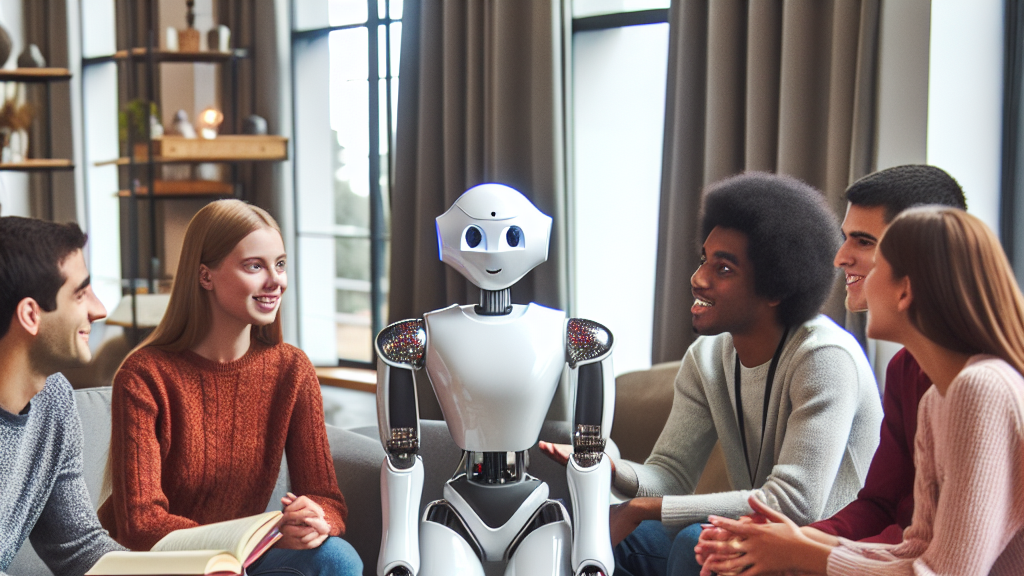
Can you imagine learning a new language with the help of a robot that speaks to you just like a lively friend? That’s the future we’re looking at with the latest research in robot voices. Scientists are developing special voices for robots that can adapt to different environments and make language learning more interesting and effective.
The research focuses on a technology called text-to-speech, which allows robots to talk just like humans. These robots are not only able to speak clearly but can also change the way they sound depending on the situation, like using a higher pitch in noisy places. Scientists even fine-tuned a system to help people who are learning English as a second language by focusing on how their ears interpret different vowel sounds.
In the future, this could mean that language learning in schools or at home could be even more exciting and personalized. Imagine having a robot assistant that can adjust its tone when reading you a story or speaking slowly to help you understand challenging words. It’s like having a teacher that tailors their lessons to your needs, making learning both fun and effective!
Did you know? Robots can adapt their voice to match the noise level of the room, making them sound more like they’re really ‘there’ with you!
FAQs
What is the focus of this robot language teaching research?
The research explores how robots can use expressive, synthesized voices to effectively teach languages by fine-tuning text-to-speech technology for language learners, making it more engaging and understandable.
How do robots adjust their voice in different environments?
Robots can modify their pitch and rate to suit the surrounding environment, such as increasing their pitch in noisy areas to make their speech more audible and contextually appropriate.
How does this research improve English learning for non-native speakers?
The study focuses on tailoring robot voices to help English learners understand difficult vowel sounds by adjusting vowel duration, making it easier for learners to distinguish between similar sounds.
Why are expressive robot voices important for language teaching?
Expressive robot voices make learning more engaging and effective by simulating human-like interaction, keeping learners interested, and providing clearer, more understandable speech.
What is an ‘L2 clarity mode’ in this research?
The ‘L2 clarity mode’ is a feature of the voice system designed to make English learning easier for non-native speakers by applying specific adjustments to vowel durations, enhancing clarity and comprehension.
Background
At the heart of this research is text-to-speech (TTS) technology, which allows computers and robots to convert text into spoken words. The study aims to make these voices more human-like and expressive, particularly for teaching languages. By adjusting pitch, speed, and vowel duration, the research seeks to make robot speech more contextually aware and clear for language learners, especially those learning English as a second language.
History
Teaching languages with technology has a rich history, with early attempts using cassette tapes and recorded lessons. The advent of computers and artificial intelligence brought about computer-assisted language learning programs, but these often lacked the natural touch of human interaction. This study builds on previous developments by offering a more interactive and customized approach through expressive robot voices that adapt to the learner’s needs and environment.
Based on “I Know You’re Listening: Adaptive Voice for HRI” by Paige Tuttósi, available on arXiv (arxiv.org/abs/2506.15107), used under CC BY 4.0 (creativecommons.org/licenses/by/4.0/).