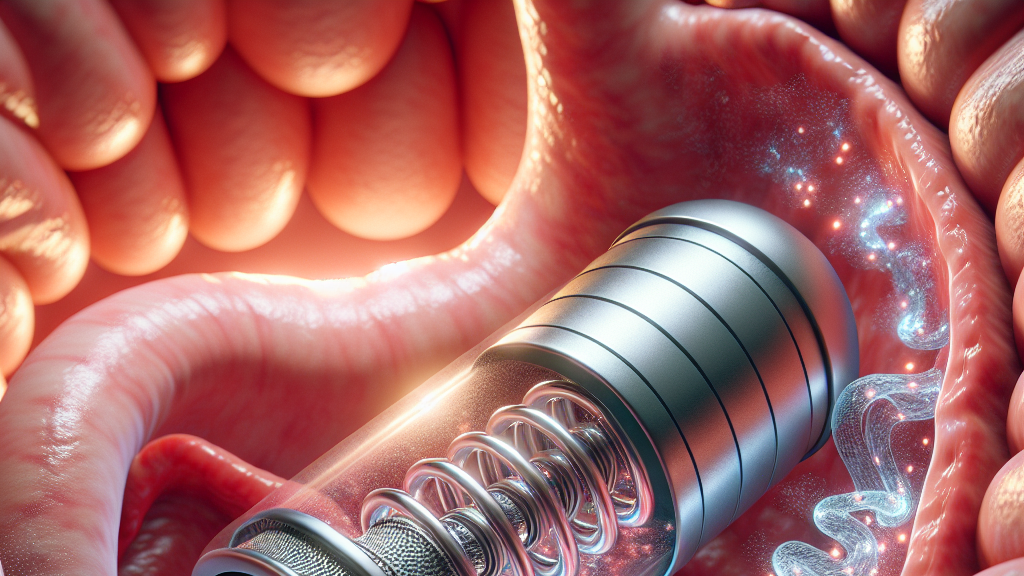
Imagine a tiny robot inside your stomach, powered without any batteries. Sounds like science fiction, right? Well, it’s becoming reality! This groundbreaking research introduces a wireless power transfer system within a robotic capsule that doctors can guide through your stomach to look for issues. The best part? It doesn’t even need batteries, making procedures safer and more efficient.
Behind this mind-boggling innovation is a technology called inductive wireless power transfer. Think of it like setting your phone on a charging pad, but instead, it’s a tiny capsule navigating your stomach. By using a robotic arm with a special transmitting coil, the system sends power directly to the capsule. This space-saving marvel not only powers the robotic capsule but also lets doctors precisely control its journey inside your body using magnetic fields.
This isn’t just cool technology for the sake of it; it has real-world implications! Imagine doctors having a more reliable, safer way to inspect your stomach without invasive procedures. By eliminating the need for batteries, these capsules could stay inside longer to gather extensive data, paving the way for quicker, more accurate diagnoses of gastrointestinal diseases. It could even make a trip to the doctor’s office more pleasant and effective!
Did you know? This tiny, battery-free robot can wirelessly receive up to 110 milliwatts of power inside your body!
FAQs
How does this wireless power transfer system work in a robotic capsule?
The wireless power transfer system uses resonant inductive coupling, where a coil on a robotic arm sends power to a coil inside the capsule. This allows the robotic capsule to perform tasks without needing a battery, making it lighter and more efficient for medical procedures.
Why is battery-free operation important for robotic capsules?
Battery-free operation is crucial because it reduces the size and weight of the capsule, making it easier to swallow and less invasive. It also extends the capsule’s operational time, allowing it to gather more data during medical examinations without needing frequent replacements.
What safety measures are in place for this wireless system inside the body?
To ensure safety, the system includes a closed-loop adaptive control that adjusts the power dynamically to maintain efficiency while adhering to specific absorption rate (SAR) safety limits. This means the power transferred is safe for human tissues and does not cause harmful heating or effects.
How effective is this technology in real conditions?
This technology has been tested through experiments in a live animal model, showing reliable power transfer and effective navigation in conditions similar to the human gastrointestinal tract. It demonstrated stable power delivery, even with varying rotation angles of the capsule.
Could this technology be used for other medical applications?
Absolutely, this wireless power technology could be adapted for various medical devices that require internal power supply without batteries. Its potential spans across different fields of medicine, offering new ways to perform diagnostics and treatments in a less invasive manner.
Background
Inductive wireless power transfer is a method where energy is sent from one coil to another without physical connections. It’s mainly used in charging devices like electric toothbrushes or smartphones wirelessly. In this study, the concept is being utilized inside the body, integrated into a tiny robot called a capsule endoscope. It also includes a control system that ensures the power is adjusted for optimal performance while staying within safe limits for human tissues.
History
Capsule endoscopy first emerged as a significant leap in gastrointestinal diagnostics, allowing doctors to view the digestive tract from the inside. Early versions used small batteries, limiting their operational time and adding weight. Previous studies laid the groundwork for magnetically controlled capsules, but until now, integrating wireless power transfer in such tiny devices remained a challenge. This study expands on past advancements by successfully integrating a powerful and precise control mechanism, ensuring that the capsule remains powered and operational without a battery.
Based on “In vivo validation of Wireless Power Transfer System for Magnetically Controlled Robotic Capsule Endoscopy” by Alessandro Catania, Michele Bertozzi, Nikita J. Greenidge, Benjamin Calme, Gabriele Bandini, Christian Sbrana, Roberto Cecchi, Alice Buffi, Sebastiano Strangio, Pietro Valdastri, Giuseppe Iannaccone, available on arXiv (arxiv.org/abs/2503.12850), used under CC BY 4.0 (creativecommons.org/licenses/by/4.0/).