Connect with us

Search by keyword

Computers

How Robots Are Learning to Follow Our Directions

Imagine robots following your spoken directions to create complex patterns. This research blends language understanding with robotics, allowing multiple robots to move in harmony just by understanding what humans say.

How Robots Are Learning to Follow Our Directions
✨Researched by humans. Explained by robots. Learn more.

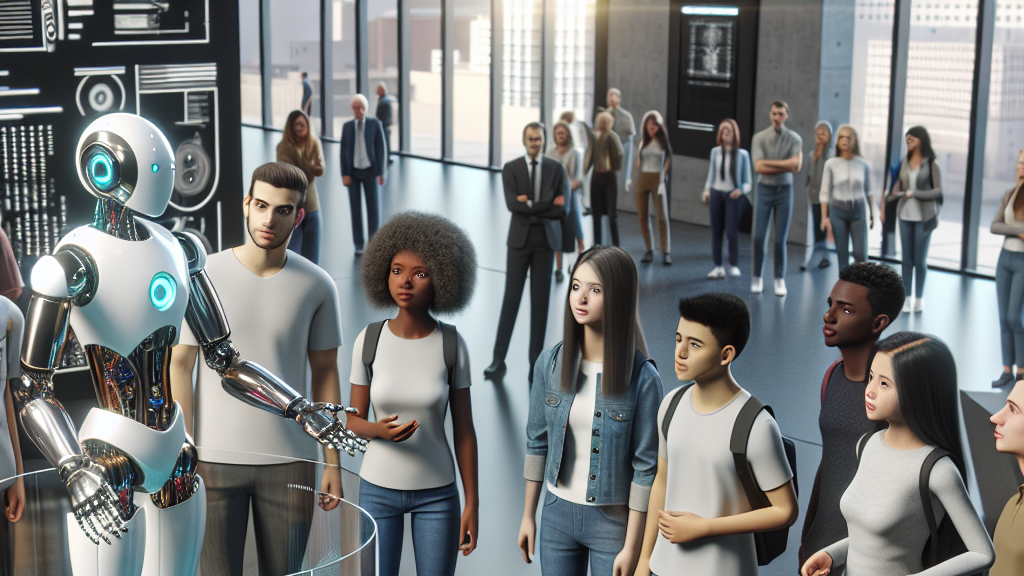
Ever dreamt of commanding a group of robots to perform complex tasks just by speaking to them? That’s becoming a reality! Researchers have developed a system where robots can understand and act on human language to form patterns, a task as tricky as it sounds.

The magic behind this innovation is a system called ZeroCAP. It uses smart language models that help robots interpret what we say and convert it into real-world actions. These robots can now coordinate with each other to form patterns, like surrounding an object or filling in a space, all based on our instructions. It’s like having a team of assistants who understand not just your words but also the context behind them.

Imagine being at a concert and directing a fleet of drones to create specific formations for a light show, just by telling them what to do. This could change how we interact with technology in daily life, from entertainment to construction, by making robotic systems more intuitive and adaptable to our needs.

Did you know? With current technology, robots can interpret human language and work together to form complex shapes and patterns!

FAQs

How does the ZeroCAP system help robots understand language?

ZeroCAP uses advanced language models to translate human spoken instructions into commands that robots can follow, enabling them to perform tasks based on context and spatial orientation.

What makes pattern formation challenging for robots?

Pattern formation involves spatial awareness and coordination among multiple robots, tasks that require understanding of both language and environment to execute accurately without prior examples.

Can robots with ZeroCAP form patterns in real-world scenarios?

Yes, ZeroCAP has shown proficiency in executing context-aware pattern formations across various tasks, proving its adaptability in real-world environments.

Why is language conditioning important in robotics?

Language conditioning allows robots to understand and interpret human intentions more naturally, opening up new possibilities for human-robot interaction and collaborative tasks.

What are potential applications of this research in everyday life?

This technology could revolutionize areas such as automated event management, smart construction sites, and even personalized home automation systems, making interactions with robots seamless and intuitive.

Background

The core idea here is language-conditioned robotics. It combines the interpretative capabilities of language models, which are like super-smart computer programs that understand human language, with robotic operations. This is important because while robots can perform a lot of tasks, getting them to understand and follow complex human instructions—especially in dynamic environments—is a real game-changer.

History

Robotics has been evolving from the days of simple, pre-programmed machines to advanced systems capable of learning new tasks. Earlier, robots needed specific programming for every action, but recent developments in artificial intelligence, particularly in language models, have allowed them to interpret natural language instructions. This study builds on those advances by integrating them into multi-robot systems, showcasing a significant leap from task-specific robots to those capable of complex coordination by understanding human language.

Based on “ZeroCAP: Zero-Shot Multi-Robot Context Aware Pattern Formation via Large Language Models” by Vishnunandan L. N. Venkatesh, Byung-Cheol Min, available on arXiv (arxiv.org/abs/2404.02318), used under CC BY 4.0 (creativecommons.org/licenses/by/4.0/).


Trending

Latest

Can AI Save Water Discover How

Computers

AI is transforming the tech world, but it uses lots of water! A new tool, SCARF, helps us measure and reduce AI's water footprint,...

Whats a Forbush Decrease and Why Should We Care Whats a Forbush Decrease and Why Should We Care

Space

Scientists just observed the biggest solar storm event in years, revealing unexpected cosmic ray patterns. Understanding these changes could help us protect our technology...

Can Cars Spot Danger Faster Than Humans Can Cars Spot Danger Faster Than Humans

Computers

Think about how quickly you react when something unexpected happens on the road. This research brings us closer to creating self-driving cars that can...

Can Fear of the Other Stop Social Harmony Can Fear of the Other Stop Social Harmony

Physics

Fear of the unknown might make it harder for people to agree and get along. This study shows that when people have strong xenophobic...

Can AI Revolutionize Breast Cancer Diagnosis Can AI Revolutionize Breast Cancer Diagnosis

Electricity

This research introduces a groundbreaking AI model that can accurately assess HER2-positive breast cancer using widely accessible staining methods, potentially revolutionizing how we diagnose...

Can AI Transform Your Singing into a Choir Can AI Transform Your Singing into a Choir

Computers

Imagine singing solo and having AI turn you into a choir. This research unveils a groundbreaking AI tool that transforms your voice into rich...

You May Also Like

Computers

What if talking to a robot could feel as comforting as a therapy session? This research uncovers the striking similarities between human therapists and...

Computers

This research explores how artificial intelligence language-powered robots might think they're seeing things that aren't actually there. Investigating this quirk could lead to more...

Computers

Imagine robots and humans interacting like friends! This research reveals how we can study such interactions in real-life settings like museums. The insights could...

Computers

What if robots could ditch cords and cables and move freely just by using light? This mind-blowing research reveals a new way to power...

Computers

This research explores how robots that understand and act on both vision and language can be tricked into doing things they shouldn't, revealing potential...

Computers

Imagine robots that can move as easily across rocky landscapes as they do on flat ground. New research shows a cutting-edge method that helps...

Computers

Researchers found that people reveal personal information to robots and AI in similar ways as they do to humans. This insight might help improve...

Computers

Ever wondered if robots can dodge sneaky challenges on their paths? This study shows how unexpected obstacles can mess with a robot's travel plans...

Nonlinear Sciences

Ever wondered how chaos leads to order? Scientists are exploring the mesmerizing transition of random particles into stunning patterns. This research could unlock secrets...

Copyright © 2024 8ig8rain.

Disclaimer: The content on 8ig8rain.com consists of AI-generated summaries of scientific abstracts from arXiv. Please note that most arXiv abstracts are preprints and may not have undergone formal peer review. While these summaries aim to convey key ideas and potential applications, they are provided for informational purposes only and should not be interpreted as validated scientific findings or professional advice. The summaries are intended to educate, spark curiosity, and inspire further exploration of science.