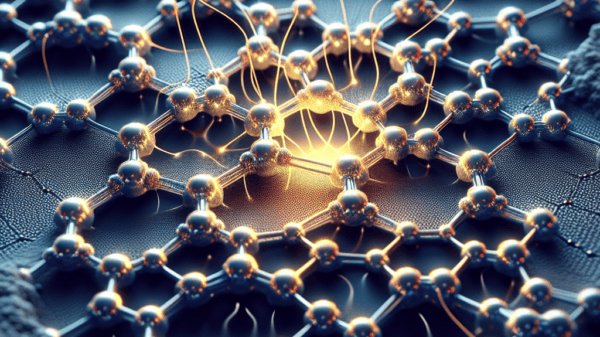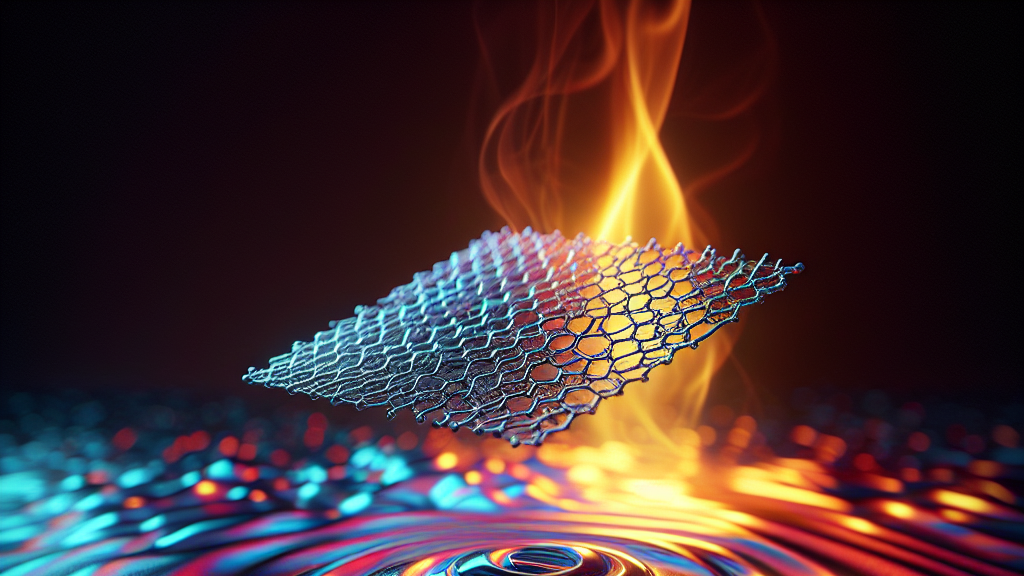
Imagine a sheet of material so thin it’s practically two-dimensional, delicately dancing on a pool of liquid metal. That’s what scientists achieved with graphene, a super-strong and incredibly thin material, known for its exciting potential. They discovered that the forces at play resemble those of the Casimir effect—a strange quantum phenomenon that makes objects mysteriously attract each other without touching.
In their research, scientists observed how graphene sheets move and come together to form seamless layers on molten metals like gold and copper. This is not just any movement; it’s guided by the invisible ‘Casimir-like’ forces, which are like a pair of ghostly hands orchestrating a dance. By understanding these forces, scientists can control how these sheets assemble, leading to perfectly stitched layers that could revolutionize materials used for electronics, displays, or even solar panels.
Imagine future screens that are paper-thin yet unbreakable, or batteries that last longer and charge faster than ever. This research is like a treasure map, pointing us towards new innovations that could change our everyday gadgets and the tech industry as a whole. The potential applications of this dance of graphene could redefine how we live and interact with technology, making once futuristic ideas a part of our daily lives.
Did you know? The Casimir effect can make objects attract each other even if they’re separated by a vacuum.
FAQs
What is the Casimir effect, and how does it relate to graphene?
The Casimir effect is a mysterious quantum phenomenon where two objects experience a force even when they’re not in touch. In the research, this force is seen in how graphene sheets spontaneously self-assemble on molten metals, guided by Casimir-like effects.
How does this research impact everyday technology?
The findings could lead to major advancements in creating stronger, thinner, and more efficient electronic devices. Imagine future gadgets with screens that are indestructible or batteries that last significantly longer.
Why is graphene important in material science?
Graphene is incredibly strong, light, and conducts electricity better than copper. Its uses in technology, from electronics to energy storage, can revolutionize how we build and use devices.
How does the behavior of graphene on molten metals differ from that on solids?
On molten metals, graphene exhibits movement and seamless self-assembly due to the Casimir-like forces at play, unlike on solid surfaces where such behavior isn’t observed.
What’s the significance of seamless stitching of graphene layers?
Seamlessly stitched graphene layers mean stronger, unbroken sheets that can be used in next-gen materials for electronics and energy, enhancing their performance and durability.
Background
The Casimir effect is a fascinating quantum phenomenon where two uncharged, parallel surfaces attract due to changes in vacuum energy between them, first explained by physicist Hendrik Casimir in 1948. For graphene, this research investigates similar forces acting on 2D layers on molten metals, facilitating its self-assembly in ways that could revolutionize how we use this material.
History
Since the discovery of graphene, researchers have been exploring its unique properties, like its incredible strength and conductivity. Building on past breakthroughs in material science and quantum mechanics, this study delves into the Casimir effect and applies it to graphene, linking past theories with today’s high-tech applications.
Based on “Casimir-like effect driven self-assembly of graphene on molten metals” by Kristýna Bukvišová, Radek Kalousek, Marek Patočka, Jakub Zlámal, Jakub Planer, Vojtěch Mahel, Daniel Citterberg, Libor Novák, Tomáš Šikola, Suneel Kodambaka, Miroslav Kolíbal, available on arXiv (arxiv.org/abs/2503.04327), used under CC BY 4.0 (creativecommons.org/licenses/by/4.0/).