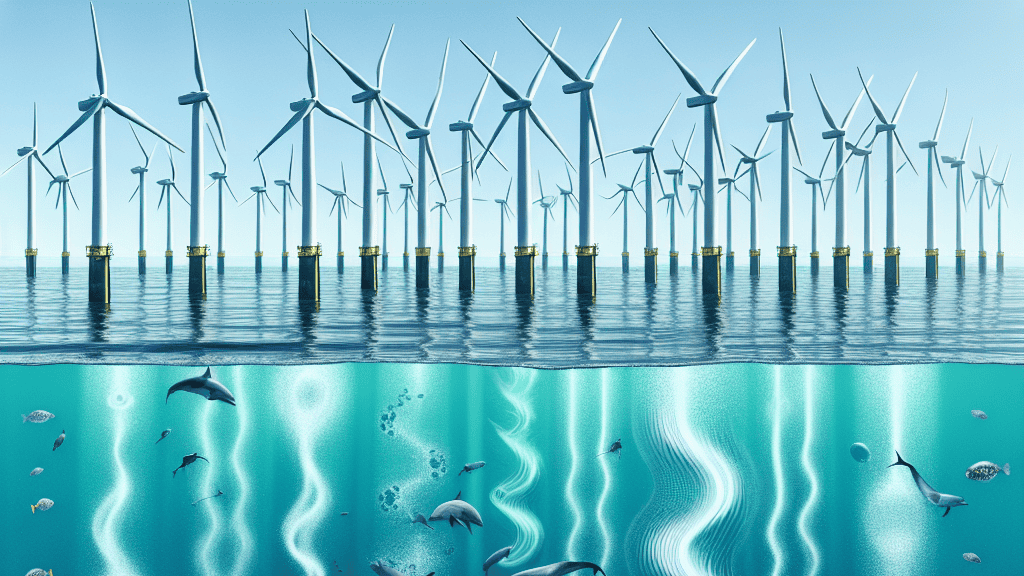
As we race toward harnessing wind energy to meet our growing electricity demands, there’s a fascinating yet worrying side effect brewing beneath the sea. Imagine enormous wind turbines, larger than most buildings, standing amidst 100 others in the sea. These aren’t just powerful giants—they’re also potential noise-makers affecting the underwater world.
A new study has focused on understanding the noise emissions from large offshore turbines, some as mighty as 22 megawatts. Researchers analyzed how much noise they generate and how this might be heard by marine animals that live below the waves. The findings are quite surprising. When compared to the hearing ranges of sea creatures, these turbines can produce noise levels that might soon pose a severe issue.
What does this mean for the future? It isn’t about turning the turbines off but finding a balance. The study suggests that designers can use these insights to create quieter turbines or implement effective noise-reduction measures. If we succeed, we’ll continue to reap the benefits of wind energy without unintentionally harming the aquatic world that calls our oceans home.
Did you know that some marine animals can hear frequencies up to 200 kHz, much higher than any human can hear?
FAQs
How does wind turbine noise impact marine life?
The noise generated by large offshore wind turbines can reach frequencies that marine animals are sensitive to, potentially disrupting their communication and navigation.
What is the significance of this research on turbine noise?
This research helps in predicting and mitigating underwater noise, ensuring we keep harnessing wind energy without harming marine ecosystems.
Could offshore farms be too noisy for sea life?
Yes, as offshore farms grow larger with more powerful turbines, the cumulative underwater noise can become a concern for marine life sensitive to these frequencies.
What can be done to reduce turbine noise?
Turbine designers can use the research to develop quieter technologies and implement strategies to mitigate noise emission, promoting a balance between energy production and marine health.
Background
Wind turbines convert wind energy into electricity, increasingly important as we seek cleaner energy sources. Offshore turbines are placed in the sea and require larger sizes and numbers to maximize efficiency. This growth, however, raises concerns about the noise they produce underwater, affecting marine life that relies on sound for essential life functions.
History
Wind energy has advanced rapidly over the decades, starting on land and expanding offshore as technology allowed for bigger and more efficient turbines. The environmental impacts, especially underwater noise, have only recently become a focus, spotlighting the need for sustainable development strategies.
Based on “Can aerodynamic noise from large offshore wind turbines affect marine life?” by Laura Botero Bolívar, Oscar A. Muñoz, Martín de Frutos, Esteban Ferrer, available on arXiv (arxiv.org/abs/2501.12404), used under CC BY 4.0 (creativecommons.org/licenses/by/4.0/).