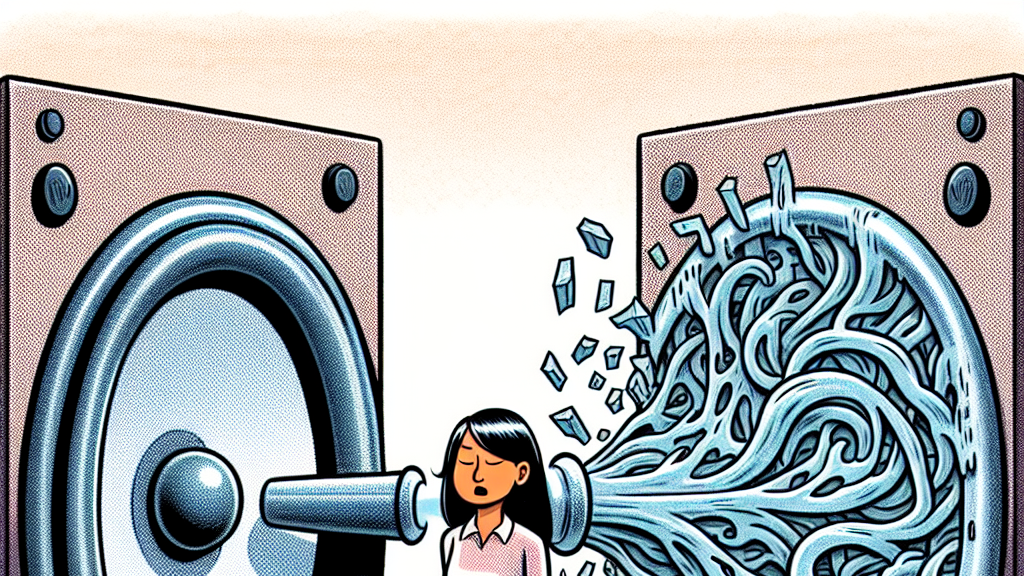
Imagine a world where the noise from fake news doesn’t just mislead us – it actually helps set us straight! Sounds backward, right? Well, researchers have uncovered that when real news is clear and loud enough, while the fake news is just as noisy with its disinformation, the end result might be a surprising twist: reinforcing the truth! Instead of making us believe something false, fake news can sometimes have the unintended effect of pointing us back in the right direction.
At the heart of this mind-bending finding is an intricate dance between information signals and noise. Picture two radio stations: one broadcasting clear, genuine news and the other spewing fuzzy, misleading signals. When the genuine source is strong enough, our brains can somehow sift through the static and find the right melody in the chaos, even if we aren’t aware of the noise’s intentions. This phenomenon gives us a fascinating peek into how we process the world around us, especially in today’s flood of information.
So, what does this mean for you? In a future where disinformation is rampant, strategies that ensure clarity and quality in genuine information might build our own mental immune systems against fake news. Imagine teaching kids to be smart listeners, tuning into the clearest signals even when they’re bombarded with noise. It’s like training our minds to pick out the best song even in a cacophony of sounds, ensuring we stay on the right path even when the information landscape is a bit topsy-turvy!
Surprisingly, when fake news is noisy enough, it can accidentally backfire and make the truth stand out even more!
FAQs
How does fake news sometimes reinforce the truth?
Fake news can backfire when the genuine information source is clear enough and the noise in the fake news is just as loud. Our brains can then focus on the truth, even if unintentionally.
What role does signal-to-noise ratio play in this phenomenon?
A strong signal-to-noise ratio from the genuine source ensures that true information stands out over the noisy disinformation, reversing its intended effect.
Can this effect be reliably used to counter disinformation?
While it can’t always be guaranteed, ensuring a clear and strong signal for real information can sometimes help counteract the effects of fake news.
How might this research affect media consumption habits?
Understanding this flip-flop effect might encourage people to seek stronger and clearer sources of genuine news, making them more resilient to disinformation.
What does this mean for the future of media literacy?
This research suggests that educating people to identify clear and genuine signals could be key in navigating the complex media landscape.
Background
This research hinges on understanding how information sources interact for a rational receiver. When signal-to-noise ratio is high, which means the true information is much clearer than any noise or disinformation, the intended effects of disinformation can get flipped. Positive correlation of noise means when the noise level in a disinformation source rises, it rises in the genuine one too, creating a situation where the truth stands out.
History
Over the years, the world has grappled with the impact of disinformation, from political campaigns to health misinformation. Earlier studies have focused on how fake news misleads people. This research diverges from previous findings by suggesting that, under certain conditions, fake news might reinforce the truth, offering a fresh perspective on the fight against misinformation.
Based on “How fake news can turn against its spreader” by Dorje C. Brody, Tomooki Yuasa, available on arXiv (arxiv.org/abs/2504.17820), used under CC BY 4.0 (creativecommons.org/licenses/by/4.0/).