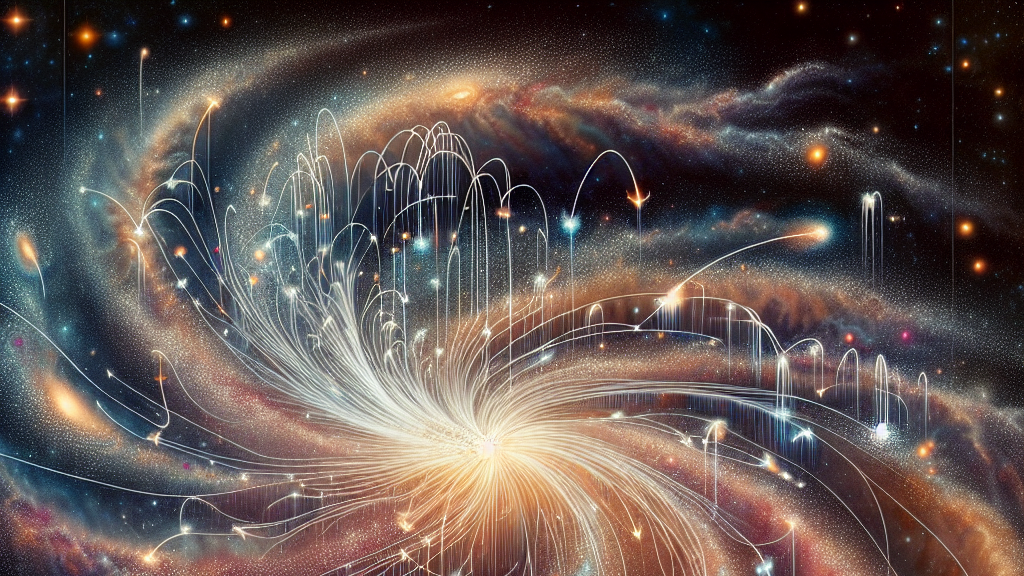
Imagine if tiny particles of dust could break free from a planet’s grip and journey across the galaxy, potentially carrying life as they travel. This isn’t just a sci-fi dream—scientists are looking into how these minuscule travelers, propelled by the pressure from stars’ radiation, might roam the cosmos and perhaps even spread life to other worlds.
The study suggests that given the right conditions, dust particles can gain enough momentum to escape not only a single planet’s gravity but also the entire star system they’re part of. Once free, these cosmic hitchhikers could potentially travel across the galaxy, reaching over 100,000 different star systems within 5 billion years. This ties into the panspermia theory, which suggests that life could be distributed throughout the universe via these space-traveling particles.
In the future, this research might help us understand not just the spread of life, but also the interconnected nature of stellar systems. For example, if a planetary dust particle carrying microbes lands on a hospitable planet, it could potentially seed life—just like planting a seed in fertile soil. This could either be the reason for existing life or a future possibility for spreading life across the galaxy, pushing our understanding of existence beyond our home planet.
Did you know that just like a sail catches the wind, dust particles can use star energy to sail through space?
FAQs
What is the main concept of planetary dust escaping a planet’s gravity?
The idea is that tiny dust particles can be pushed away from a planet by the pressure of radiation from a star, allowing them to travel across the galaxy.
How could planetary dust particles help spread life in the galaxy?
Through a process called panspermia, dust particles might carry microorganisms or organic compounds to other star systems, potentially initiating life if they land on a suitable planet.
How far can these dust particles travel, and why is it significant?
Over billions of years, these particles could reach up to 100,000 star systems. This journey highlights the interconnectedness of different planetary systems and raises fascinating possibilities about the distribution of life in the universe.
How does the Drake equation relate to this study on planetary dust?
The Drake equation estimates the number of active, communicative extraterrestrial civilizations in the Milky Way. The study suggests that with enough time, planetary dust could reach a significant portion of the galaxy, potentially influencing these estimates.
What could studying the dynamics of cosmic dust reveal about our galaxy?
Understanding how dust particles travel could offer insights into the spread of organic materials and life, the formation of planetary systems, and the evolution of galaxies.
Background
The concept revolves around ‘radiation pressure,’ the force exerted by a star’s light on small particles. This force can push dust particles, which are tiny fragments often found around planets and stars, out of the gravitational pull of their home planet. The research connects this to panspermia, a theory proposing that life can be distributed throughout the universe by space dust, meteoroids, or comets.
History
The idea of panspermia dates back to ancient Greek philosophy but gained scientific traction in the 19th century. Over the years, studies have suggested that life could travel across space, potentially supported by radiation pressure. This new study extends previous work by focusing on how tiny particles might navigate the vast distances between star systems.
Based on “The possibility for panspermia in the galaxy by means of planetary dust grains” by Z. N. Osmanov, available on arXiv (arxiv.org/abs/2402.04990), used under CC BY 4.0 (creativecommons.org/licenses/by/4.0/).