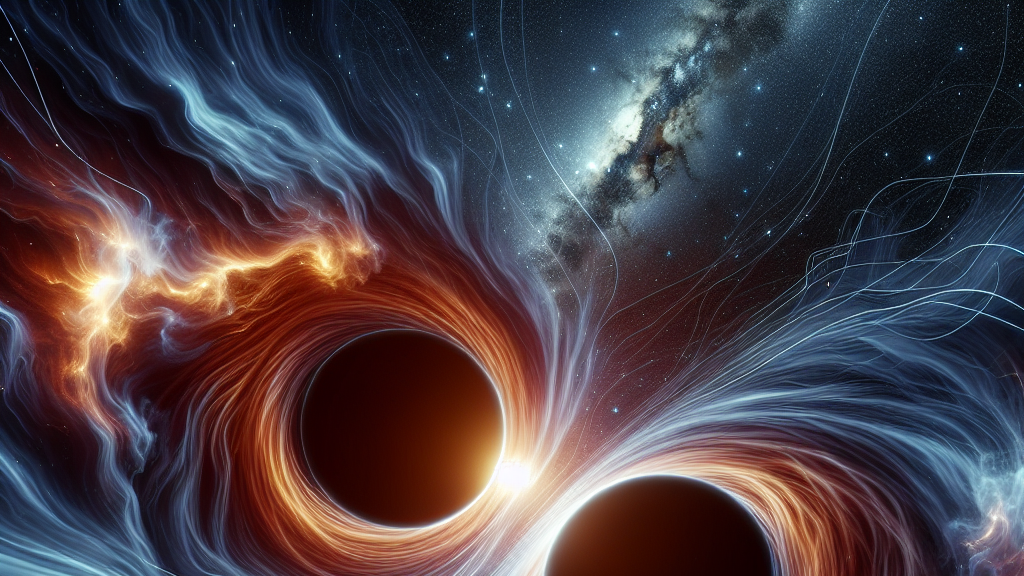
Imagine peering into the universe and uncovering secrets that have been hidden for millennia. That’s what scientists are doing as they explore the mysterious ballet of supermassive black hole binaries gobbling up matter, swirling around each other, and distorting the very fabric of space and time. These cosmic giants hold the key to understanding more than just black holes; they might help us uncover the universe’s deepest mysteries.
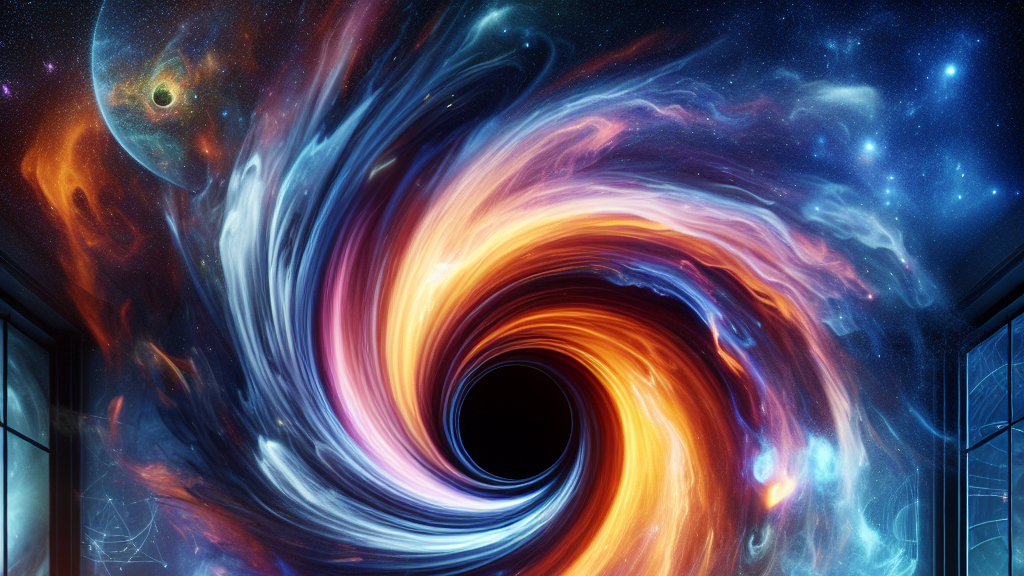
At the heart of this research lies a fascinating dance by supermassive black holes, draped in clouds of hot gas and magnetic fields. As these black holes orbit each other, they create eccentric, warped disks of matter and launch powerful, collimated magnetic outflows. It’s like watching two titans in a cosmic waltz, generating gravitational waves that next-generation space detectors aim to capture. These waves can tell us not only about the black holes themselves but also about the environment in which they thrive, contributing to a better understanding of cosmic evolution.
Imagine the potential of uncovering the hidden dynamics of these black hole pairs to predict or even manipulate cosmic events. Think about it—understanding their gravitational waves could revolutionize how we approach everything from space exploration to navigation in the galaxy. In a future where these cosmic dances are deciphered, we might even find new pathways to explore the vast universe or learn more about how our own galaxy was formed.
Did you know? Gravitational waves from black holes travel through the universe, warping time and space along the way!
FAQs
What are supermassive black hole binaries?
Supermassive black hole binaries are pairs of enormous black holes that orbit each other, often found at the centers of galaxies. These pairs are fascinating targets for studying gravitational waves as their interactions create ripples in space-time.
How do gravitational waves help us understand black hole behavior?
Gravitational waves are like cosmic messages that carry information about the movement and interactions of massive objects like black holes. By capturing these waves, scientists can learn about the properties and dynamics of black holes, unlocking mysteries of the universe.
Why are magnetic outflows significant in black hole study?
Magnetic outflows from black holes reveal insights into the complex environments around black holes. These outflows transport energy and matter, influencing how black holes evolve and interact with their surroundings, which is crucial for understanding cosmic evolution.
How might this black hole research affect future space exploration?
By understanding black holes and their gravitational waves, researchers could develop new technologies for space exploration, navigation, and even galaxy mapping, opening up new avenues for discovery and exploration in the universe.
What makes supermassive black holes exciting for future science?
The immense size and power of supermassive black holes make them crucial for studying fundamental questions about the universe, such as the nature of space-time and the evolution of galaxies, inspiring future generations of scientists.
Background
Black holes are regions in space where gravity is so strong that nothing, not even light, can escape. Supermassive black holes reside at the centers of galaxies and have masses millions to billions of times greater than our Sun. When two such black holes orbit each other, they form what is known as a binary. As they interact, these binaries give off gravitational waves—ripples in space-time that can be detected by advanced instruments. Understanding these waves helps scientists learn more about the nature of black holes and the universe as a whole.
History
The study of black holes has evolved from theoretical predictions in the early 20th century to direct observations in recent years. The detection of gravitational waves in 2015 opened new doors to studying these mysterious objects. Gravitational wave astronomy has become a key area of research, with scientists around the globe working to understand the cosmic phenomena that produce these waves. This study builds on past discoveries by exploring the complex environments and behavior of supermassive black hole binaries, a relatively new and exciting frontier in astrophysics.
Based on “Galactic-scale Feeding Reveals Warped Hypermagnetized Multiphase Circumbinary Accretion Around Supermassive Black Hole Binaries” by Hai-Yang Wang, Minghao Guo, Elias R. Most, Philip F. Hopkins, Aretaios Lalakos, available on arXiv (arxiv.org/abs/2504.03874), used under CC BY 4.0 (creativecommons.org/licenses/by/4.0/).