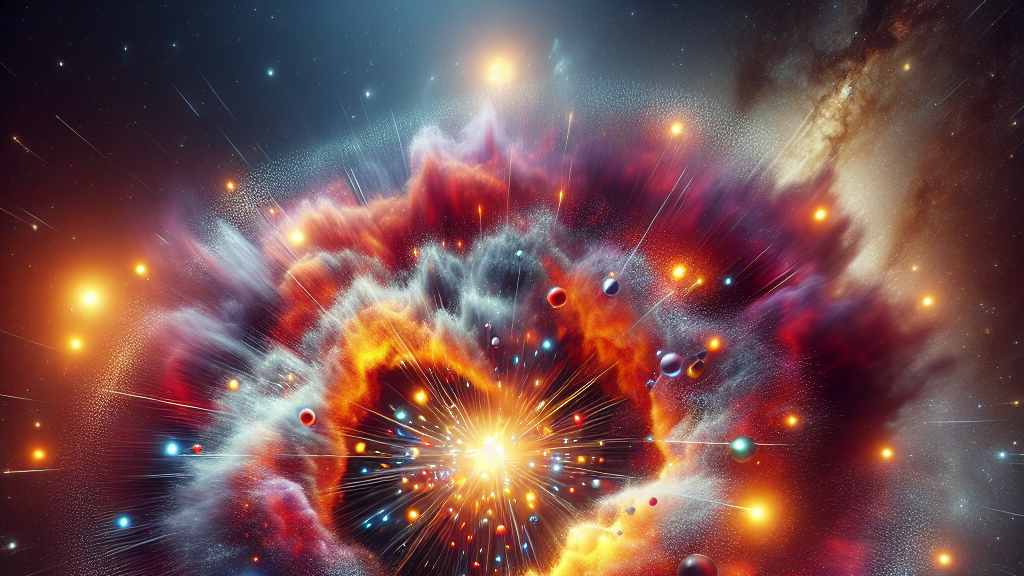
Did you know that planets like Earth might have been forming long before galaxies even existed? That’s right! Recent research has shown that right after massive cosmic explosions called primordial supernovae, the very first pieces of planet-like worlds, known as planetesimals, started to come together. This happened about 200 million years after the Big Bang. These early explosions didn’t just light up the universe; they were epic creators, forging the elements that eventually led to planets.
The exciting discovery reveals that these planetesimals formed around low-mass stars, in conditions where temperatures ranged from warm to chilly, similar to places in our own solar system. The stars they circled were about 70% the mass of our Sun, and they carried water content not too different from the planets we know. This means that habitable worlds could have existed among the very first stars before the first galaxies even came into being.
So, what does this mean for us? Imagine if planets capable of supporting life were sprouting up across the universe almost as soon as stars did. Such ancient habitable worlds could hold secrets of life that we are just beginning to explore. They might change the way we understand the timeline of life in our universe. Just think how this knowledge can influence the search for life on other planets in the universe, providing new hope and clues in finding other ‘Earths’ out there.
The first planet-like pieces may have formed just 200 million years after the Big Bang—much sooner than anyone expected!
FAQs
What unexpected discovery did scientists make?
Scientists found that planetesimals, the building blocks of planets, formed around low-mass stars before the first galaxies, much earlier than previously thought.
How could these early planetesimals affect our understanding of life in the universe?
These findings suggest that habitable worlds may have existed very early in the universe, potentially offering new insights into the timeline for life beyond Earth.
Why is this research a big deal?
This research changes our understanding of when and how planets might have formed, pushing back the timeline significantly and opening up possibilities for discovering life-supporting planets that are older than galaxies.
What does it mean for the search for extraterrestrial life?
Knowing that habitable worlds formed early means there might be ancient planets capable of supporting life, guiding future searches for extraterrestrial life toward older star systems.
How did these planetesimals form?
They formed from the dense cores of explosion remnants that collapsed into protoplanetary disks, eventually coalescing into planetesimals with water and other essentials for life.
Background
In the early universe, primordial supernovae served as powerful forges, creating the elements essential for planet formation. Planetesimals are small bodies formed from cosmic dust and gas, serving as the building blocks of planets. In this study, scientists discovered that such planetesimals emerged around stars much sooner and in different conditions than traditionally believed.
History
The study of the early universe and its formation of celestial bodies has evolved rapidly. Initially, scientists thought galaxies formed before planets, with planetesimals being a later development. However, past research on star formation and nucleosynthesis laid the groundwork for this study, which finds that planetesimals appeared soon after the first stars, challenging previous notions and highlighting the complexity of cosmic development.
Based on “Habitable Worlds Formed at Cosmic Dawn” by Daniel J. Whalen, Eduard I. Vorobyov, Muhammad A. Latif, Christopher Jessop, Ryoki Matsukoba, Takashi Hosokawa, Alexander M. Skliarevskii, Devesh Nandal, Nicholas P. Herrington, available on arXiv (arxiv.org/abs/2501.08375), used under CC BY 4.0 (creativecommons.org/licenses/by/4.0/).