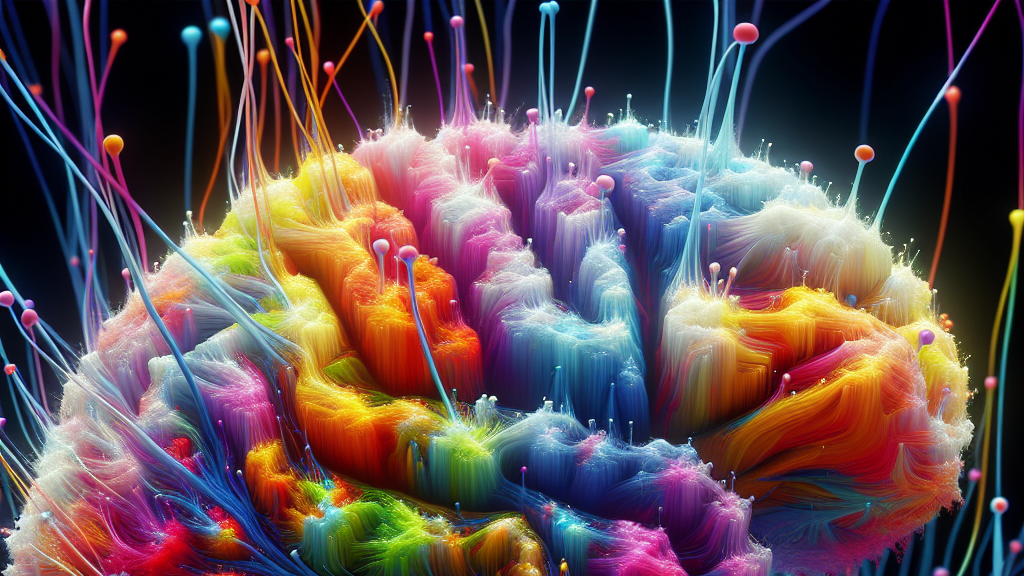
Imagine if your brain could hit pause on the chaos. Researchers have discovered a fascinating way to control the intense chaos that naturally occurs in our brain’s neural dynamics. This chaos isn’t necessarily bad—it’s part of what allows us to think flexibly and adapt to new situations. But when it gets too intense, it might hamper our ability to process information effectively.
The traditional method to handle this chaos involves altering the connections within the brain through something called Hebbian plasticity. It’s like rewiring a circuit board. But in this new research, scientists avoided tinkering with the brain’s wiring. Instead, they introduced a feedback mechanism from the neurons themselves. Think of it like a thermostat for your brain—it stabilizes the chaos by adjusting the ‘temperature’ of neural activities, making them less erratic.
This isn’t just theoretical. This approach could potentially be applied to improve memory recall and predict changes in real-time stimuli, like remembering where you left your keys or anticipating a friend’s next move in a game. By making brain networks more stable, we might enhance both everyday tasks and complex cognitive functions, without needing to rewire our brains completely.
Did you know? The human brain has about 86 billion neurons and trillions of synapses making it one of the most complex structures in the known universe!
FAQs
How does this research help control chaos in brain activity?
Scientists discovered a feedback mechanism within neurons that can stabilize chaotic brain dynamics without altering synaptic connections. This acts like a built-in thermostat to balance the brain’s activity.
What role does feedback play in this new approach to brain dynamics?
The feedback mechanism leverages the neuron’s own reactions to reduce chaotic activity, potentially improving information processing and reducing harmful fluctuations.
How can freezing chaos impact memory and learning?
By stabilizing neural dynamics, this method could enhance the brain’s capability to recall memories and process new information more effectively, without the need for structural changes.
Why is it essential to freeze chaotic brain dynamics?
Excessive chaos in neural activity can hinder our ability to process information, so controlling this chaos helps maintain optimal brain function and could make learning and memory tasks easier.
Is this research applicable to everyday life tasks?
Absolutely! By stabilizing brain activity, people might find it easier to perform daily tasks like remembering information, learning new skills, or even predicting certain patterns in their environment.
Background
To understand this research, it’s important to know that our brains are a whirlwind of activity, with neurons constantly interacting. This interaction can sometimes become chaotic, which helps with flexibility and adaptability, but can also impede our ability to focus and retain information. Traditionally, scientists have tried to manage this chaos by altering how neurons connect, a process known as synaptic plasticity. However, this new research suggests an alternative that doesn’t involve changing these connections.
History
Historically, controlling chaos in neural networks has involved using Hebbian plasticity, which essentially strengthens or weakens connections between neurons based on their activity. This theory has been fundamental for decades. Recently, though, scientists are exploring new methods, like the one in this study, which manipulates the inherent feedback of neurons to stabilize chaos, representing a significant shift in understanding and approach.
Based on “Freezing chaos without synaptic plasticity” by Weizhong Huang, Haiping Huang, available on arXiv (arxiv.org/abs/2503.08069), used under CC BY 4.0 (creativecommons.org/licenses/by/4.0/).