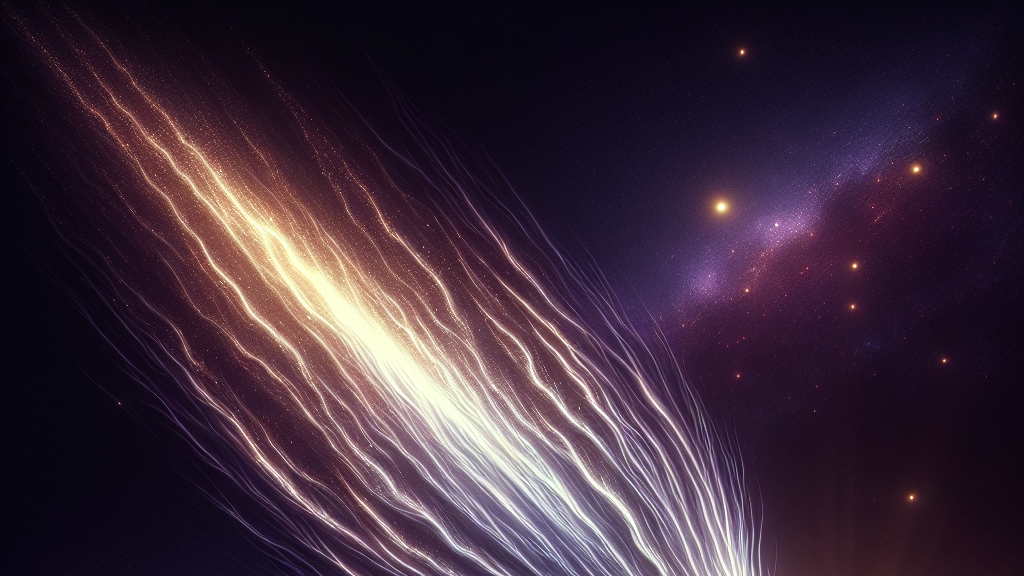
Imagine looking through a telescope and witnessing a comet suddenly becoming a hundred times brighter, transforming into a majestic celestial spectacle. That’s precisely what happened with the comet 12P/Pons-Brooks as it zoomed closer to the Sun. Not only did it light up the night sky, but its glowing tail took on a unique horned shape, capturing the attention of astronomers worldwide.
So, what’s causing these cosmic fireworks? Scientists observed a series of dramatic outbursts from the comet when it was still quite far from the Sun—around 4 astronomical units away (that’s about 372 million miles!). They believe these outbursts might be due to the crystallization of icy materials within the comet. As the ice changes form, it releases trapped gases in an explosive way, launching dust and gas into space and creating a stunning visual show.
But why should you care about a comet’s performance far out in space? Understanding these outbursts gives scientists clues about the early solar system and how comets behave as they approach the Sun. This knowledge can help us prepare for potential comet impacts on Earth, guide future space missions, and uncover the secrets of the volatile substances trapped inside these ancient cosmic travelers.
Did you know? A single outburst from a comet like 12P/Pons-Brooks can pack more energy than a small nuclear explosion!
FAQs
What makes comet 12P/Pons-Brooks so unique?
Comet 12P/Pons-Brooks is fascinating because it undergoes dramatic brightness changes and develops a unique horned shape as it approaches the Sun. These outbursts are linked to the transformation of ice within the comet, giving scientists crucial insights into comet behavior.
Why do comets have outbursts?
Comet outbursts occur due to the rapid release of gases and dust when ice within a comet converts from one form to another, often triggered by the warmth of the Sun as the comet approaches it during its orbit.
How does studying comets impact our understanding of space?
Studying comets helps scientists learn about the early solar system, as these icy bodies are like time capsules holding ancient materials. Understanding their behavior also prepares us for future space exploration and potential interactions with comets.
Background
Comets are icy celestial objects that orbit the Sun, often developing bright tails as they near the Sun due to sublimation of their icy components. The gravitational pull of the Sun and planets influences their paths, and as they warm up, they can release gases and dust in dramatic outbursts. These outbursts are essential for understanding the chemical and physical processes that comets undergo, providing insights into the early solar system’s conditions.
History
Comet research has been ongoing for centuries, with observations dating back to ancient civilizations. Halley’s Comet, a well-known periodic comet, paved the way for understanding cometary orbits and behaviors. More recently, space missions like the Rosetta mission to Comet 67P have deepened our understanding. This study of 12P/Pons-Brooks builds upon that foundation, exploring the specific phenomena of brightness outbursts linked to crystalline ice processes.
Based on “Multiple Outbursts of Halley-Type Comet 12P/Pons-Brooks” by David Jewitt, Jane Luu, available on arXiv (arxiv.org/abs/2504.20316), used under CC BY 4.0 (creativecommons.org/licenses/by/4.0/).