Did you know that weather isn’t just something we experience here on Earth? Imagine a planet far away where clouds form in the morning, get carried across the sky, and disappear by evening. Researchers have recently detected such phenomena on a planet called WASP-94A b, showing how weather patterns might exist on exoplanets, much like on our own planet.
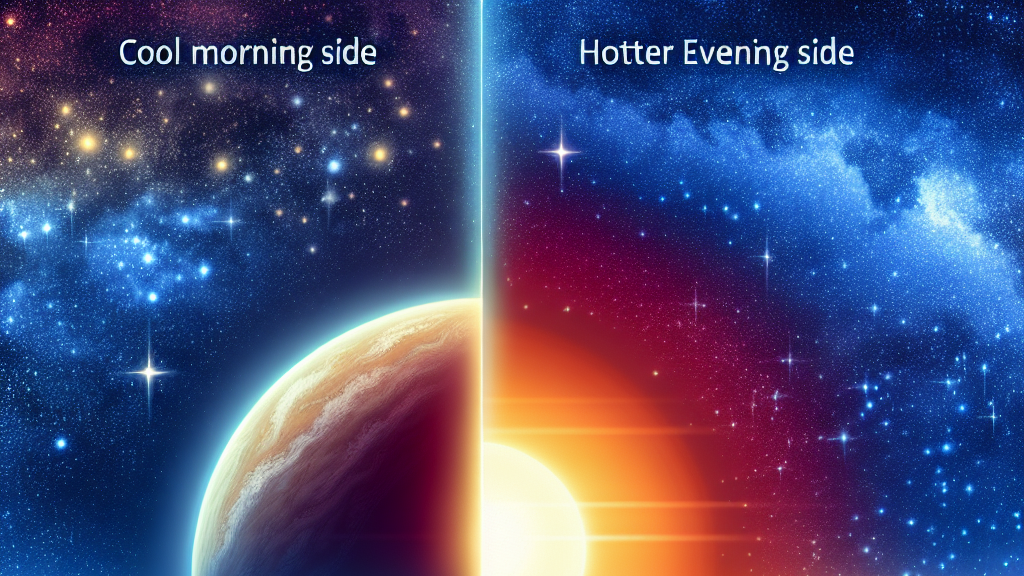
WASP-94A b, a so-called hot Jupiter, has shown us that clouds can roll across the sky from its cooler morning side to its hotter evening side. When these clouds move to the hotter side, they dissipate, revealing the planet’s gaseous atmosphere below. This discovery is like unlocking a new chapter in our understanding of exoplanets, as it sheds light on how atmospheres work on these mysterious worlds far away from our solar system.
Imagine a future where scientists can predict weather patterns on exoplanets just as meteorologists do for Earth. This research could pave the way for better understanding how planets form and evolve. By knowing more about these atmospheric dynamics, it could one day even help us identify other planets that might support life, or simply give us a deeper appreciation of the wonders of the cosmos.
Hot Jupiters experience extreme temperature changes from day to night, up to hundreds of degrees, unlike anything on Earth!
FAQs
What does limb asymmetry mean in exoplanet research?
Limb asymmetry refers to the differences in temperature and atmospheric conditions between the morning and evening sides of an exoplanet as seen during transit. This helps scientists understand more about the planet’s atmospheric dynamics and weather patterns.
Why is the discovery of cloud patterns on WASP-94A b important?
It’s crucial because it reveals that weather phenomena similar to Earth’s may exist on distant planets. This insight helps scientists better understand the atmospheric processes and climate of exoplanets, potentially impacting the search for habitable worlds.
How might this research affect our understanding of other exoplanets?
This study shows that exoplanet atmospheres can have dynamic weather systems, challenging previous assumptions about their chemical compositions. It suggests that scientists need to consider these patterns for accurate atmospheric characterizations.
Why do clouds on WASP-94A b form on the morning side and disappear by evening?
The clouds form due to cooler temperatures and atmospheric conditions conducive to cloud formation. As they move to the hotter evening side, they evaporate due to the rise in temperature, showcasing a unique weather cycle.
Is this type of study unique to hot Jupiters?
While this study focuses on a hot Jupiter, similar limb-resolved spectroscopic studies could be applied to various types of exoplanets, allowing scientists to explore weather patterns and atmospheric dynamics across different planetary environments.
Background
Researchers study exoplanets to understand atmospheres beyond our solar system. Exoplanet atmospheres can have clouds formed by gas condensation or photochemical reactions. WASP-94A b, a hot Jupiter, shows varied atmospheric conditions from morning to night, offering clues about these processes.
History
Earlier studies using the Hubble Space Telescope have provided insights into exoplanet atmospheres, but they often assumed uniform conditions. This study refines the understanding by showing the importance of accounting for differences in temperature and cloud coverage across a planet’s surface, known as limb asymmetry.
Based on “Cloudy mornings and clear evenings on a giant extrasolar world” by Sagnick Mukherjee, David K. Sing, Guangwei Fu, Kevin B. Stevenson, Stephen P. Schmidt, Harry Baskett, Patrick McCreery, Natalie H. Allen, Katherine A. Bennett, Duncan A. Christie, Carlos Gascón, Jayesh Goyal, Éric Hébrard, Joshua D. Lothringer, Mercedes López-Morales, Jacob Lustig-Yaeger, Erin M. May, L. C. Mayorga, Nathan Mayne, Lakeisha M. Ramos Rosado, Henrique Reggiani, Zafar Rustamkulov, Kevin C. Schlaufman, K. S. Sotzen, Daniel Thorngren, Le-Chris Wang, Maria Zamyatina, available on arXiv (arxiv.org/abs/2505.10910), used under CC BY 4.0 (creativecommons.org/licenses/by/4.0/).