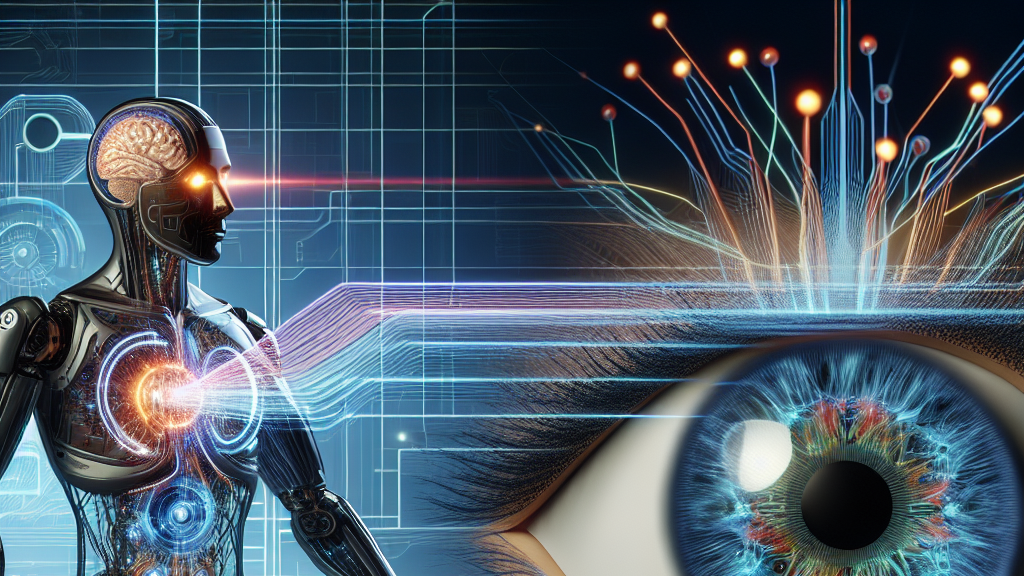
Imagine robots that can see and react faster than the human eye. That’s the power of the new neuromorphic optical flow technology, inspired by how our own visual systems work but supercharged to outpace us. This advancement could drastically improve how robots function in busy, ever-changing environments, like bustling factories or chaotic urban streets.
The magic behind this technology lies in embedding temporal information directly in a special kind of electronics known as synaptic transistors. These transistors mimic the human brain’s ability to process moving scenes by combining time and space data, allowing them to rapidly detect what’s important in just milliseconds. Unlike traditional methods that only consider spatial data, this approach makes everything quicker without compromising the accuracy of what’s being seen and analyzed.
In the future, this could mean robots that help in disaster zones, rescue missions, or even assist with precision tasks like surgery. Since these robots can process visual information faster than ever, they could make decisions quicker than we thought possible, opening doors to applications we are only beginning to imagine.
A neuromorphic optical flow system can identify motion 400 times faster than current algorithms.
FAQs
What is neuromorphic optical flow, and why is it important?
Neuromorphic optical flow is a technology inspired by biological visual systems to improve how quickly and accurately robots can interpret motion in visual scenes. It is important because it enables robots to process visual information faster, making them more effective in dynamic and complex environments.
How do synaptic transistors improve optical flow processing in robots?
Synaptic transistors improve optical flow by embedding temporal information, allowing the system to process both time and space data simultaneously. This innovation helps robots quickly recognize important visual cues with speed and accuracy that surpasses current algorithms.
Can neuromorphic optical flow outperform human visual processing speed?
Yes, the neuromorphic optical flow system can process visual motion information up to 400% faster than humans, allowing robots to react more swiftly than ever before.
What real-world applications could benefit from faster optical flow in robots?
Faster optical flow can enhance robotics in areas such as disaster response, precision surgeries, autonomous vehicles, and industrial automation, by enabling quicker and more precise decision-making in dynamic environments.
How is the performance and durability of synaptic transistors optimized for optical flow?
Synaptic transistors used in this system are built with atomically sharp interfaces that allow them to respond quickly to high-frequency signals while maintaining robust endurance and non-volatility over thousands of cycles, ensuring reliable and efficient visual processing.
Background
Optical flow is a concept borrowed from our own biology—it’s how we perceive motion in our surroundings. In robotics, this involves calculating how objects move across a camera’s view or visual scene. Typically, this process uses algorithms to handle spatial data, but it can be slow when extra details like time changes (temporal information) aren’t considered. Neuromorphic technology takes inspiration from our brain’s neural networks to improve how these temporal data points are utilized, leading to faster processing speeds.
History
Optical flow as an area of study grew significantly alongside advancements in computer vision and artificial intelligence. Early work focused on understanding motion through static algorithms, not accounting for temporal changes. Over time, layering complex algorithms showed improvements, but still faced delays that limited their practical use in robotics. Recent breakthroughs in neuromorphic engineering—drawing from brain-like structures—have changed the game by integrating time-based data, offering faster processing capabilities and making systems that mimic human vision more seamless.
Based on “Neuromorphic spatiotemporal optical flow: Enabling ultrafast visual perception beyond human capabilities” by Shengbo Wang, Jingwen Zhao, Tongming Pu, Liangbing Zhao, Xiaoyu Guo, Yue Cheng, Cong Li, Weihao Ma, Chenyu Tang, Zhenyu Xu, Ningli Wang, Luigi Occhipinti, Arokia Nathan, Ravinder Dahiya, Huaqiang Wu, Li Tao, Shuo Gao, available on arXiv (arxiv.org/abs/2409.15345), used under CC BY 4.0 (creativecommons.org/licenses/by/4.0/).