Connect with us

Search by keyword

Physics

Discovering New Particles Could Transform Energy Tech

Scientists have found hints of new particles that might change how we harness energy, potentially leading to more efficient technologies. Understanding these could revolutionize industries by creating more powerful and sustainable energy solutions.

Discovering New Particles Could Transform Energy Tech

Have you ever imagined a future where our energy sources are not only sustainable but also incredibly efficient? Recent research hints at the discovery of new particles that could make this dream a reality. Scientists are uncovering hidden particles beyond the well-known photon and Z boson, potentially leading to groundbreaking advancements in energy technology.

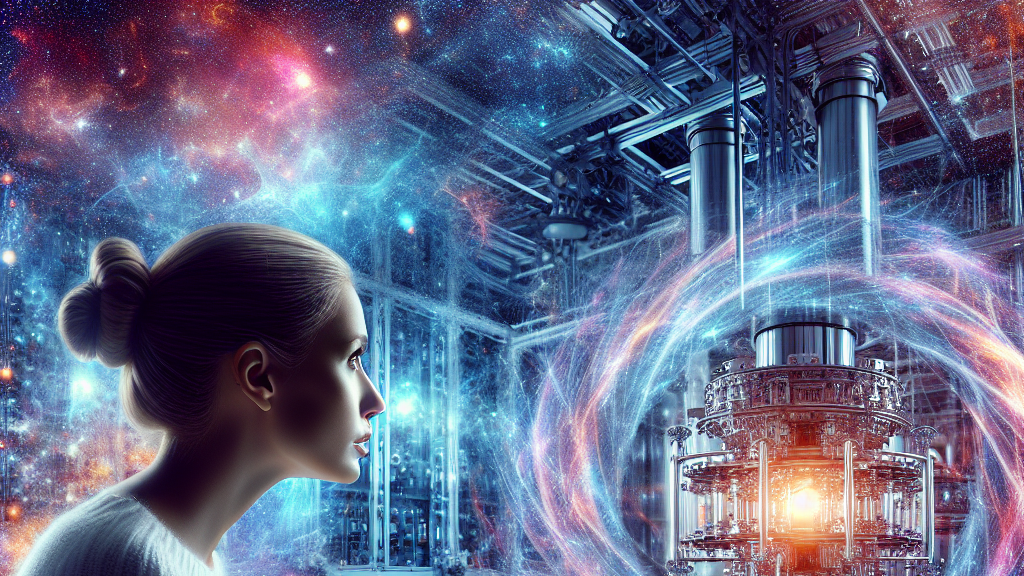
The research involved using advanced mathematical models and high-tech simulations to detect these elusive particles. By creating unique states in a virtual lab environment and analyzing how they behave, researchers were able to identify signs of new vector bosons. These particles could hold the key to unlocking more efficient ways of generating and storing energy, thanks to their unique properties.

Imagine being able to recharge your devices in seconds or powering entire cities using less energy. That’s what this discovery could mean for us in the future. As we learn more about these particles, we not only expand our understanding of the universe but also open doors to innovative solutions that could reshape how we live and interact with energy.

Did you know that the photon, which is the particle of light, is actually massless? This allows it to travel at the speed of light, making it the fastest known particle in the universe!

FAQs

What unexpected discovery did scientists make?

Researchers found hints of new vector bosons, particles which could have profound implications for future energy technologies.

Why does this matter to everyday people?

The discovery could eventually lead to more efficient and sustainable energy solutions, affecting everything from smartphones to city power grids.

How did scientists find these new particles?

They used simulations and mathematical models in a controlled lab setting to observe unique particle behaviors not accounted for by known physics.

What is a vector boson?

A vector boson is a type of particle that acts as a force carrier in physics, like the photon or the Z boson.

What are the potential applications of this discovery?

This could lead to new technologies for energy production and storage, benefiting industries and helping combat climate change.

Background

In physics, particles like the photon and Z boson are fundamental components that carry forces, such as electromagnetism. The electroweak theory combines electromagnetic and weak forces into a single framework. By using lattice simulations, scientists can predict and analyze particle behaviors in a controlled environment. This research builds on these foundations to explore hidden particles that haven’t been observed yet, using innovative mathematical and computational techniques.

History

Electroweak theory is a cornerstone of modern physics, formulated in the mid-20th century. It unified two of the four fundamental forces: electromagnetism and the weak nuclear force. This led to the discovery of the W and Z bosons, which are crucial for particle interactions. As technology has advanced, so has our ability to model and study these forces at even smaller scales, leading to discoveries like the Higgs boson in 2012 and now, potentially, new vector bosons.

Based on “Does the Z boson have a lighter cousin?” by Jeff Greensite, available on arXiv (arxiv.org/abs/2501.02083), used under CC BY 4.0 (creativecommons.org/licenses/by/4.0/).

Trending

Latest

Can AI Save Water Discover How

Computers

AI is transforming the tech world, but it uses lots of water! A new tool, SCARF, helps us measure and reduce AI's water footprint,...

Whats a Forbush Decrease and Why Should We Care Whats a Forbush Decrease and Why Should We Care

Space

Scientists just observed the biggest solar storm event in years, revealing unexpected cosmic ray patterns. Understanding these changes could help us protect our technology...

Can Cars Spot Danger Faster Than Humans Can Cars Spot Danger Faster Than Humans

Computers

Think about how quickly you react when something unexpected happens on the road. This research brings us closer to creating self-driving cars that can...

Can Fear of the Other Stop Social Harmony Can Fear of the Other Stop Social Harmony

Physics

Fear of the unknown might make it harder for people to agree and get along. This study shows that when people have strong xenophobic...

Can AI Revolutionize Breast Cancer Diagnosis Can AI Revolutionize Breast Cancer Diagnosis

Electricity

This research introduces a groundbreaking AI model that can accurately assess HER2-positive breast cancer using widely accessible staining methods, potentially revolutionizing how we diagnose...

Can AI Transform Your Singing into a Choir Can AI Transform Your Singing into a Choir

Computers

Imagine singing solo and having AI turn you into a choir. This research unveils a groundbreaking AI tool that transforms your voice into rich...

You May Also Like

Physics

Scientists are on a mission to discover if ghost-like particles called neutrinos could reveal astonishing insights about the universe. Using cutting-edge technology, they searched...

Physics

Scientists might be on the brink of discovering new particles that challenge our understanding of the universe. These findings, centered around the Large Hadron...

Physics

Scientists are exploring a mind-boggling idea: what if some neutrons decay into unknown particles that could reveal secrets about our universe? This research might...

General Relativity and Quantum Cosmology

Scientists are finding that black holes might not be the simple, spherical giants we once thought—they could have fractal edges, with surprising effects on...

Physics

This research digs into the mysterious boundary separating our everyday classical world from the weird quantum realm, exploring if this divide could be at...

General Relativity and Quantum Cosmology

Imagine a place in space where particles smash into each other with immense energy, like nature's own supercollider. Black holes might just be the...

Physics

Is our universe truly curved, or could it be flat with a twist? This debate could reshape our understanding of reality, sparking curiosity about...

Physics

Inertia is that mystical force influencing everything from a rolling ball to Earth’s orbit. This research redefines how we understand motion, based on the...

Physics

Ever wondered what inertia really is? This research could reshape our understanding of motion, potentially impacting everything from space travel to everyday transport.

Copyright © 2024 8ig8rain.

Disclaimer: The content on 8ig8rain.com consists of AI-generated summaries of scientific abstracts from arXiv. Please note that most arXiv abstracts are preprints and may not have undergone formal peer review. While these summaries aim to convey key ideas and potential applications, they are provided for informational purposes only and should not be interpreted as validated scientific findings or professional advice. The summaries are intended to educate, spark curiosity, and inspire further exploration of science.