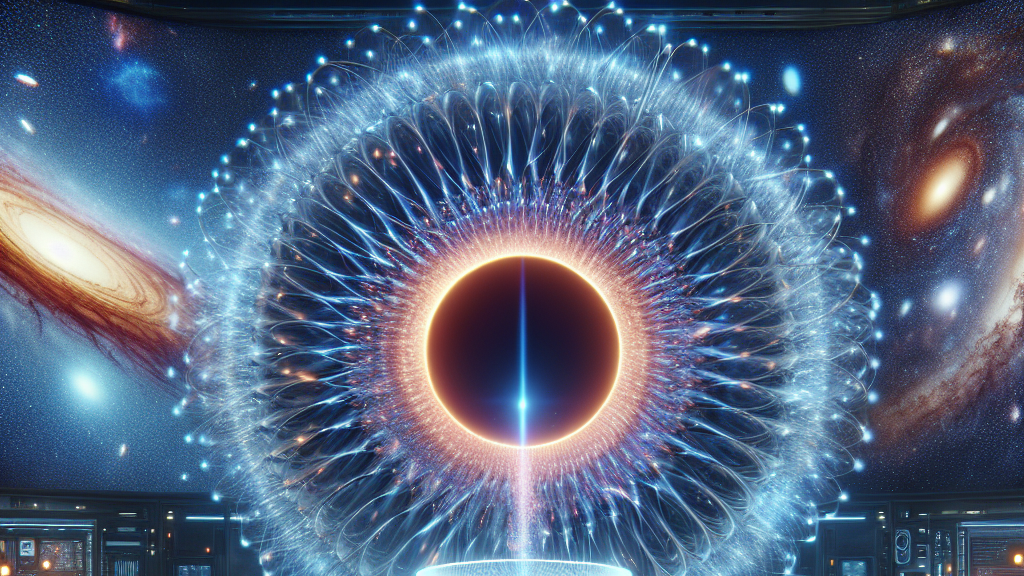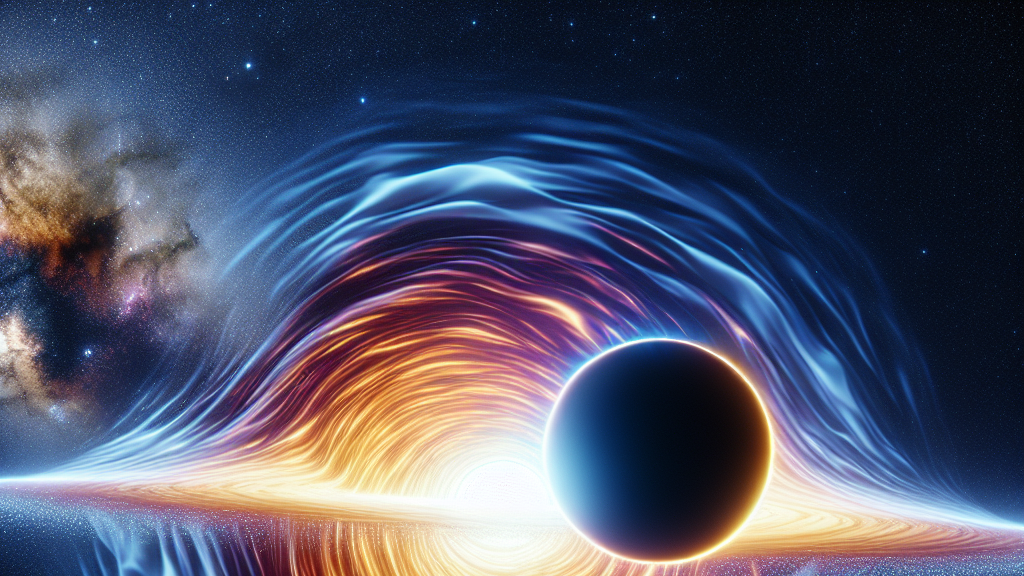
Imagine a star locked in an epic cosmic dance with a supermassive black hole in the center of our galaxy. This star is gradually losing its outer layers as it spirals inward, but rather than being gobbled up instantly, it whispers its secrets to us in the form of ripples in space-time, called gravitational waves. These fascinating waves can travel vast cosmic distances, carrying with them the untold stories of the universe’s hidden corners.
In this research, scientists have explored how a special type of star, called a subgiant, interacts with a supermassive black hole, creating a stable, long-lasting phase of mass transfer. As the star sheds its hydrogen envelope, the remaining helium core spirals inward, producing strong gravitational waves. These waves, detectable by instruments like the LISA space observatory, could clue us in to magnificent events happening far beyond our reach. What’s more, if such a system existed at the heart of our own Milky Way, it could be detectable for several hundred thousand years, becoming one of the loudest cosmic whispers we’ve ever heard.
This cosmic exchange has profound implications for our understanding of the universe. By detecting the gravitational waves emitted during these events, scientists can uncover details about the structure and evolution of stars and black holes. One day, we might even discover such an event happening close enough to witness it transform the way we view our own galactic center. Just imagine being able to tune into the universe’s wavelength and discover new cosmic phenomena that could redefine our understanding of space and time.
A star’s dying whisper in the form of gravitational waves can travel up to a billion light-years, reaching us from the farthest corners of the universe.
FAQs
What are gravitational waves and why are they important in studying black holes?
Gravitational waves are ripples in space-time caused by massive objects like black holes interacting with one another. They are crucial for studying black holes because they allow us to observe cosmic events that are otherwise invisible, thus helping us understand the structure and behavior of these mysterious cosmic giants.
How can stars orbiting black holes inform us about cosmic events?
Stars near black holes can create gravitational waves as they interact. By analyzing these waves, scientists can gather information about the star’s properties, the black hole’s characteristics, and the dynamics of their interaction, which can tell us more about the life cycle of stars and galactic evolution.
Why is detecting gravitational waves significant for understanding our galaxy?
Detecting gravitational waves could reveal events occurring at the Milky Way’s core, where a supermassive black hole resides. Understanding these events could change our perspective on the formation and development of our galaxy and others.
Could we detect such cosmic events from Earth?
Yes, future detectors like LISA are designed to sense gravitational waves from these cosmic events. Such detectors can potentially identify these events from great distances, providing a new way to explore our universe.
What role do gravitational waves play in modern astrophysics?
Gravitational waves are revolutionizing astrophysics by offering a new observational method to study cosmic phenomena, allowing us to explore areas of the universe that traditional light-based astronomy cannot reach.
Background
The key scientific principle here is gravitational waves, which are ripples in space-time caused by massive objects, like stars interacting with black holes. These waves open a new vista for observing cosmic events that were previously invisible to astronomers. Detecting them helps researchers explore the dynamics of celestial objects and the universe’s fundamental properties.
History
The concept of gravitational waves stems from Albert Einstein’s theory of general relativity, which describes how massive objects can warp space-time. The first direct detection of gravitational waves was achieved by the Laser Interferometer Gravitational-Wave Observatory in 2015, revolutionizing our understanding of the universe and sparking interest in finding more such cosmic signals.
Based on “Supermassive black holes stripping a subgiant star down to its helium core: a new type of multi-messenger source for LISA” by Aleksandra Olejak, Jakob Stegmann, Selma E. de Mink, Ruggero Valli, Re’em Sari, Stephen Justham, available on arXiv (arxiv.org/abs/2503.21995), used under CC BY 4.0 (creativecommons.org/licenses/by/4.0/).