Connect with us

Search by keyword

Space

Could Planets Orbit Two Suns at Strange Angles?

Scientists have discovered a planet orbiting a pair of suns at a weird angle, changing how we understand space. This could help us find more unusual planets and learn about their orbits.

Could Planets Orbit Two Suns at Strange Angles
✨Researched by humans. Explained by robots. Learn more.

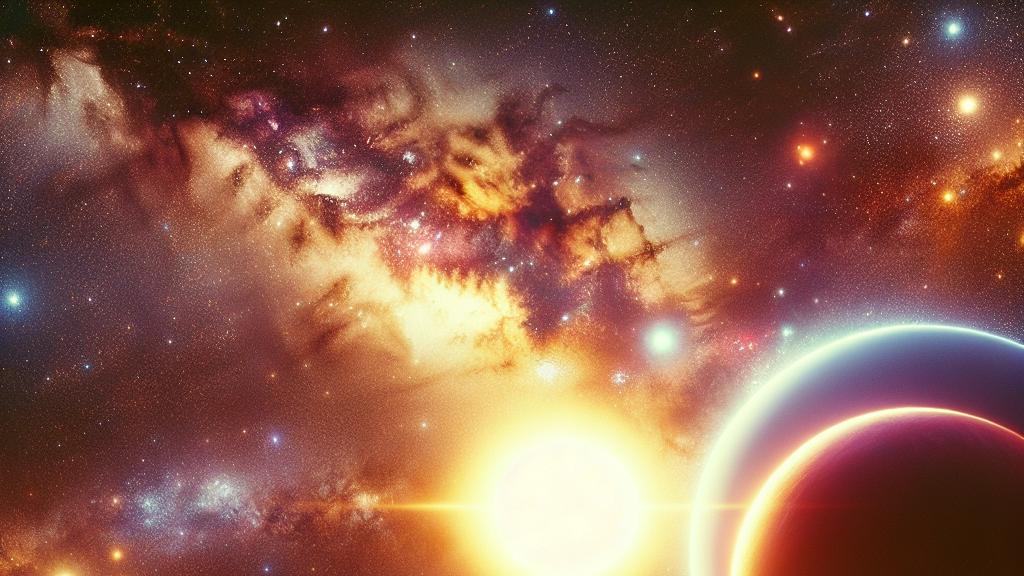
Imagine a planet that doesn’t follow the usual rules of orbiting its sun. That’s what astronomers have just discovered—a planet circling not one, but two suns, and doing so at an unusually steep angle. This isn’t just another space discovery; it’s a whole new way of thinking about how planets can exist, acting like rebels in the cosmic dance.

The researchers found this unusual planet orbiting around a pair of brown dwarf stars. These are cooler, smaller stars that didn’t quite make it to full star status. What’s so fascinating is that the planet orbits in a polar plane—a fancy way of saying it moves perpendicular to how we usually see things orbiting. This discovery was made by examining the movements and gravitational interactions in the star system, which suggested there must be something unusual—a polar planet—influencing the stars’ orbits.

So why should you care? Well, this could change the game in how we search for other planets. If planets can orbit their stars at such strange angles, who knows what other surprises are out there in the galaxy? Understanding these oddballs could also give us better clues about how planets form and behave, and maybe even point us to another Earth-like world hiding somewhere in the universe.

Did you know? A planet can orbit two suns, just like the fictional planet Tatooine in Star Wars!

FAQs

What are circumbinary planets and how are they different from regular planets?

Circumbinary planets orbit two stars instead of just one, like most planets we know. This can create unique gravitational dynamics and unusual orbits.

What makes this newly discovered polar circumbinary planet so special?

This planet orbits at a steep angle, nearly perpendicular to how we commonly see planets orbit. It’s the first strong evidence we’ve found of such a configuration, challenging our understanding of planetary and orbital dynamics.

Why is the discovery of a polar circumbinary planet important?

This discovery opens up new possibilities for how planets can exist in the universe. It suggests there may be more planets with unique orbits, leading to a more diverse understanding of how planetary systems form and operate.

How do scientists find planets that orbit two stars?

Scientists observe the gravitational effects and movements within star systems. Changes or irregularities can indicate the presence of planets, even when they can’t be directly seen.

What are the implications of finding planets at different orbital angles?

It could revolutionize our search strategies for exoplanets, potentially uncovering a variety of new worlds that have been overlooked due to their unconventional orbits around binary stars.

Background

In space, most planets orbit a single star in a flat, circular path. This pattern is based on gravity’s grip and resulting forces as stars and planets form. But when a planet orbits two stars, its path can become more complex. Scientists study these circumbinary planets to understand diverse planetary systems and the limits of celestial mechanics.

History

The study of circumbinary planets began with the discovery of planet-like objects orbiting binary star systems. The breakthrough came with the first confirmed circumbinary exoplanet found by the Kepler Space Telescope. Since then, scientists have been exploring how and why these planets form, building on past theories to explain their unusual characteristics.

Based on “Evidence for a polar circumbinary exoplanet orbiting a pair of eclipsing brown dwarfs” by Thomas A. Baycroft, Lalitha Sairam, Amaury H. M. J Triaud, Alexandre C. M. Correia, available on arXiv (arxiv.org/abs/2504.12209), used under CC BY 4.0 (creativecommons.org/licenses/by/4.0/).

Trending

Latest

Can AI Save Water Discover How

Computers

AI is transforming the tech world, but it uses lots of water! A new tool, SCARF, helps us measure and reduce AI's water footprint,...

Whats a Forbush Decrease and Why Should We Care Whats a Forbush Decrease and Why Should We Care

Space

Scientists just observed the biggest solar storm event in years, revealing unexpected cosmic ray patterns. Understanding these changes could help us protect our technology...

Can Cars Spot Danger Faster Than Humans Can Cars Spot Danger Faster Than Humans

Computers

Think about how quickly you react when something unexpected happens on the road. This research brings us closer to creating self-driving cars that can...

Can Fear of the Other Stop Social Harmony Can Fear of the Other Stop Social Harmony

Physics

Fear of the unknown might make it harder for people to agree and get along. This study shows that when people have strong xenophobic...

Can AI Revolutionize Breast Cancer Diagnosis Can AI Revolutionize Breast Cancer Diagnosis

Electricity

This research introduces a groundbreaking AI model that can accurately assess HER2-positive breast cancer using widely accessible staining methods, potentially revolutionizing how we diagnose...

Can AI Transform Your Singing into a Choir Can AI Transform Your Singing into a Choir

Computers

Imagine singing solo and having AI turn you into a choir. This research unveils a groundbreaking AI tool that transforms your voice into rich...

You May Also Like

Space

Discovering planets orbiting two stars is like finding a new chapter in a cosmic fairytale. These findings can change what we think about planet...

Space

Scientists searched for alien radio signals from distant planets, but found none, giving us a peek into the universe's mysteries and possibly sparking more...

Space

Scientists have discovered a new way to check for volcanic activity on planets outside our solar system, opening the door to understanding how these...

Space

This research helps us understand how planets and stars line up in space, which can reveal secrets about the universe's past and future. Knowing...

Space

Researchers explore the possibility of habitable moons around distant gas giants, suggesting that these moons could extend the habitable zones beyond what they've traditionally...

Space

Scientists are exploring the potential for moons of giant planets to host life, finding that nearly a third could be habitable. This research suggests...

Space

We've discovered that exoplanet skies, like on WASP-94A b, can change dramatically between day and night due to cloud movements—similar to weather on Earth,...

Space

Discover how clouds on distant planets might change daily, much like Earth's weather, revealing new insights into their atmospheres.

Space

Scientists have discovered intriguing structures around a miniature star-like object, suggesting that even the smallest stars might help us understand how planets form.

Copyright © 2024 8ig8rain.

Disclaimer: The content on 8ig8rain.com consists of AI-generated summaries of scientific abstracts from arXiv. Please note that most arXiv abstracts are preprints and may not have undergone formal peer review. While these summaries aim to convey key ideas and potential applications, they are provided for informational purposes only and should not be interpreted as validated scientific findings or professional advice. The summaries are intended to educate, spark curiosity, and inspire further exploration of science.