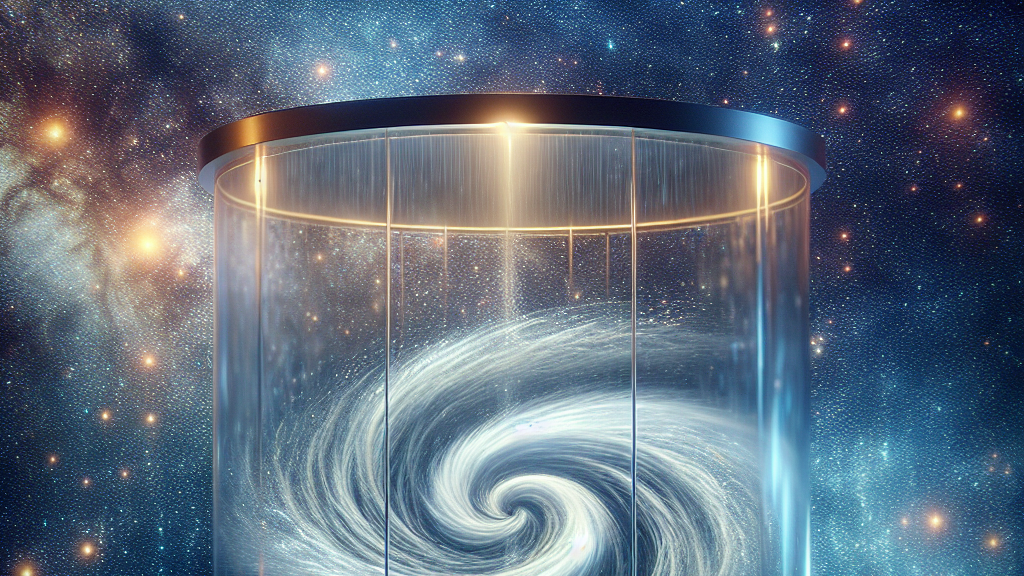
Imagine a universe where tiny whirlpools dance together, creating cosmic avalanches. That might sound like sci-fi, but scientists have observed such a phenomenon in what they’re calling vortex avalanches. These tiny quantum vortexes spin like little tornadoes inside a container, similar to how they might behave in the extreme environment of a neutron star. It’s a spectacle of nature at a minuscule scale with potentially cosmic implications.
By using a model called Gross-Pitaevskii, scientists simulated a whopping 600 of these vortexes spinning down in a cylindrical container. As they spin, these whirling dervishes occasionally escape in masses of 10 to 20 at a time, creating an avalanche effect that interrupts the usual flow of spinning motion, known as the superfluid angular momentum. They leave behind a ‘void,’ an area suddenly empty of vortices, before continuing their mesmerizing dance around this gap. This groundbreaking discovery of avalanching behavior and collective motion is a first and could bridge our understanding from tiny whirlpools to vast cosmic events.
Why does this matter to you and me? Well, similar processes might occur in neutron stars, which are some of the universe’s most fascinating and extreme objects. If we can understand how these vortex avalanches work, we might unlock secrets about these dense cosmic bodies, potentially leading to new technologies or breakthroughs in understanding gravity and the universe beyond. So, next time you’re sipping your coffee, imagine tiny whirlpools in your cup hinting at the mysteries of massive stars in distant galaxies!
A neutron star is so dense that a sugar-cube-sized amount of its material would weigh about as much as all of humanity!
FAQs
What are vortex avalanches in quantum physics?
Vortex avalanches refer to the sudden and collective movement of quantum vortices, tiny swirling motions in a superfluid, which create dramatic disruptions in their flow. This research shows how these avalanches occur and behave.
How does this quantum vortex research relate to neutron stars?
Understanding vortex avalanches in a controlled environment helps scientists simulate conditions in neutron stars, where similar vortex behavior might explain certain cosmic phenomena.
Why is it challenging to apply the results of this vortex avalanche study to neutron stars?
Neutron stars contain far more vortices than can be simulated in a lab, making it challenging to directly apply findings. However, these simulations provide vital clues to the processes happening on a larger cosmic scale.
What makes the effective Magnus force important in predicting vortex avalanches?
The Magnus force, acting on rotating bodies in fluids, helps scientists predict when and where the vortex avalanches will occur, providing insights into the dynamics of these collective motions.
How could understanding vortex behavior impact technology or science?
By unlocking the secrets of cosmic phenomena like neutron stars, this research could lead to new technologies and a deeper understanding of universal forces, possibly affecting fields like material science, quantum computing, and advanced physics.
Background
In quantum physics, a vortex is a spinning flow of atoms in a superfluid, a state of matter with zero viscosity that flows without energy loss. This research explores how these vortices behave under specific conditions, such as in a rotating container, where they can collectively release in events called avalanches, producing a noticeable impact on the superfluid’s overall motion.
History
Studying vortices has long been a key interest in physics, with previous research focusing on single or isolated vortices. Earlier models like point-vortex simulations have hinted at collective behaviors, but this study is the first to capture convincing spatial-temporal evidence of a phenomenon akin to an avalanche, inspired by the dynamic conditions of neutron stars.
Based on “Vortex Avalanches and Collective Motion in Neutron Stars” by I-Kang Liu, Andrew W. Baggaley, Carlo F. Barenghi, Toby S. Wood, available on arXiv (arxiv.org/abs/2410.16878), used under CC BY 4.0 (creativecommons.org/licenses/by/4.0/).