Connect with us

Search by keyword

Physics

Can Math Explain Why We Feel the Way We Do?

This research explores how our inner experiences, known as qualia, could emerge from the brain using groundbreaking mathematical ideas. It might help us understand why humans feel emotions and experience the world in unique ways.

Can Math Explain Why We Feel the Way We Do
✨Researched by humans. Explained by robots. Learn more.

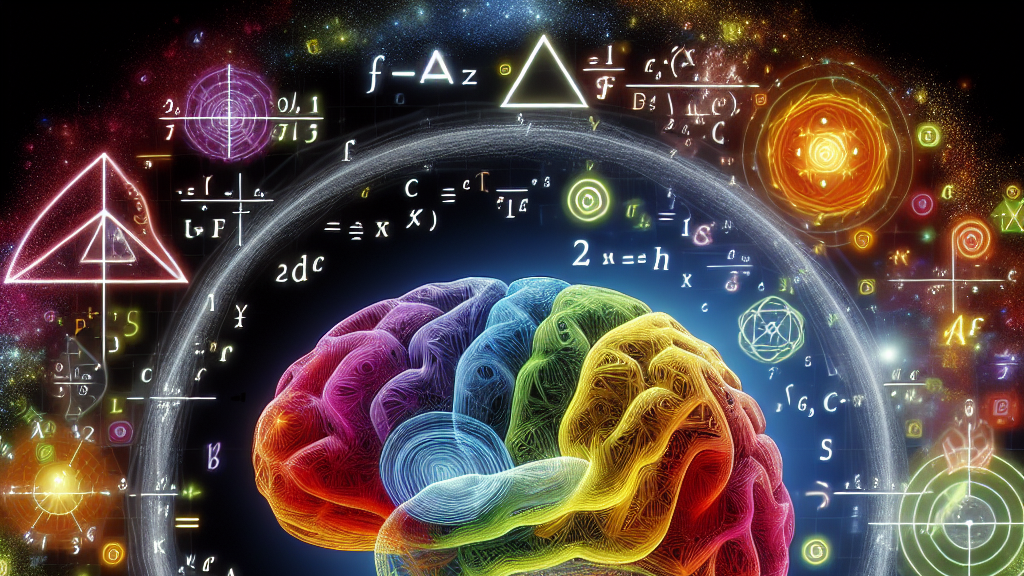
Imagine if we could use math to understand why we feel joy, sadness, or recognize the color red! This research dives into the complicated world of consciousness, using some of the most mind-bending mathematical principles to explain how our personal, internal experiences, or ‘qualia,’ come to be.

The researchers built on ideas from non-Euclidean geometry, known for its strange yet captivating shapes, to propose a theory for these elusive qualia. They argue that qualia aren’t physical things but more like a different layer of reality that responds to our awareness. The study introduces ‘relative reality,’ suggesting our perception of the world isn’t fixed but shifts depending on who’s observing and when. The mathematical tool of choice here is Hilbert space theory, which helps bridge our understanding of cognitive science and physics and brings new insights into famous debates in quantum mechanics.

In the real world, this could mean we’re one step closer to understanding the ‘why’ behind our emotional responses and subjective experiences. We might even begin to see them as essential parts of the universe, similar to gravity or electromagnetism. Imagine a future where this understanding helps improve mental health treatments by better aligning them with our unique, personal experiences.

Did you know? Qualia, our personal experiences, might have ‘force’ much like gravity!

FAQs

What is the ‘Hard Problem’ of consciousness?

The Hard Problem of consciousness refers to the mystery of how and why we have personal experiences, like colors, sounds, and emotions, that arise from the brain’s physical processes.

How does this research use mathematics to tackle consciousness?

This study uses ideas from non-Euclidean geometry and Hilbert space theory to propose that our personal experiences, or qualia, are non-physical parts of reality shaped by awareness.

What is ‘relative reality’ in the context of this research?

‘Relative reality’ is a concept suggesting that our perception of the world isn’t absolute but changes based on the observer and the context, explained through mathematical models.

Why might qualia be considered a force of nature?

The study suggests that qualia, like other fundamental forces such as gravity, could be essential parts of absolute reality, influencing how we perceive and interact with the world.

How could this research impact real-world applications?

Understanding qualia may enhance mental health treatments by aligning them with individual perceptions and emotions, offering more personalized approaches.

Background

The ‘Hard Problem’ of consciousness tries to solve how personal experiences arise from the brain. This research uses non-Euclidean geometry, which deals with complex shapes that don’t follow traditional geometry rules, to offer a new perspective. Hilbert space theory is a mathematical concept used to unite physics and cognitive science, helping to model these experiences without relying on physical explanations alone.

History

For decades, scientists and philosophers have debated the nature of consciousness and the ‘Hard Problem,’ with little consensus. This study builds on major breakthroughs in non-Euclidean geometry, a field that challenged traditional math views, and quantum mechanics, like the Schrödinger equation, to forge new insights into how our minds might process reality.

Based on “Relative Reality” by Rongwei Yang, available on arXiv (arxiv.org/abs/2502.05536), used under CC BY 4.0 (creativecommons.org/licenses/by/4.0/).

Trending

Latest

Can AI Save Water Discover How

Computers

AI is transforming the tech world, but it uses lots of water! A new tool, SCARF, helps us measure and reduce AI's water footprint,...

Whats a Forbush Decrease and Why Should We Care Whats a Forbush Decrease and Why Should We Care

Space

Scientists just observed the biggest solar storm event in years, revealing unexpected cosmic ray patterns. Understanding these changes could help us protect our technology...

Can Cars Spot Danger Faster Than Humans Can Cars Spot Danger Faster Than Humans

Computers

Think about how quickly you react when something unexpected happens on the road. This research brings us closer to creating self-driving cars that can...

Can Fear of the Other Stop Social Harmony Can Fear of the Other Stop Social Harmony

Physics

Fear of the unknown might make it harder for people to agree and get along. This study shows that when people have strong xenophobic...

Can AI Revolutionize Breast Cancer Diagnosis Can AI Revolutionize Breast Cancer Diagnosis

Electricity

This research introduces a groundbreaking AI model that can accurately assess HER2-positive breast cancer using widely accessible staining methods, potentially revolutionizing how we diagnose...

Can AI Transform Your Singing into a Choir Can AI Transform Your Singing into a Choir

Computers

Imagine singing solo and having AI turn you into a choir. This research unveils a groundbreaking AI tool that transforms your voice into rich...

You May Also Like

Computers

Imagine if we could see the images your mind creates just by reading brain waves! This groundbreaking research uses brain responses to predict and...

Quantum Biology

This research reveals how the size of a mammal's brain impacts the survival of messages within its neural network, affecting brain function and potentially...

Quantum Biology

This research dives into the fascinating link between evolution and our feelings, exploring how natural selection might shape not only our minds but also...

Math

Ever wonder how your brain can sort through chaos and keep your memories intact? Scientists have found fascinating ways our brain networks stay focused...

Quantum Biology

Scientists have found universal patterns in brain activity, revealing how our minds may work similarly across different states like being awake, under anesthesia, or...

Quantum Biology

Our brains aren't just complex—they show universal patterns even when we're asleep or distracted. Using EEG, scientists found that our brain dynamics align in...

Physics

This exciting research suggests our brains might work differently than computers, indicating our consciousness can't be fully explained by traditional computing models. It could...

Physics

This research explores how the complexity of human consciousness might exceed the capabilities of digital computers, suggesting our brains process information in ways we...

Quantum Biology

By leveraging a brain's natural feedback mechanisms, researchers found a way to tame chaotic neural dynamics, potentially enhancing memory and learning without even altering...

Copyright © 2024 8ig8rain.

Disclaimer: The content on 8ig8rain.com consists of AI-generated summaries of scientific abstracts from arXiv. Please note that most arXiv abstracts are preprints and may not have undergone formal peer review. While these summaries aim to convey key ideas and potential applications, they are provided for informational purposes only and should not be interpreted as validated scientific findings or professional advice. The summaries are intended to educate, spark curiosity, and inspire further exploration of science.